Disruptive Paradox
Deconstructive Architecture and its Subversive Power


1_Introduction
Since the 1980s, deconstructivist architecture has attracted attention with its radical departure from orthogonal structures and its aesthetic boldness. As a provocative counter-model to traditional building regulations, it has sparked a lasting discourse on form and meaning in architectural theory. But precisely because of their exceptional forms and broken angles, the architects were quickly dismissed by many critics as attention-seeking and purely provocative. Even as the term ‘deconstructivist’ was emerging in in the field of architecture, the prevailing opinion was that architects had nothing to do with the philosophy of deconstruction and that there was no way to transform this idea into a built environment.
However, a deconstructivist architectural approach is based on a profound and theoretical view of structurally and semantically constructed hierarchies. At the beginning of the 1980s, several architects adopted a critical attitude towards the prevailing discourses of modernism and postmodernism. In various forms, they created references to Derrida’s philosophy of deconstruction. Architects such as Peter Eisenman, Bernard Tschumi, and Daniel Libeskind, among others, explored the guiding ideas and integrated key aspects into their own theoretical positions. Jacques Derrida’s philosophy of deconstruction provided a critical approach that revealed the inherent instability of meaning within texts, concepts, and discourses. By exposing internal contradictions and undermining binary hierarchies, deconstruction demonstrates that interpretation is never fixed. Deconstructivist architecture draws inspiration from this philosophical stance but applies it in a different medium. Based on considerations of pluralism and contingency, the architects criticized the centuries-old established architectural order and cast doubt on its claim to truth. One of the main themes among these architects’ work was the design of a contemporary architecture that questioned its own constitution, e.g., its order, ethics and aesthetics, but also its codes of function and meaning. Deconstructivist architecture was able to challenge its own abilities and limits with the help of disruptions that revealed the relationship between norm and deviation. Disruptions are temporary deviations from norms or order that make it possible to reintroduce different normatively excluded forms and meanings into architectural discourse. Disruptions reveal architectural alternatives when order fails. [1] The philosophy of deconstruction was translated into an architectural design strategy that destabilizes conventional and expected forms and norms through disruptions such as fragmentation, disjunction, distortion and disillusion.
The equally critical character of deconstruction and disruption phenomena, therefore, is interesting because architecture is understood as a conservative medium that is strongly tied to function and representation. This article examines how deconstructivist architecture functions as a reflexive medium in the moment of disruption. By utilizing Derrida’s concept of deconstruction, deconstructivist architecture is able to radically question political, social and aesthetic structures. As disruption is ascribed both destructive and productive powers according to common definitions, [2] disruption and deconstruction (in the sense of destruction and construction) have significant parallels that are evident in architecture.
The structural and conceptual ruptures of deconstructivist architecture mirror the ambiguities of contemporary life. While much of today’s architectural practice views buildings primarily as functional objects, deconstructivist architecture provides a critical lens for examining the built environment amid complexity and transformation. The relevance of deconstructivist architecture for contemporary cultural discourse lies in its conceptual alignment with broader societal dynamics. Deconstructivist architecture provides a formal and theoretical means of critically examining established hierarchies and revealing alternative spatial and semantic orders, for example when it comes to creating safer, more inclusive spaces in cities world over, or indeed developing a critical awareness in urban planning that is tailored to real needs.
The _Article begins with an introduction to Jacques Derrida’s concept of deconstruction and outlines its fundamental philosophical approaches. Building on this, it looks at the possibility of transferring this way of thinking to architectural theory. The focus is on the parallels between Derrida’s philosophy and architectural design processes, particularly with regard to the relationship between metaphysics and architecture and the challenge of understanding architecture as a material and physical medium. In a further step, the _Article traces the history of disruptive phenomena in the twentieth century. What becomes apparent is that disruptions were initially regarded as negative, destabilizing interventions, but over time they have increasingly been recognized as productive and necessary impulses. On this basis, the text links the subversive dynamics of deconstruction with the principles of disruption. In doing so, similarities between linguistic and architectural disruptive forces become clearly apparent. Finally, the theoretical considerations are concretized using the example of Bernard Tschumis’ Parc de la Villette (1985) in Paris. Here, it becomes clear how the architect deliberately uses the layout to subversively undermine established traditions of perception, orientation, and meaning attribution.
2_The Idea of Deconstruction: A Brief Introduction
Originally derived from Martin Heidegger’s philosophy, the term ‘deconstruction’ refers to a synthesis of the two mutually dependent concepts of ‘construction’ and ‘destruction.’ As theorists have noted, deconstruction’s appeal in architecture stems from its dialectical process of “building up and tearing down.” [3] Heidegger writes: “Konstruktion […] ist notwendig Destruktion, d. h. ein im historischen Rückgang auf die Tradition vollzogener Abbau des Überlieferten, was keine Negation und Verurteilung der Tradition zur Nichtigkeit, sondern umgekehrt gerade positive Aneignung ihrer bedeutet.” [4]
The implied movements of ‘construction’ and ‘destruction’ by Heidegger renders deconstruction a composite term characterized by architectural labels. It was Jacques Derrida who created the specific term “deconstruction” in his 1967 book, Of Grammatology. [5] In 1988, Philip Johnson and Mark Wigley adopted Derrida’s term and conceived an exhibition at the Museum of Modern Art in New York that would go on to become famous worldwide. Under the title “Deconstructivist Architecture,” the works of seven up-and-coming architects were highlighted, all of whom are now internationally renowned. [6] The curators adopted a distinctly formalist perspective, focusing on visual and structural characteristics rather than on philosophical theories. They explicitly rejected a direct link to Jacques Derrida’s philosophy of deconstruction, stating: “It is not that they [architects] derive from the mode of contemporary philosophy known as ‘deconstruction’.” [7] Many of the architects associated with the show are in fact working with ideas of deconstruction by Derrida. Yet they soon distanced themselves from the label ‘deconstructivism,’ primarily because they did not see themselves as an aesthetic entity and did not want to be subsumed under any particular style, like Johnson and Wigley would claim based on their formalist interpretation. Instead, each architect pursued individual approaches to form, space, and meaning—reflecting a broader diversity that resisted simple categorization. [8]
In the mid-1980s, years before the aforementioned exhibition opened to the public, the philosopher Jacques Derrida first entered into dialogue with the architects Bernard Tschumi and Peter Eisenman, and then with Daniel Libeskind in the 1990s. The collaborations are fruitful for these style-critical architects, because Derrida’s idea of deconstruction is to be understood less as a stylistic category and more as a subversive process that primarily aims to question existing norms, rules and conventions. In several collaborations, which resulted in interviews, essays, and book-length publications, the principle of deconstruction was discussed in relation to architecture. [9] Deconstruction is an intellectual approach that attempts to dissolve centrisms and hierarchies within systems, like philosophy or linguistics. [10] For Derrida, all entities can be interpreted as text, including institutions, structures, and systems that operate according to hierarchical orders founded on what he terms logocentrism. Logocentrism here denotes the privileging of logos, understood as reason, language, and meaning, as the fundamental basis for truth and comprehension. [11] Derrida criticizes Western metaphysics since Plato for placing the spoken word and the presence of meaning above writing, difference, and context. The focus on the logos is manifested such that it creates a totality which excludes everything irrational or beyond reason. This makes logocentrism seem insurmountable. Traditional metaphysics is also associated with logocentrism and plays a crucial role in deconstruction. As a “science of presence” it asks questions about being, existence, substance, cause, space, time and the conditions that underlie all things. [12] It is further characterized by dualisms, in which one term of a pair is consistently valorized as the superior expression of logos, while its counterpart is relegated to an inferior or subordinate position. This hierarchy is organized through systems of binary oppositions, such as good over evil, beautiful over ugly, or order over chaos, which structure thought and experience in a dialectical tension that deconstruction seeks to expose and interrogate. This means that metaphysics must exclude the aspects degraded by the hierarchy of opposites in order to preserve its own order. This is the a way in which metaphysics can achieve a sense of oneness, a unified whole; as Derrida states:
It is precisely these concepts that permitted the exclusion of writing: image or representation, sensible and intelligible, nature and culture, nature and technics, etc. They are solidary with all metaphysical conceptuality and particularly with a naturalist, objectivist, and derivative determination of the difference between outside and inside. [13]
Architects have developed their own architectural theory based on Derrida’s critique of logocentrism. For Peter Eisenman, architecture is also built metaphysics because it follows an order aesthetics, representation and function. Architecture has also fallen prey to logocentrism and therefore lost its autonomy. The claim is that architecture is mainly expressed, for example, through anthropocentric dogmas such as symmetry, axes and proportional harmony. [14] Eisenman states: “Whatever the style, space was constituted as an understandable construction, organised around spatial elements such as axes, places, symmetries, etc. Perspective is even more virulent in architecture than in painting because of the imperious demands of the eye and the body to orient itself in architectural space through processes of rational perspectival ordering.” [15] Therefore, architecture materially embodies the stable construct of philosophical metaphysics. The metaphysical investigation of presence acquires a real-physical dimension in architecture, in that buildings create a perceptible reality on the basis of material, physicality and durability. [16] This seemingly insurmountable system should be scrutinized with the help of deconstruction by exposing the inherent metaphysics and its hierarchy.
3_Thinking Architecture Deconstructively?
Is it possible to dissolve hierarchical systems of thought in general? Derrida emphasizes that there is no ‘outside’ to these dichotomous structures: “There is nothing outside the text” [17] [“il n’y a pas de hors-texte”]. [18] That would also apply for ‘texts’ as language, writing, architecture, etc. Language would not be comprehensible if one did not refer to its linguistic system, such as grammar and the attribution of meaning. [19] In the same way, architecture would not be architecture without its characteristics such as function and stability, or elements such as roofs, doors, windows and so on. For the discipline of architecture, then, as a form of text, this results in both opportunities and limitations of metaphysics: on the one hand, it provides the framework for defining entities such as objects, concepts or phenomena; on the other hand, its binary system always obscures certain perspectives. If there is no escape from the systems of language and thought, then deconstruction must attack the system from within, as Mark Wigley states: “It is thereby possible to operate within the traditional description of architecture […].” [20] This means that those excluded aspects that do not correspond to the norm are understood as constitutive: by excluding instability, for example, architecture can be designed as stable in the first place. [21] In other words, what appears as a ‘natural’ arrangement, such as stability, order, and coherence, is actively constructed through design choices, rather than simply given. How can metaphysics be understood in relation to architecture? As the word metaphysics is composed of metá (behind, beyond) and physis (nature), etymologically, metaphysics can be interpreted as something that goes beyond the purely physical. [22] Metaphysics refers to a set combination of both aspects: the physical form or order as well as the non-physical factors such as protection, beauty, meaning. Architects like Eisenman criticize these supposedly truthful connections that have been cultivated for centuries. About beauty, for example, he says: “I am not interested in beauty. […] Beauty does not disrupt anything.” [23] In his opinion, through their form and order, architectural systems serve to express aesthetic, political, and social ideas. For example, axes and central perspectives are considered metaphysical symbols, as they represent continuity, causality, and power. [24] Peter Eisenman criticizes the idea that man is the scale of all architectural elements. [25] Eisenman and also Bernard Tschumi criticize the transfer of human expectations or “imperatives” of an aesthetic/meaningful nature to architecture. [26] The physical constitution of a column is, for example, a static structure, but at the same time, it is also a symbol of strength and solidity. With their ornamental and sometimes decorative capitals, columns have embodied an idea of beauty from ancient times until today. Vitruvius already interpreted the column as a symbol for people: the Doric as masculine, the Corinthian as feminine. [27] For example, Tschumi wants to separate this seemingly natural connection between form and meaning, to liberate the architectural form from its manifested ideas: “[…] an architecture of the signifier rather than the signified – one that is pure trace or play of language.” [28] Eisenman states: “whether it be a city or a house, the idea of site must be freed from its traditional places, histories, and systems of meanings.” [29] Principles of disruption in particular, when used by architects, can break these bonds and make the unconsciously excluded recognizable by destabilizing an established order. [30]
Deconstruction can therefore be seen as a procedure, a way of thinking about the working process of architects in order to rethink essential questions of building and seek solutions to problems that had previously remained unthematized. According to Derrida, thinking about architecture and the associated questioning of circumstances in discourse form the basis for building: “Affirmation, decision, invention […] is not possible unless the philosophy of architecture, the history of architecture, the foundations themselves have been questioned. […] Thus deconstruction is the condition of construction.” [31] The aim of the philosophy of deconstruction is to free discourse from hierarchies and standardizations, to point out their constructed nature and to accept the coexistence of different truths. Architecture should also be reflected in its own, that is, architectural manifestations. [32] Deconstruction is therefore a possible discursive, architectural reflection and can be part of the architect’s working method.
When discussing deconstruction as a link between architectural theory and practice, Jacques Derrida points out that the possibilities of deconstructivist working methods become visible in the language of architectural form, recognizing a significant relationship between deconstructive thinking and the design of forms. This can be explained by the critical questioning of aspects of building that are essential and which directly determine the appearance of architectural objects: function, meaning, representation, but also questions of living and security. [33]
New theoretical reflections on architecture demand new spatial and formal solutions. Examining new theoretical approaches therefore also means scrutinizing their previous formal means of expression (aesthetic and formal solutions, proportional systems, etc.). [34] Formalism that is merely concerned with an aesthetic solution must be distinguished from actual deconstruction: “To translate deconstruction in architecture does not simply lead to a formal reconfiguration of the architectural object or architectural theory. Rather, it calls into question the status of the object without simply abandoning it.” [35] The broad opinion that deconstructivist architecture inevitably has to work with displaced, broken forms is therefore a mistake. [36] Deconstructivist architecture searches for not purely formally “oblique” building, [37] but ways to juxtapose both the given and what used to be excluded.
Deconstruction according to Derrida can ultimately be understood as a process that exposes contingency. The aim of disruption is to create alternatives which, in an oscillating juxtaposition, clarify the reciprocal condition of generality and particularity, of norm and abnormality. Deconstruction and disruption therefore offer a fundamental openness of options. [38] Deconstruction can thus be understood as a process that disrupts traditional thought and at the same time exposes the generation of truth by means of exclusion procedures in the form of binary pairs of concepts and meanings and questions their self-evidence. It creates a “disruption of reference” [39] between the object and its meaning.
4_Architecture and Principles of Disruption
The next step is to ask how deconstructivist architecture and principles of disruption can interact. In that sense, it is important to analyze the disruptive character of specific architectural procedures identified as deconstructivist. By definition, a disruption can be understood as a temporary interruption of an order or norm. [40] It can therefore never occur without a set norm, as it is at the same time dependent on it in order to become visible. In this respect, disruption was initially connoted negatively and as dysfunctional, in that it represents obstructions or changes to a smooth process. In 1949, the American mathematician Claude Elwood Shannon focused on communication systems and their susceptibility to disruption, which he termed noise. [41] Noise is an accidental disruption of the transmitter signal and therefore a negation that hinders the undisturbed flow of information between one sender and a receiver. [42] However, disruption also refers to its own causes, which are important for disruption elimination, i.e., restoration. The disruption that has occurred can be named and resolved. Thus, disruptions can be understood not only as dysfunctional, but also as productive and constitutive, by making visible processes that were mostly hidden beforehand. In the 1960s, Edward N. Lorenz came across illogical phenomena that led to the development of chaos theory. Chaos theory is primarily used to investigate non-linear, dynamic phenomena whose description falls between disruption and resonance, and whose development and outcome are unpredictable. A famous example used to illustrate chaos theory is that of a butterfly flapping its wings triggering a natural disaster in another part of the world. The so-called butterfly effect illustrates how the slightest changes—disruptions—to an initial system can have considerable consequences. [43] With the popularization of chaos theory, disruptions have become valorized. [44] Since the 1980s, the basic ideas of chaos theory have been adopted in literature, art and architecture. Chaos theory also represents an elementary link between deconstructivist architecture and disruption. Peter Eisenman has been working with this approach, attempting to incorporate the butterfly effect in the form of unpredictability into architectural concepts in order to disrupt architectural traditions. [45] Dorothea Eimert also associates deconstructivist architecture with chaos theory. [46] Eimert emphasizes that previously negatively connoted terms such as disruption have lost their bad reputation with the acceptance of chaos theory. [47] Chaos is now seen as productive, which changes the system of order. According to Eimert, disruptions have led to a paradigm shift in the sciences. [48] The goal is to undermine principles such as presence, but also linearity and causality, and to reflect on these critically. Instead of logical order, deconstruction aims to visualize arbitrariness and contingency. The non-linear, dynamic, and unpredictable—phenomena that chaos theory investigates—also play an important role in deconstruction. [49]
Since the 2010s, there has been an increased academic debate on disruption phenomena. German academics in particular, such as Norman Ächter, Carsten Gansel, Lars Koch and Tobias Nanz, have defined and characterized principles of disruption for the humanities and the arts. As an approach to conceptualizing disruptive phenomena, Gansel identifies a number generalities: 1) they hinder smooth communication of any kind (linguistic, musical, visual); 2) the mediality, i.e., the way in which communication takes place, becomes visible through the disruption; 3) this offers the opportunity for reflection of order; 4) the boundaries of the original norm can be recursively shifted; 5) an alternative, renewed order can emerge. [50] A disruption is therefore an event that requires active intervention to restore continuity and stability.
Since 2014, Lars Koch and Tobias Nanz have regularly published books and essays on disruption. They have developed a version of the concept of disruption specifically intended to interpret contemporary art, so the observer can describe and interpret disruption staged in art appropriately. They describe disruption “as a new meta-category in cultural studies,” which is “intended as a contribution to the deconstruction of certain still powerful categories.” [51] Due to its ability to elicit reflection and understanding, the most important characteristic of disruption is its inherently productive character. [52] Koch recognizes that disruptions are interruptions of learned and established practices, whereby a given starting point is not destroyed but altered in time and at the same time, the process of reception is revealed, showing how the viewer actively engages with and makes sense of what they perceive. [53] For the first time, disruption is thus conceptually concretized specifically for art. It is important to mention that disruptions in art have an effect both on the shaping of discourse and its requirement, as well as on the aesthetic-receptive level. [54] By observing or analyzing artworks, the way art operates becomes visible in a repeated, reflective process. [55]
Another new aspect observing disruption in the arts is the connection between disruption and the political potential of art. Art becomes political when new perspectives that refer to the contingency of reality become available, or when an established aesthetic order is confronted with an alternative. [56] When both perspectives (order and deviation) are presented, the habitualized reception process is disrupted by the appearance of the alternative. [57] Such disruptions can be used intentionally by artists. However, they can also arise as interference between two competing orders, whose otherwise independent logics begin to overlap, resulting in contradictions whose ambiguity cannot be resolved. To summarize, the disruption unfolds in two aspects: on the one hand, it reveals the order of things and its stability; on the other, disruption allows for a productive reflexivity and cultural analysis. [58]
5_Disruptions in Deconstructivist Architecture: The Process
Places and spaces where disruptions can manifest are of particular interest to architecture. In such cases, the character of the place, i.e., the architectural-spatial order, must be analyzed. [59] In addition to the spatial component, the time during which disruptions occur is also important. Space and time determine the disruptive event, i.e., the manifestation of the disruption, in that the given order is temporarily cancelled, and at the same time other aspects come to the fore, which usually contain a moment of surprise and can only be described discursively. [60]
Architects such as Peter Eisenman and Bernard Tschumi have developed various methods that create temporary disruptions to the order, so as to allow that which is suppressed and excluded by the discourse to emerge. Through their work, shifts in meaning, significance, and function towards an ‘other’ should be a feature of architecture. [61] In this way, order and traditions are undermined and called into question. A tested deconstructive process in architecture consists of several steps. First is the creation of an architectural order that has its own rules and laws. It expresses given norms, traditions, and values associated with them (shelter, meaning, function, beauty, etc.). [62] After the first order, a second, sometimes even a third order is created, which is juxtaposed with the first and is intended to unbalance it. This does not negate the old order per se. Rather, the interference of old and new allows for multiple meanings, whereby neither can claim absolute correctness for itself. This is a deeply deconstructivist idea. Previously marginalized, excluded aspects of the first order are introduced by the second. [63] At that moment shifts occur, as diverse, non-hierarchical relationships are established between the first and the second text. The object manifests a difference between its known, familiar characteristics and the other, the excluded or the third. [64] Since neither the one nor the other order is true or false, architecture is able firstly to violate the metaphysical system of the whole, and secondly to generate meaning in the oscillation, which means that this can be experienced as a difference between the first and the other orders. Thirdly and finally, architecture can insert absence as a constitutive element for presence out of this movement. It becomes apparent that the now-disrupted order is fragile. The disruption favors a rethinking previously accepted norms. [65] The constitution of the order itself becomes comprehensible; and in general that it is contingent in its construction. [66]
Ultimately, such disruptions can bring about what the architects hope for on a theoretical level: architectural forms are separated from their expectations in terms of function, meaning, aesthetics (utilitas, venustas). Forms thus no longer serve one representation of standards or one purpose. As a result, these elements, strongly anchored in the consciousness of architecture, are to be pushed into the background without negating them completely.
Such disruptions can have an effect in architecture on a structural, spatial, formal, and visual level, whereby an order of a discursive and visual nature is challenged, for instance, through unexpected juxtapositions of materials, disorienting perspectives, or deliberate breaks in symmetry. Disruptions in architecture can be understood as conscious or unconscious stagings of irritations which act as an impulse on the perception of the recipient and undermine the standardized cognitive mechanisms. [67] Disruptions, especially in deconstructivist architecture, emerge from radical rethinking, which in turn can lead to differentiated and ambiguous theories, conception, and design.
When they happen to built work, disruptions ultimately serve as a stimulus to expose and scrutinize one’s own habits, experiences, and expectations of architecture. The formal design of architecture can recursively embody the deconstructive-critical approach of architects, mediated through disruptions that operate on both visual and cognitive levels. This will be illustrated next, using the example of Bernard Tschumi’s Parc de la Villette.
6_The Parc de la Villette as a Place of Disruption
The Parc de la Villette is a prime example of deconstructivist architecture. Bernard Tschumi and Jacques Derrida worked closely together on this project. In addition, Jacques Derrida and Peter Eisenman especially collaborated on a certain section of the parc within the Promenade Cinematique. Derrida’s and Eisenman’s texts and transcripts of their conversations about this collaboration are documented in the publication ChoraL Works, which is also a record of their often varying ideas. [68] However, the project was never implemented. This was due to the garden section’s budget being exceeded sixfold, [69] as well as presumably differences between Derrida and Eisenman regarding the architectural interpretation of absence. [70]
As part of a broader historical context, Bernard Tschumi’s planning of the Parc de la Villette was initiated as part of a major urban development program in Paris, which was launched by former French President François Mitterrand as a series of new construction projects between the 1970s and 1980s. [71] TheParc de la Villette was realized until 1985 and is a public park in the 19th Arrondisment. Until 1974, a large slaughterhouse (called “Cité du Sang”) built in 1867 was located on the site of the park. [72] A few buildings of the old slaughterhouse have been preserved. And aspects of Tschumi’s work that draw from Derrida’s ideas find concrete material expression in his architecture, manifesting across multiple levels. In another of Derrida’s essays, “Point de la folie – maintenant l’architecture,” he describes the park system from the perspective of deconstruction. Building on this, Tschumi frames his own theory around terms that resonate with disruption—such as violation, madness, permutation, dislocation, and deviation—which permeate both his conceptual approach and the design of the park. These terms not only reflect the logic of deconstruction but are also directly instantiated in the material and spatial aspects of his work.
The connection between deconstruction and disruption appears to be inevitable, as Derrida himself addresses disruption not as destruction [73] but as a calculated intervention and a method of inscribing the “dis” withing structures of meaning. [74]
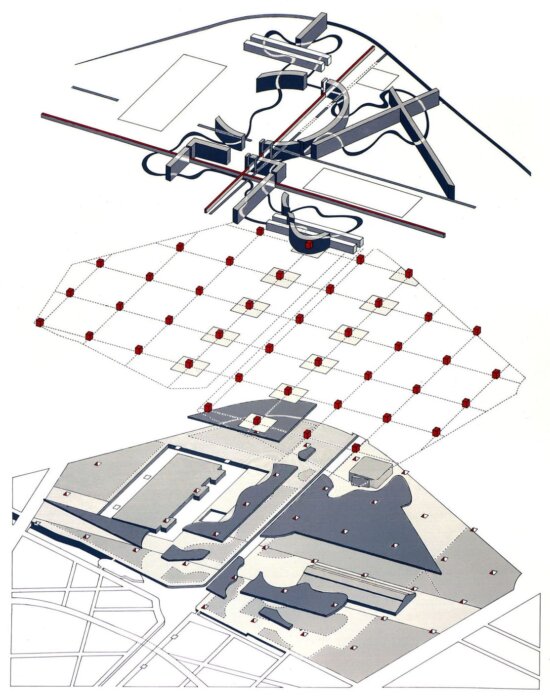
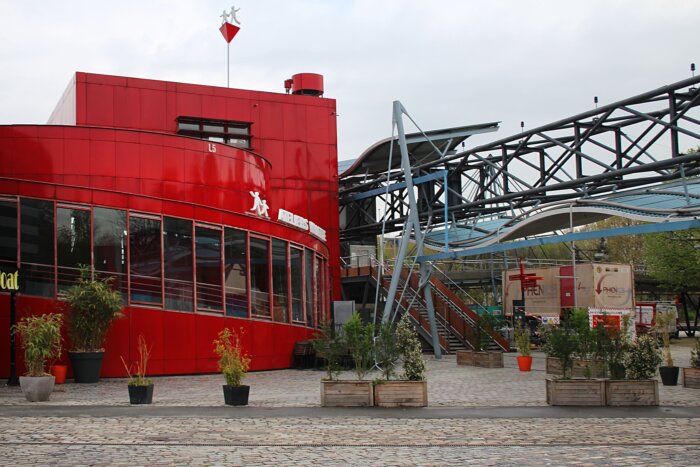
Conceptually, the park consists of three systems (Fig. 1) [75]: a grid of points, an axis-line system, and an area system. [76] The grid system forms a regular structure of 26 red pavilions, called folies, every 120 meters. Functioning as a kind of coordinate system, it appears as a logical order, [77] and is oriented towards the Canal de l’Ourq, which runs through the park. The structure allows for the folies to line the waterside at regular intervals (Fig. 2). [78] The foliesthemselves are red pavilions of various shapes that form places of action and events, functioning as restaurants, exhibition halls, kindergartens, sports facilities, etc., although their functions change constantly (Fig. 3). The second conceptual level, the so-called axis-line system comprises two long main axes extending across the park, which are close together in the south and diverge towards the north. The western axis runs towards the Cité des Sciences in the north and opens up the Grande Halle in the south. It is overlapped by an orthogonal line that runs parallel to the Canal de l’Ourq. Its orthogonals are covered with galleries mounted on a steel structure. Visitors can access the park at ground level but are also able to ascend stairs to cross the elevated level of the galleries and cross the Canal. The second axis runs towards the Zenith concert hall and is lined with trees (Fig. 4 and 5). It too has a crossing axis, although not at a right angle. Last, a circular path is laid out across the Canal de l’Ourq, bordering the Cité des Sciences to the north. The circle is not quite in the center of the park and its shape is broken up (Fig. 2). The circle of paths is also intersected several times by an gently meandering Promenade Cinematique (the “Path of Thematic Gardens” [79]). The Promenade Cinematique is the longest continuous path that crosses both axes in the park. All paths offer multiple opportunities of deviation and to walk in new directions. The combination of logical axes and curved, organic pathways leads to ever new places and provides surprises. The pathways deliberately counteract clear directionality. The third conceptual level, the system of areas includes both the buildings on the site and the green spaces intended for sport, meditation and other leisure activities. According to Tschumi, there is programmatic freedom here. [80]

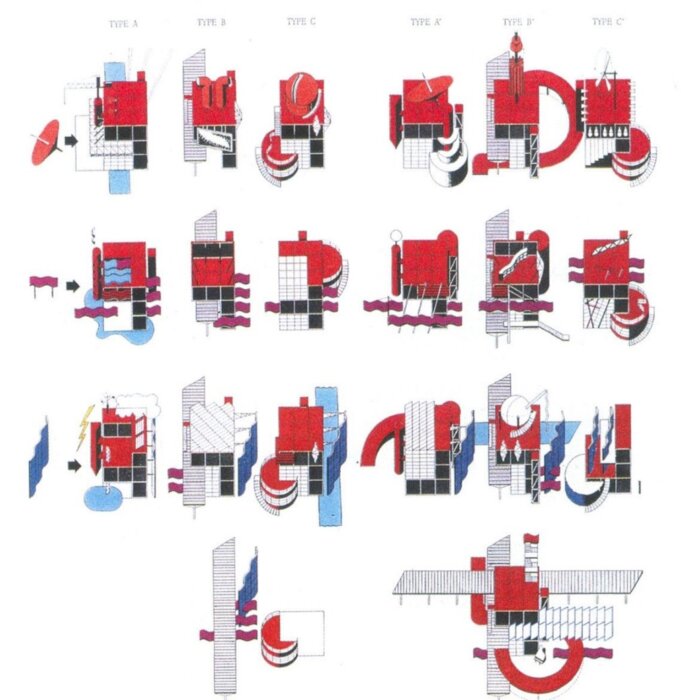

The 26 folies in the grid system are pavilion-like buildings in the shape of a cube, all in a bright red color. What is special about them is their variety of individual shapes, as none of the folies is alike. Sometimes they form clear boundaries between the exterior and interior, sometimes they have a completely open grid structure. Many feature wheel-shaped structures, curved and spiral staircases or other geometric applications. In the folies, formal and functional norm and abnormality are provocatively juxtaposed. The spiral staircase of folie no. 4, for example, leads to nowhere and presents a semantic disruption because it can be recognized as a staircase without functionally being one (Fig. 6). The purpose of a staircase, i.e. connecting floors, is thus negated: it becomes an ornament. The contrast between appearance and functionality of the staircases exemplifies the interplay between sense and nonsense, function and futility. This leads to an oscillation in perception by demonstrating that the relationship between form and its meaning is contingent and prompting the question of when an architectural element is considered ‘appropriate’ or ‘inappropriate.’

All three conceptual levels of the park form logically self-contained systems. The design shows that they have been put together using the principle of superimposition, whereby the systems are interpenetrated and allow for spatial conflicts. The separate levels become interchangeable. There are many places in the park where the systems interfere with each other, as folies illogically cross paths, lean against buildings or stand randomly in open spaces. Tschumi aimed to call into question the concepts of spatial hierarchy, in the sense of a revision of classical binary oppositions. [81] In Derrida’s essay “Point de la folie – maintenant l’architecture” [82] and in several texts by Tschumi, [83] both authors deny any causal or natural connections between form and meaning in the concept of the parc, recognizing their relationship as arbitrary. In Tschumi’s approach, disjunction, superimposition, and permutation are developed into architectural means, with the result that there is no logical order of precedence among the individual systems of the park. That means that there is no ‘natural’ relationship between them; their relation can be described as contingent. In this way, the idea of several intersecting orders is thus realized.
Bernard Tschumi created a park of processuality, whereby the diversity of individual, constantly intersecting orders undermines unity as a standardizing measure. [84] He writes: “the sequential transformation then becomes its own theoretical object, insofar as the process becomes the result […].” [85] The disruption resulting from the interaction of the three systems is significant, as they bring together the park as a conglomerate of several numerous simultaneously valid principles. The park is a whole insofar as it forms a boundary to the city and contains all the elements required for a park: paths, structures, sunbathing areas, places for activities and recreation. At the same time, it undermines this unity. Threeautonomous, incompatible systems of organization are at work within the park, and the factors of these systems can multiply, exclude one another, come enter into conflict.
Confrontations between historical park systems
Bernard Tschumi wanted to create “an urban park” for the 21st century. [86] Namely, older urban parks are organized according to the principles of classical park design (Fig. 1), comprising lawns and recreational terraces, tree-lined avenues and groves, defined promenades and pathways. Such parks uphold the separation of city and garden (and of culture and nature). Against this, Parc de la Villette undermines that separation; the concepts confront one another within the site, and this confrontation is experienced spatially.
A further important feature are the routs through the Parc de la Villette, which does not seem to follow any logic. Usually, paths in parks should not only invite visitors to stroll, but also lead to certain important elements, such as fountains or buildings, so that the full splendor of the design can be experienced. Although incorporated into the park, the pathways and their directions are (seemingly) imperfectly realized in that they are interrupted by disruptive elements. For example, the pathways in the Parc de la Villette are deliberately arranged in a seemingly illogical manner, preventing direct access to the park’s culturally significant buildings.
An examination of the three types of pathways in the Parc de la Villette—the axis, the path, and the circular route—reveals that no fundamentally new concepts were introduced. Instead, their models are derived from the traditions of historical garden design and landscape art. The long, straight axes recall the Baroque principle of symmetry, exemplified in grand promenades that organize space through central perspective. In Italian and French formal gardens, the axial path was designed to produce an impressive, almost theatrical view of the representative building placed at its endpoint. The axis thus served both as an instrument of orientation and as a device of visual control: it positioned the viewer for maximum perspectival effect and guided the gaze toward a predetermined focal point. This optical power was never merely aesthetic. It also functioned as a spatial expression of political or religious authority. As Eisenman notes, the axis embodies the very measure of man—a symbol of rational order and human-centered design. Through this strategy, rulers inscribed their influence into the spatial fabric of the garden, transforming geometry into a medium of representation and legitimation.
In contrast of the axial order of the Baroque garden, the principle of the English landscape garden of the 17th and 18th centuries provides an opposing model that is also reinterpreted in Tschumi’s park. [87] The English garden sought to imitate the irregularity of natural scenery as in an untouched landscape. Visitors were meant to experience the garden as a three-dimensional landscape painting through which they could move freely, following the seemingly spontaneous paths through a naturally grown terrain. [88] Yet, as in the case of the classical axis, Tschumi’s design ultimately disrupts this convention: the paths may recall the naturalism of the English model, but their course resists coherence and orientation, exposing the constructed and artificial logic that underlies even the most ‘natural’ landscape.
By superimposing two self-sufficient historical French and English park systems, Tschumi plays off the immanent hierarchies of the French and English gardens against each other. This becomes visible in the shifted visual axes, which architecturally shift the logic of the infrastructure, while semantically altering the meaning of established and fixed orders. In addition, the ‘incorrect positioning’ of the axes, not leading to historical buildings, dissolves the hierarchy of perspective. The geometric rigor of the French garden is literally displaced. This leads to a conflict of artificiality and naturalness while walking through the park itself. [89] By superimposing the French and English park systems, the originally opposing orders become tangible, yet their coexistence renders each unstable as it is always on the verge of transforming its meaning, i.e., in the case of the different pathways and lines of movement through the park. Ultimately, the machine-aesthetic constructions of the red folies and the galleries aligned along the axes are diametrically opposed to the park’s natural elements such as trees and green spaces. This juxtaposition evokes and questions modernity, as it recalls the formal language of the Russian avant-garde, as well as the historical slaughterhouse, a place of spilled blood, while at the same time critically negating these associations. Bernard Tschumi’s idea of deconstruction is realized through the oscillation between two poles: “when confronted with an urbanistic program, an architect may […] deconstruct what exists by critically analyzing the historical layers that preceded it, even adding other layers derived from elsewhere—from other cities, other parks (a palimpsest).” [90]
How the Parc de la Villette deconstructs Mitterrand’s agenda of a cultural promoter
Finally, the dissolution of hierarchies in the Parc de la Villette can also be transferred to the political level of 1980s France. As the first of the Grands Projets initiated by Francois Mitterrand and at the same time the largest construction project in Paris at the time, the park symbolizes Mitterrand’s intention to imbue his presidency with an image of the cultivated cultural patron. [91] With this representative staging, Mitterrand attempted to enter the tradition of great rulers, such as Louis XIV. As a patron, Louis XIV ushered Paris and France into a period of remarkable flourishing, during which the capital underwent major urban planning transformations under the supervision of Jean-Baptiste Colbert. [92] Centralism, which has a long tradition in France and has its origins in the reign of Louis XIII, represents the idea of a strong state. [93] There was a building boom in the 17th century, reflected not only in the famous Palace of Versailles [94], but also in the extensive remodeling of the Louvre and the establishment of such iconic works as the Tuileries Gardens, the Champs-Élysées, and the Arc de Triomphe. [95] The urban planning and symbolic construction of the city, with parade axes such as the Grand-Cours designed by André Le Nôtre, was a way of expressing and establishing power and authority through architecture.
In contrast to previous eras, the Parc de la Villette does not simply reproduce traditional structures that legitimize power, such as the visual axis. Instead, it deconstructs them by taking up their elements—such as axes, pathways, and formal layouts—but subverting their internal logic and expected function. Even the circular path, traditionally understood as a symbol of a political or cultural center, is disrupted and fragmented, undermining the notion of a fixed center of authority. This deconstruction of Tschumi successfully undermines Francois Mitterrand’s aim to be a patron of culture as a foundation for his state-supporting projects. Deconstruction here means that Tschumi’s installation consciously and consistently draws on historically representative stylistic devices, while at the same time subverting their conventional order. The dissolution of a perspectival hierarchy in the park implies a dissolution of the historically legitimized French government structure. This centrally organized system operates by approving decisions through a hierarchical structure.
The deconstructivist concept of the Parc de la Villette undermines precisely the traditional architectural structures through which power has historically been represented. Architectural-metaphysical principles such as the axis, perspective, symmetry, linearity, stereometry, and monumentality, which have long expressed hierarchies and an anthropocentric order, are deliberately destabilized. Through Tschumi’s strategy of disjunction and superimposition, these conventions are turned against themselves, dissolving the unity and metaphysical authority, carried to the point of absurdity. The Parc de la Villette thus turns out to be a concept of decentering, and deliberately aims at a political dimension that crystalizes through Mitterrand as the initiator of representative buildings in Paris, as Martina Gugeler writes. [96] There is a deconstruction of the figure of Mitterrand himself, who is no longer in control of his mission and its symbolism: his power turns out to be a construction manifested through art, unmasked by his greatest project itself.
7_Conclusion
This _Article explored the structural parallels between Jacques Derrida’s idea of deconstruction and the architecture of the 1980s. It establishes that deconstructivist architecture initially meant an intellectual positioning and attitude of the architects, which had an impact on thinking about architecture, its discourses, traditions and tasks. [97] With this view, deconstructivist approaches to architecture came to define not only theory and thus texts, but also sketches, designs, models and ultimately even realized buildings. This approach reflected an orientation towards the central principles of philosophical deconstruction, seeking to destabilize the conventional relation between architecture, its functions, and the meanings ascribed of it. To achieve this goal, deconstructivist architecture uses disruptions to critically scrutinize the fundamental structures of architecture—its order, ethics, aesthetics, and its functional and symbolic meanings. Temporary deviations from established norms reveal alternative architectural possibilities that were previously suppressed by existing orders. This approach makes it possible to experience the simultaneity of order and disorder, encouraging reflection on their interdependence. By taking up Derrida’s concept of deconstruction, deconstructivist architecture becomes an instrument of critical reflection that scrutinizes political, social, and aesthetic structures. The political infiltration of power is particularly evident in the concept of the Parc de la Villette, where Mitterrand sought to inscribe political authority into the urban fabric. Tschumi’s design, however, exposes and destabilizes this ambition by dissolving traditional symbols of order and representation. Here, the close connection between disruption and deconstruction in architecture is revealed as a dynamic process that not only breaks up existing structures but also takes up historical concepts and thwarts them at the same time. Through the deliberate concealment of representative elements drawn from historical park systems, Bernard Tschumi questioned Mitterrand’s use of architecture as a means of legitimizing political power, while deconstructing his position as a state-appointed patron of culture.
_How to Cite
Jennifer Konrad. “Disruptive Paradox: Deconstructive Architecture and its Subversive Power.” On_Culture: The Open Journal for the Study of Culture 19 (2025). <https://doi.org/10.22029/oc.2025.1506>.

_Endnotes
- [1] See Daniel Libeskind, “End-Raum,” in No Place at This Point: Writings on Architecture—Visions for Berlin, ed. Daniel Libeskind (Dresden/Basel: Verlag der Kunst, 1995), 167–171.
- [2] See Lars Koch and Tobias Nanz, Disruption in the Arts: Textual, Visual and Performative Strategies for Analysing Societal Self-Descriptions (Berlin: De Gruyter, 2018).
- [3] Martin Heidegger, “Die Grundprobleme der Phänomenologie (Sommersemester 1927),” in Gesamtausgabe, Band 24, ed. Friedrich-Wilhelm von Herrmann (Frankfurt am Main: Vittorio Klostermann, 1975), 31.
- [4] Heidegger, “Die Grundprobleme der Phänomenologie,” 31.
- [5] Jacques Derrida, De la grammatologie (Paris: Éditions de Minuit, 1967).
- [6] Zaha Hadid, Frank Gehry, Peter Eisenman, Bernard Tschumi, Daniel Libeskind, Coop Himmelb(l)au, Rem Koolhaas and OMA.
- [7] Philip Johnson and Mark Wigley, eds., Deconstructivist Architecture (New York: Museum of Modern Arts, 1988), 10.
- [8] Peter Eisenman, “I Don’t Think There Is Such a Movement: Deconstruction Has Become a Stylistic Term Rather than an Ideological One,” El Croquis 41 (1989): 7–15, here: 7.
- [9] Peter Eisenman, “Post/El Cards: Reply to Jacques Derrida,” in: Choral Works, eds. Jacques Derrida, Peter Eisenman, and Jeffrey Kipnis (London: The Monacelli Press, 1995), 187–189, here: 187–188.
- [10] Jonathan Culler, On Deconstruction: Theory and Criticism after Structuralism (London: Routledge, 2008).
- [11] Encyclopedia Britanica, “Deconstruction,” in Encyclopaedia Britannica, accessed February 21, 2025, <https://www.britannica.com/topic/deconstruction#ref273090>.
- [12] Jacques Derrida, “Sign, Structure & Play in Human Sciences,” in The Languages of Criticism and The Sciences of Man: The Structuralist Controversy, eds. Richard Macsey and Eugenio Donato (Baltimore, 1970), 249.
- [13] Jacques Derrida, Of Grammatology, transl. Gayatri Chakravorty Spivak (Baltimore: John Hopkins University Press, 1976), 71.
- [14] See Peter Eisenman, “Architecture as a Second Language,” in Eisenman Inside Out: Selected Writings 1963–1988 (New Haven: Yale University Press, 2004), 227–237, here: 228.
- [15] Peter Eisenman, “Visions Unfolding: Architecture in the Age of Electronic Media,” in Intelligence Ambiente, Ars Electronica ‘94, eds. Karl Gerbel and Peter Weibel (Vienna: PVS, 1994), 203–215.
- [16] Peter Eisenman, “Visions Unfolding,” 204.
- [17] Derrida, Of Grammatology, 158.
- [18] Derrida, De la grammatologie, 227.
- [19] Eisenman, Post/El Cards,187–188.
- [20] Mark Wigley, “The Translation of Architecture: The Product of Babel,” in Deconstruction III, ed. Andreas Papadakis (London: Academy Group, 1994), 6–13, here: 12.
- [21] See Mark Wigley, The Architecture of Deconstruction: Derrida’s Haunt (Cambridge, MA, London: MIT Press, 1993), 29: “Just as instability must always be concealed to produce the effect of unambiguous stability, philosophical discourse, which represents itself as both the stabilizing discourse and the discourse about stability, is unable to articulate its debt to architecture.”
- [22] John W. Carroll and Ned Markosian, An Introduction to Metaphysics (London: Cambridge University Press, 2010), 1–3.
- [23] Peter Eisenman, “Conversations with Peter Eisenman: The Evolution of Architectural Style,”ArchDaily, accessed February 21, 2025, <https://www.archdaily.com/785334/interview-with-peter-eisenman-i-am-not-convinced-that-i-have-a-style?utm_source=chatgpt.com>.
- [24] Eisenman, “Visions Unfolding,” 205–206.
- [25] Peter Eisenman, “Architecture and the Problem of the Rhetorical Figure,” in Eisenman Inside Out: Selected Writings, 1963–1988, ed. Peter Eisenman (New Haven/London: Yale University Press, 2004), 54–57.
- [26] Cf. Bernard Tschumi, “Six Concepts,” in Architecture and Disjunction, ed. Bernard Tschumi (London: AA Publications, 1996), 227–259, here: 256.
- [27] Burkhard Wesenberg, “Die Entstehung der Griechischen Säulen und Gebälkformen in der literarischen Überlieferung der Antike,” in Säule und Gebälk: Zu Struktur und Wandlungsprozeß griechisch-römischer Architektur, ed. Ernst Schwandner (Mainz: Zabern, 1994), 1–15.
- [28] Bernard Tschumi, “Abstract Mediation and Strategy,” in Cinégramme Folie: Le Parc de la Villette, ed. Bernard Tschumi (Princeton: Princeton Architectural Press, 1987), 4–8, here: 8.
- [29] Eisenman,“Architecture and the Problem of the Rhetorical Figure,” 54–55.
- [30] Lars Koch, Tobias Nanz, and Johannes Pause, “Disruption in the Arts: Prologue,” in Disruption in the Arts. Textual, Visual and Performative Strategies for Analysing Societal Self-Descriptions, eds. Lars Koch, Tobias Nanz, and Johannes Pause (Berlin and New York: De Gruyter, 2018), IX–XV.
- [31] Peter Brunette and David Wills, eds., Deconstruction and the Visual Arts: Art, Media, Architecture (Cambridge: University Press, 1994), 27.
- [32] Jacques Derrida, “Der Philosoph und die Architekten: Ausschnitte aus einem Interview mit Jacques Derrida,” in Paper Art 6:Dekonstruktivistische Tendenzen, ed. Dorothea Eimert (Ostfildern-Ruit: Hatje Cantz, 1996), 84–87, here: 85.
- [33] Christopher Norris, “Das dekonstruktivistische Projekt,” in Dekonstruktivismus – Eine Anthologie, ed. Andreas Papadakis (Stuttgart: Klett-Cotta, 1989), 73–78.
- [34] Wigley, The Architecture of Deconstruction, 47: “The questioning of the very idea of building is aligned with a questioning of institutional authority. It is the rethinking of architecture that defines the politics of deconstruction.”
- [35] Wigley, The Architecture of Deconstruction, 30.
- [36] See Wigley, The Architecture of Deconstruction, 27: “At the very least, the building is no longer simply standing on the ground, and the whole conceptual economy it is meant to put in place is disturbed.”
- [37] Wigley, The Architecture of Deconstruction, 30.
- [38] Niklas Luhmann, Soziale Systeme: Grundriß einer allgemeinen Theorie (Frankfurt am Main: Suhrkamp, 2001), 152: “Kontingent ist etwas, was weder notwendig noch unmöglich ist; was also so, wie es ist (war, sein wird), sein kann, aber auch anders möglich ist.” Translated by author: “Contingent is something that is neither necessary nor impossible; something that can be as it is (was, will be), but is also possible in a different way.”
- [39] Peter Geimer, “Was ist kein Bild? Zur ‘Störung der Verweisung’,” in Ordnungen der Sichtbarkeit: Fotografie in Wissenschaft, Kunst und Technologie, ed. Peter Geimer (Frankfurt am Main: Suhrkamp, 2002), 313–341.
- [40] Oxford English Dictionary, “disruption (n.),” June 2025. doi: 10.1093/OED/1251789448.
- [41] See Claude Elwood Shannon and Warren Weaver, The Mathematical Theory of Communication (Illinois: Combined Academic Publisher, 1963); see also Claude Elwood Shannon, “Communication in the Presence of Noise,” in Proceedings of the IEEE 86, no. 2 (1998): 447–457.
- [42] Carsten Gansel, “Das ‘Prinzip Störung’ in den Geistes- und Sozialwissenschaften—Einleitung,” in Das “Prinzip” Störung in den Geistes- und Sozialwissenschaften, eds. Carsten Gansel and Norman Ächtler (Berlin: De Gruyter, 2013), 7–14, here: 7.
- [43] Otto Loistl, Chaostheorie: Zur Theorie nichtlinearer dynamischer Systeme (Berlin: De Gruyter, 2018); Albert Kümmel, “Störung,” in Grundbegriffe der Medientheorie, eds. Alexander Roesler, Bernd Stiegler (Paderborn: UTB, 2003), 229–235, here: 232.
- [44] Kümmel, “Störung,” 232.
- [45] Carolin Höfler, “Drawing Without Knowing: Prozess und Form in den Diagrammen von Peter Eisenman,” in Diagrammatik der Architektur, eds. Günter Blamberger and Dietrich Boschung (Munich: Wilhelm Fink, 2013), 149–170.
- [46] See Dorothea Eimert, “Papier, Zufall und Dekonstruktivismus,” in Paper Art 6: Dekonstruktivistische Tendenzen, ed. Dorothea Eimert (Ostfildern-Ruit: Hatje Cantz, 1996), 8–17, here: 10.
- [47] Eimert, “Papier, Zufall und Dekonstruktivismus,” 10.
- [48] Eimert, “Papier, Zufall und Dekonstruktivismus,” 10.
- [49] Culler, On Deconstruction, 139.
- [50] Gansel, “Das ‘Prinzip Störung’ in den Geistes- und Sozialwissenschaften—Einleitung,” 13.
- [51] Lars Koch and Tobias Nanz, “Aesthetic Experiments: On the Event-Like Character and the Function of Disruptions in the Arts,” in Disruption in the Arts: Textual, Visual and Performative Strategies for Analysing Societal Self-Descriptions, eds., Lars Koch, Tobias Nanz, and Johannes Pause (Berlin and New York: De Gruyter, 2018), 3–26, here: 3.
- [52] Koch and Nanz, “Aesthetic Experiments,” 6.
- [53] Koch, Nanz, and Pause, “Disruption in the Arts: Prologue,” IX.
- [54] Koch, Nanz, and Pause, “Disruption in the Arts: Prologue,” X. The authors distinguish between “artistic disruption” and “aesthetic disruption.”
- [55] Koch, Nanz, and Pause, “Disruption in the Arts: Prologue,” IX.
- [56] See Jacques Rancière, Ist Kunst widerständig?(Berlin: Merve Verlag, 2004), 13, 27.
- [57] See Koch, Nanz, and Pause, “Disruption in the Arts: Prologue,” X: “[A]esthetic of disruptions […] break with one’s own (pre)-suppositions.”
- [58] Koch and Nanz, “Aesthetic Experiments,” 96.
- [59] Carsten Gansel, “Zu Aspekten einer Bestimmung der Kategorie ‘Störung’—Möglichkeiten der Anwendung für Analysen des Handlungs- und Symbolsystems Literatur,” in Das “Prinzip” Störung in den Geistes- und Sozialwissenschaften, eds. Carsten Gansel and Norman Ächtler (Berlin: De Gruyter, 2013), 31–56, here: 35.
- [60] Gansel, “Zu Aspekten einer Bestimmung der Kategorie ‘Störung’—Möglichkeiten der Anwendung für Analysen des Handlungs- und Symbolsystems Literatur,” 36.
- [61] Giorgio Ciucci, “Eisenmanamnesie,” in Peter Eisenman: Bauten und Projekte, ed. Pippo Ciorra (Stuttgart: DVA, 1995), 7–12, here: 8.
- [62] Eisenman, “Architecture as a Second Language,” 227.
- [63] Eisenman, “Architecture as a Second Language,” 229.
- [64] Eisenman, “Architecture as a Second Language,” 227. See further Bernard Tschumi, “Events: The Turning Point,” in Red is Not a Colour, ed. Bernard Tschumni (New York: Rizzoli, 2012), 176–177, here: 176. Bernard Tschumi, “De-, Dis-, Ex-,” in Architecture and Disjunction, ed. Bernard Tschumi (Cambridge, MA/London: MIT Press, 1996), 215–226, 219.
- [65] Andreas Hiepko and Katja Stopka, “Einleitung,” in Rauschen: Seine Phänomenologie und Semantik zwischen Sinn und Störung, eds. Andreas Hiepko and Katja Stopka (Würzburg: Königshausen and Neumann, 2001), 9–18.
- [66] Gansel, “Das ‘Prinzip Störung’ in den Geistes- und Sozialwissenschaften—Einleitung,” 7.
- [67] Nina Zschocke, Der irritierte Blick: Kunstrezeption und Aufmerksamkeit (Munich: Fink, 2006), 73.
- [68] Jacques Derrida, Peter Eisenman, and Jeffrey Kipnis, ChoraL Works (New York: Monacelli Press, 1995).
- [69] Tschumi, “Six Concepts,” 250.
- [70] Cf. Jacques Derrida, “Letter to Peter Eisenman,” in ChoraL Works, eds. Jacques Derrida, Peter Eisenman and Jeffrey Kipnis (London: AA Publications, 1995), 182–186.
- [71] Brendon Wocke, “Derrida at Villette: (An)aesthetic of Space,” in University of Toronto Quarterly 83, no. 3 (2014), 739–755, here: 739; see also the Website of Mitterrand, accessed February 21, 2025, <http://www.mitterrand.org/Theleme-a-la-Villette.html>; Andrea Geiniger, Gerhard Matzig, and Sebastian Redecke, Paris: Architektur der Gegenwart (Munich/New York: 1997), 50.
- [72] Eric Fournier: La Cité du sang (Paris: Libertalia, 2008).
- [73] Jacques Derrida, “Am Nullpunkt der Verrücktheit: Jetzt die Architektur,” in ARCH+ 97 (1988): 54 –62, here: 58; see also Jacques Derrida, “Point de Folie—Maintenant l’Architecture,” in La Case Vide: La Villette, ed. Bernard Tschumi (London: Architectural Association, 1985), 65 –75.
- [74] Derrida, “Point de Folie,” 65–66: Derrida uses the prefix “dis” to describe the inherent absence in the presence of architecture.
- [75] The images of Bernard Tschumi’s drawings and photographs included in this article are subject to copyright protection. Their reproduction is made solely under the conditions of scholarly quotation as defined in Section 51 of the German Copyright Act (UrhG) and Article 5(3)(a) of Directive 2001/29/EC. The images are not used for illustrative or decorative purposes but serve a strictly academic function of analysis and documentation within the context of this study. They are reproduced only to the extent necessary for scholarly discussion (“as large as necessary, as small as possible”). Any commercial use or aesthetic appropriation is expressly excluded. All copyrights and image rights remain with Bernard Tschumi and/or the respective rights holders, who are duly credited in the list of sources.
- [76] See Johnson and Wigley, Deconstructivist Architecture, 92.
- [77] Geiniger, Matzig, and Redecke, Paris, 50.
- [78] Simone Kraft, Dekonstruktivismus in der Architektur? Eine Analyse der Ausstellung Deconstructivist Architecture im New Yorker Museum of Modern Art 1988 (Bielefeld: Transcript, 2015), 295.
- [79] Bernard Tschumi “An Urban Parc for the 21st Century,” in Cinégramme Folie: Le Parc de la Villette, ed. Bernard Tschumi (Princeton: Princeton Architectural Press, 1987), 1–55, here: 8.
- [80] Tschumi, “An Urban Parc for the 21st Century,” 8.
- [81] Tschumi, “Abstract Mediation and Strategy,” 7.
- [82] Jacques Derrida, “Point de la folie,” in La folie et la théorie: essais sur la phénoménologie de la perception, ed. Jacques Derrida (Paris: Éditions Galilée, 1972), 23–53.
- [83] Bernard Tschumi, “Madness and the Combinative,” in Architecture and Disjunction, ed. Bernard Tschumi (Cambridge, MA/London: MIT Press, 1996), 172–189; Tschumi, “Abstract Mediation and Strategy”; Tschumi, “De-, Dis-, Ex-.”
- [84] See Bernard Tschumi, “Sequences,” in Architecture and Disjunction, ed. Bernard Tschumi (Cambridge, MA/London: MIT Press, 1996), 153–168, here: 154.
- [85] Tschumi, “Sequences,” 154.
- [86] Tschumi, “An Urban Parc for the 21st Century.”
- [87] Ulf Küster, “Natur ordnen: Landschaftserfahrung im 18. Jahrhundert,” in Von der Geometrie zur Naturalisierung: Utopisches Denken im 18. Jahrhundert zwischen literarischer Fiktion und frühneuzeitlicher Gartenkunst, ed. Richard Saage (Berlin: De Gruyter, 1999), 109–116.
- [88] Wilfried Hansmann and Kerstin Walter, Geschichte der Gartenkunst: Von der Renaissance bis zum Landschaftsgarten (Köln: DuMont, 2006).
- [89] See Tschumi, “An Urban Parc for the 21st Century.”
- [90] Tschumi, “Abstract Mediation and Strategy,” 4.
- [91] Emile Biasini, “Les Grands Projets: An Overview,” in RSA Journal 139, no. 5421(1991): 561–570.
- [92] Eric Cahm, “Mitterrand’s Grands Projets: Monuments to a Man or Monuments to an Age?,” in The Mitterrand Years, ed. Maclean Mairi (London: Springer Palgrave, 1998), 263–275.
- [93] Reinhard Sparwasser, Zentralismus, Dezentralisation, Regionalismus und Föderalismus in Frankreich: Eine institutionen-, theorien- und ideengeschichtliche Darstellung (Berlin: Duncker & Humblot, 2019).
- [94] Originally built by Philibert Le Roy as a hunting lodge for King Louis XIII, the complex underwent several phases of renovation and expansion from 1661 onwards under Louis XIV, directed by architects Louis Le Vau, François II d’Orbay, Jules Hardouin-Mansart, and Robert de Cotte. See Jean-Pierre Poisson, Jules Hardouin-Mansart (Paris: Éditions du Patrimoine, 2009), 190–192.
- [95] Michael Petzet, Claude Perrault und die Architektur des Sonnenkönigs: der Louvre Königs Ludwigs XIV. und das Werk Claude Perraults (Munich: Kunstverlag, 2000); Dietrich Erben, Paris und Rom: Die staatlich gelenkten Kunstbeziehungen unter Ludwig XIV. (Berlin: Akademie, 2004).
- [96] Martina Gugeler, “Der Parc de la Villette—Würfelwurf der Architektur: Das Zusammenwirken von Bernard Tschumi und Jacques Derrida beim Parc de la Villette in Paris,” in Kritische Berichte 33, no. 2 (2005): 44–57, here: 44: “Vielmehr gilt es, bei diesem Projekt genau auf die Konzeption des Architekten Bernard Tschumi zu blicken, der den staatstragenden Anspruch der französischen Regierung in subtiler Weise unterlaufen hat.” Translated by Author: “Rather, it is important to look closely at the design by architect Bernard Tschumi, who subtly undermined the French government’s desire to make a statement about the state.”
- [97] Peter Engelmann, Postmoderne und Dekonstruktion: Texte französischer Philosophen der Gegenwart (Stuttgart: Reclams Universal-Bibliothek, 2004), 105–106. See further Norris, Das dekonstruktivistische Projekt, 75.