Black Joy as Cultural Resistance
On Celebration and Visibility in When We See Us


The exhibition When We See Us at the Kunstmuseum Basel celebrates a century of Black figurative painting, offering a sweeping homage to Black Joy, positioned far beyond the aestheticized trauma and stereotyped suffering so often imposed upon Black subjects in European cultural institutions. More than a collection of artworks, the exhibition offers a curatorial and affective experience: an invitation to encounter joy as a force of resistance, intimacy, and self-definition.
The title, When We See Us, a deliberate echo of Ava DuVernay’s When They See Us, already signals a reversal of gaze. Where they cast their vision upon Black life, this exhibition turns the lens inward: when we see us is both an epistemic act and a political claim. It is a reorientation of visual sovereignty. Curated by Tandazani Dhlakama and Koyo Kouoh, the exhibition brings together over 200 works by artists from across the Pan-African and diasporic spectrum, mapping 100 years of Black figuration through scenes of leisure, love, spirituality, domesticity, and collective rest.
The exhibition is not the representation of Blackness as absence, brokenness, or spectacle. Rather, it is what Stuart Hall would call a “politics of representation” that insists on multiplicity, affect, and self-making. [1] Black Joy, in this exhibition, is not treated as an emotion alone but as a methodology, a visual grammar of presence, survival, and imagination. Drawing on Hall, we might say this is not about “finding the real” but about showing how identity is constructed, felt, and claimed in the act of celebration itself. [2] The exhibition’s refusal to center trauma resonates deeply with bell hooks’ call for an “oppositional gaze:” a way of seeing that resists dominance and reclaims the terms of looking. [3] Here, the gaze is not merely returned, it is shared. One sees and is seen. This mutuality is enacted not just through portraiture but through the spatial choreography of the exhibition: vibrant color palettes, layered listening zones, moments of stillness, and warmth. In such an environment, joy is not a frivolous affect but a quiet demand, a mode of staying alive and staying seen.
As a biracial cultural researcher working at the intersection of visual studies, digital ethnography, and urban Black cultural spaces, I approached the show not only as an observer but also as someone deeply attuned to the textures and politics of Black self-representation. My viewing was not neutral. It was embodied, relational, charged. Moving through the painted scenes of rest and reunion, of Black girls dancing, elders resting their feet, I felt both grounded and moved. I was not only reading the artworks but being read by them: the postures, glances, and gestures mirrored emotions I had not named but recognized instinctively. A quiet portrait of a woman holding her child brought up memories of my own mother’s tenderness; a young man lounging with his eyes closed reminded me of someone I once loved. These were not abstract images to me. They were familiar, and in their familiarity, they seemed to look back, to hold me in return.
This is perhaps what Saidiya Hartman meant when she wrote of refusing the very terms of recognition offered. [4] Rather than seeking legitimacy through dominant narratives of suffering, the exhibition stages refusal by sidestepping these narratives entirely. It does not ask for empathy by foregrounding trauma. Instead, it insists that Black life is legible, powerful, and worthy through joy, rest, and intimacy alone. When We See Us enacts this refusal not through absence or silence, but through radical celebration, through scenes of leisure, softness, spirituality, and everyday beauty that resist the demand to justify Black humanity through pain.
The exhibition’s thematic structure, with chapters dedicated to leisure, spirituality, joy, and the everyday, asserts a way of being Black in the world that is textured, complex, and defiantly present. In this _Perspective, I propose to read When We See Us not only as an art exhibition but as a performative and political act, one in which celebration itself becomes a method of seeing, a curatorial strategy, and a collective future tense.
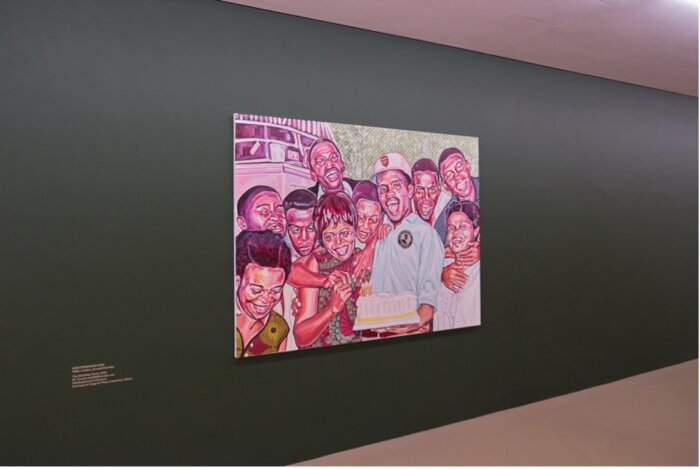
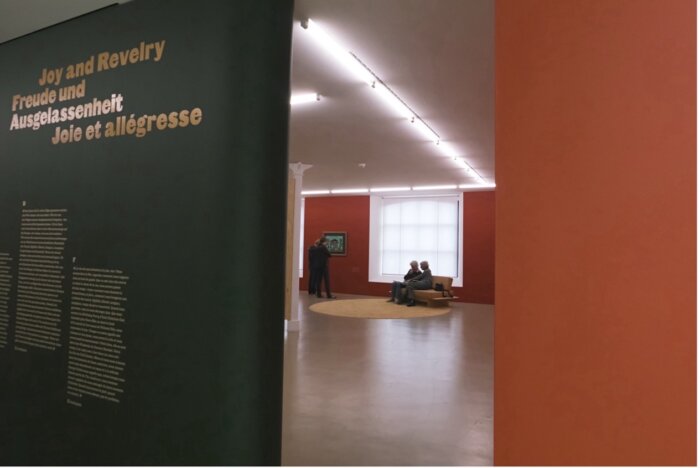
Upon entering When We See Us, what strikes the body first is not an artwork but a mood, a chromatic atmosphere that wraps the visitor in earthy saturation. The walls are painted in deep moss green and terracotta red, a palette both grounding and politically charged. These are not incidental curatorial choices. The colors evoke the Pan-African flag—red for the blood uniting people of African descent, black for the people themselves, and green for the land and hope of liberation. In the exhibition space, these colors do not hover in abstraction; they materialize in the artworks themselves. The moss green echoes the foliage in background scenes of rest and ritual, while the terracotta red recurs in garments, interiors, and painted skin tones. Together, they ground the painted figures in an earthy, political palette that vibrates with meaning. Blackness is not only symbolized but made present through the painted bodies on the canvas: lounging, standing, laughing, praying, reclining.
Every artwork is figurative, bodies take up space, command it, and extend it back toward the view as a gesture of recognition and engagement. Whether painted in expansive, loose brushstrokes or rendered in meticulous detail, these portraits radiate an undeniable intimacy. There are no abstractions to hide behind. The figures are there, visible, solid, specific. They return the gaze. The layout of the exhibition amplifies this. The paintings are generously spaced, allowing each canvas to breathe. Viewers are granted the physical and psychic room to encounter the works without having to rush or be pressed for time. From afar, the portraits beckon. Up close, they confront. There is no linear path, no forced narrative. One moves intuitively, guided by color, posture, or curiosity. The result is a spatial choreography that invites not only observation but conversation, a dialogical exchange between painting and viewer, between presence and presence. This encounter recalls Édouard Glissant’s Poetics of Relation, a philosophy that embraces shared opacity, where identities are not flattened or decoded but allowed to resonate in their complexity. [5] To stand before these works is to enter into such a relation. One does not fully grasp the figure in front of oneself; one lingers with it. You, too, become visible in that moment, not as master of the gaze, but as participant in a visual negotiation. The bodies on the wall are not explanatory. They do not need to explain themselves. They look back.
Tina Campt’s call to “listen to images” resonates here. [6] In the quietude of these rooms, the images pulse with affect. The green and terracotta walls do not merely frame the art, they absorb and reflect it. The spatial design becomes a kind of resonance chamber, amplifying the subtle gestures of the painted bodies—a hand resting on a cheek, a sideways glance, the curve of a neck, a shared grin. These are not grand gestures of political resistance. They are minor key declarations: I am here. I am relaxing. I desire. I do not flinch.
As a biracial viewer deeply attuned to questions of visibility and embodied legibility, I found myself often pausing mid-step, aware of my own body in the space. I was not looking at ‘art’ in the abstract. I was encountering scenes of kinship, of familiarity, of becoming. There is a strange comfort in being seen, not in a voyeuristic sense, but in the profound quiet of mutual recognition. These images do not merely allow Blackness to be seen; they insist on the right to complexity, to presence without performance.
bell hooks wrote of the oppositional gaze as the site of power and a way to reclaim looking from structures of domination. [7] In When We See Us, the gaze is not weaponized, but shared. There is softness here, but not passivity. The figures look back not to challenge, but to welcome, to draw you into a new kind of viewing, one not rooted in analysis but in co-presence. This is what makes the exhibition space so radical: it does not explain Black life. It does not translate. It does not plead. Instead, it stages a series of visual and spatial relations that ask only that you stay long enough to notice what is already there.
_An Invitation to Reflect: Stillness, Sound, and the Senses
There are spaces that ask us to move, to rush, to consume. When We See Us asks us to sit.
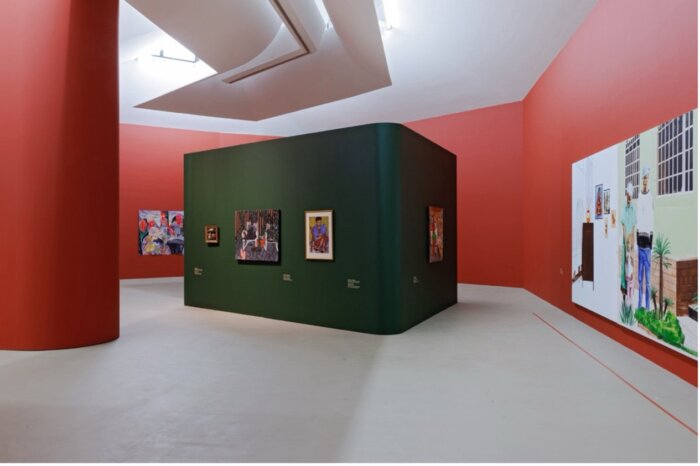
Scattered throughout the exhibition are plush, sand-colored armchairs, low benches, and warm-toned rugs that provide comfortable resting areas. At first, they seem decorative, functional, even incidental. But these soft structures are key to the exhibition’s choreography of attention. They invite the visitor not just to look but to linger, not just see but to be seen back. This is not a museum visit meant to be hurried. This is a curated slowing-down, a sensual deceleration.
At the heart of this invitation are the listening stations. At each, one sits in stillness, cradled by sound and surrounded by portraits. The music—soft, diasporic, non-intrusive—hovers in the air rather than dominates. As you lean into the audio, something curious happens: the gaze of the painted figures becomes louder than the music. They do not move, yet they pulsate with presence. One is not merely in front of an artwork, one is inside its attention.
This interaction is quiet, but not passive. It is a practice of attunement—a way of listening to images, of letting their frequencies wash over the body. [8] In these moments, the visitor is not a detached observer. The surrounding portraits—women reclining, lovers dancing, children gazing sideways—do not ask to be deciphered. They ask to be sat with.
As I settled into one of these chairs, I felt my posture shift not just physically, but emotionally. The stillness was not empty; it was charged. A man in a portrait across from me was holding a drink, leaning back, his expression unreadable. And yet, I felt read. In that moment, I was not studying the painting. I was being studied. There was no rush to understand. There was only presence, mutual and thick.
The exhibition’s design offers many such thresholds: soft spaces where reflection is not only permitted but expected. Beyond the listening corners, one encounters a wall of knowledge, a timeline mapping 100 years of Black art history alongside pivotal political, cultural, and institutional events. A few steps further is the book station. Carrying the words of bell hooks, Audre Lorde, and Paul Gilroy, they rest on wooden surfaces, waiting to be touched. These are not citations in a text. They are living companions to the art on the walls.
Lorde’s voice, in particular, seems to echo in these spaces. Her writing on the erotic not as sexual, but as deeply felt and embodied, finds resonance in the exhibition’s structure. [9] These chairs, these rugs, this curated softness: they speak of a different kind of power, a power rooted in rest, receptivity, and care. The exhibition does not demand your gaze, it holds it gently.
To sit among these works is to step out of a visual regime that equates motion with meaning, or noise with knowledge. Instead, When We See Us creates an ecology of sensation: visual, sonic, tactile, intellectual. The layering is subtle, but deliberate. The space allows for solitude without isolation, for reflection without retreat. It is a space where Blackness is not a spectacle but a slow-burning presence. Paul Gilroy once asked how we might listen to the soundscape of the Black Atlantic, the rhythms, voices, and silences that carry diasporic memory. [10] Here, that question is translated into visual space. The rooms hum with frequencies of survival and joy, of dissonance and communion. The music at the listening stations does not guide you; it meets you. It does not explain; it envelops.
When We See Us does not teach in the traditional sense. It does not hand you conclusions or mount didactic claims. Instead, it creates an environment where knowledge is felt in the gut, in the breath, in the ache of sitting still for longer than one is used to. It is not only an aesthetic space. It is an ethical one. To accept the invitation is to slow down. To listen. To stay.
_The Power of Black Joy: Pleasure, Presence, and the Everyday
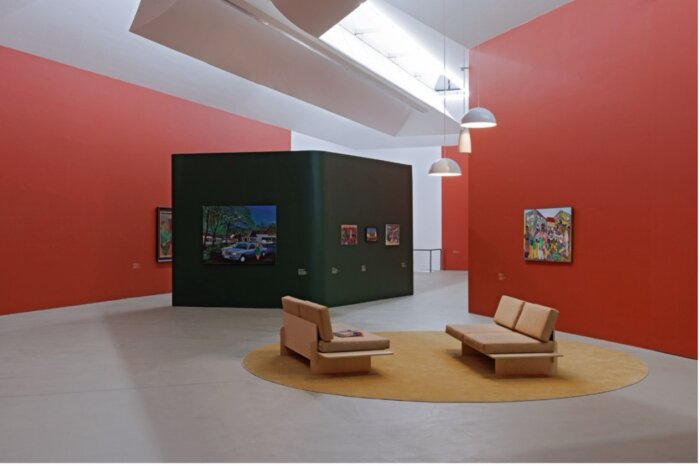
At the heart of When We See Us pulses a single, resonant force: Black Joy. Not as a fleeting mood. Not as aesthetic flourish. But as an intentional, curatorial, and political decision. Black Joy animates every chapter of the exhibition, from the artwork selection to the atmosphere of the rooms. It is not background; it is the frame.
In a world that relentlessly reduces Black identity to trauma, pain, or protest, When We See Us insists on another grammar. It constructs what Saidiya Hartman might call a “counter-history of the present”: one where pleasure, rest, intimacy, and spiritual vitality are neither marginal nor trivial, but central. [11] This is a radical refusal of the spectacularized suffering that has too often defined Blackness in the Western archive. Here, joy becomes a mode of resistance. A refusal to be broken.
The exhibition presents Black bodies not in struggle, but through softness. Not in performance, but at ease. We see scenes of leisure, of friendship, of solitude. Bodies stretched out on verandas, arms draped over shoulders, eyes half-closed in sunlit peace. These are not sanitized visions. They are layered with nuance and complexity. But they foreground what Kevin Quashie names “the sovereignty of quiet:” a Black interior life that exists beyond the gaze, beyond explanation, beyond spectacle. [12]
To walk through these rooms is to be surrounded by joy to its fullest, expressed as dancing, reclining, drumming, praying, kissing, laughing. These moments are deeply affective, not because they demand an emotional response, but because they invite one. The joy here is not loud. It is not didactic. It is atmospheric. It saturates the room like light through gauze.
The spatial design enhances this. The artworks are given room to breathe. There is no clutter, no overload. Each painting holds its own energy, has its own rhythm. The viewer is granted the time and space to approach the figures with care, feeling not just their presence, but their freedom.
As a cultural researcher, I found myself slowed down by the weight of this joy. Not in heaviness, but in reverence. It stirred in me a sense of homecoming. Not because I literally saw myself in the works, but because I recognized the textures of intimacy, the tilt of a head, the way two fingers touch a wine glass, the curve of a spine at rest. These are not generic scenes. They are specific, grounded, sensual. They insist on the fullness of Black life.
bell hooks once wrote that to love Blackness is to see it not only in resistance, but in radiance. [13] The works in When We See Us embody this ethic of love. They show us Black bodies not surveilled, but self-possessed. Bodies that do not justify their presence. Bodies that know their worth. In the chapters on leisure and rest, the power of Black Joy becomes almost overwhelming. There is a soft, humming confidence in the way people are depicted in communion with others or alone. No spectacle. No apology. Just the quiet claim: I deserve to be here. I deserve to be well.
This is perhaps what joy means in this context: not a surface emotion, but a deep, generative state. A way of being in the world that is both everyday and epic. A practice of freedom. As I stood in one of the final rooms, watching visitors discuss a painting of two boys tossing a basketball on a sun-drenched street, I felt the contagiousness of the moment. Laughter rippled. Hands gestured. There was joy not only on the canvas but in the space between bodies. The art had become relational. Dialogic. Alive. Black Joy, in this exhibition, is not ornamental. It is structural. It builds the world the exhibition wants to live in. And for a few hours walking, resting, looking, being looked at, you get to live in it too.
_Black Joy as Empowerment: Encounter, Resistance, and Shared Futures
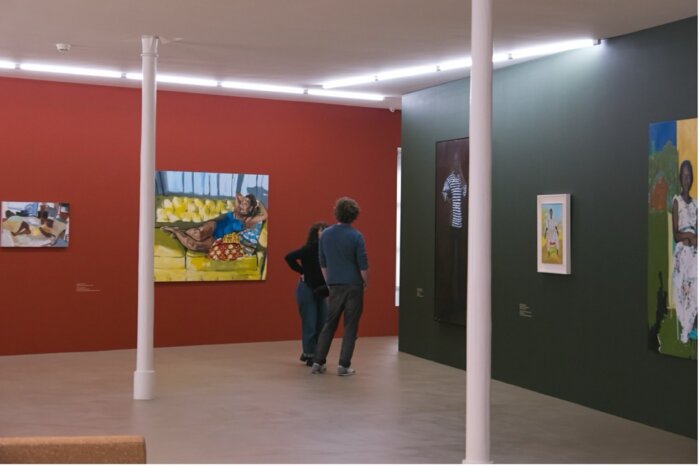
Black Joy in When We See Us is not only depicted on canvas, it pulses through the air, carried by laughter, stillness, side glances, quiet recognition. It is not confined to the art; it radiates between bodies. In the way visitors linger, the way conversations unfurl around a painting, the way people lean closer, smile, and gesture, a communal affect takes root.
The energy in the exhibition space is alive. It mirrors the vibrancy of the artworks, but also exceeds them. As Sara Ahmed writes, emotions do not reside within individuals; they move between us. [14] Joy circulates. It attaches itself to bodies, to proximity, to memory. In When We See Us, this circulation becomes visible as a contagious rhythm of pleasure, presence, and power. The paintings do not only show joy; they make room for it to happen in real time.
This is where the exhibition becomes something more than a curated narrative. It becomes a living encounter. Black visitors see themselves, their aunties, their cousins, their younger selves. They stand before these images and are reflected back not in suffering, but in radiance. For those accustomed to absence or distortion in institutional settings, this is no small thing. It is a reparation not of history, but of feeling.
I found myself drawn less to singular artworks and more to the room’s atmosphere: the way people inhabited the space, moved with it, became part of it. I remember watching a group of young Black students sitting cross-legged beneath a portrait of two women laughing over a shared drink. They were not analyzing the painting. They were with it, mirroring it, extending it. One of them tilted her head and said softly, “She looks like my mom.” That was it. No critique. No theory. Just memory, intimacy, and return.
This is the self-empowerment When We See Us offers not as grand declaration, but as quiet undoing of exclusion. It opens the archive of Blackness toward something tender, something collective. It lets joy spill beyond the frames and into the relational. It offers Black people not only the right to be represented, but the right to feel good in that representation.
For non-Black visitors, this too is a gift, not an invitation to appropriate, but to witness joy without demanding translation. The exhibition does not flatten or overexplain. It trusts that joy is legible through breath, color, rhythm. It creates an ethical aesthetic, one in which presence is not debated, but honored.
bell hooks reminds us that joy is an act of resistance. [15] And it is. But here, joy also becomes a methodology, a way of curating, of seeing, of being with others. In its structure, in its softness, When We See Us stages a practice of love that is collective, embodied, and unapologetically Black.
These moments of gathering, of being seen, of self-determination form the beating heart of the exhibition. They stand in stark contrast to the often painful narratives of Black history told in European institutions. And yet, they do not erase that history. They exceed it. Black Joy, as shown here, is not naïve. It knows where it comes from. But it insists on becoming something else. It looks back and forward. It holds the weight of the past without being crushed by it. In this way, When We See Us is not just an archive. It is a forecast. It asks: What kind of world becomes possible when we center joy? And answers: This one. This room. Right now.
_How to Cite
Serafina Andrew. “Black Joy as Cultural Resistance: On Celebration and Visibility in When We See Us.” On_Culture: The Open Journal for the Study of Culture 20 (2026). <https://doi.org/10.22029/oc.2026.1542>.

_Endnotes
- [1] Stuart Hall, “Cultural Identity and Diaspora,” in Colonial Discourse and Post-Colonial Theory, eds. Patrick Williams and Laura Chrisman (New York: Columbia University Press, 1994), 392–403.
- [2] Hall, “Cultural Identity and Diaspora.”
- [3] bell hooks, “The Oppositional Gaze: Black Female Spectators,” in Black Looks: Race and Representation (Boston: South End Press, 1992), 115–131.
- [4] Saidiya Hartman, “The Anarchy of Colored Girls Assembled in a Riotous Manner,” South Atlantic Quarterly 117, no. 3 (2018): 465–490.
- [5] Édouard Glissant, Poetics of Relation, transl. Betsy Wing (Ann Arbor: University of Michigan Press, 1997).
- [6] Tina Campt, Listening to Images (Durham: Duke University Press, 2017).
- [7] bell hooks, Art on My Mind: Visual Politics (New York: The New Press, 1995), 115; and hooks, “The Oppositional Gaze.”
- [8] Tina Campt, A Black Gaze: Artists Changing How We See (Cambridge, MA: MIT Press, 2021).
- [9] Audre Lorde, “Uses of the Erotic: The Erotic as Power,” in Sister Outsider (Berkeley: Crossing Press, 1984), 53–59.
- [10] Paul Gilroy, The Black Atlantic: Modernity and Double Consciousness (Cambridge, MA: Harvard University Press, 1993).
- [11] Saidiya Hartman, “The Anarchy of Colored Girls Assembled in a Riotous Manner,” South Atlantic Quarterly 117, no. 3 (2018): 465–490.
- [12] Kevin Quashie, The Sovereignty of Quiet: Beyond Resistance in Black Culture (New Brunswick: Rutgers University Press, 2012).
- [13] bell hooks, “The Oppositional Gaze.”
- [14] Sara Ahmed, The Cultural Politics of Emotion (New York: Routledge, 2004), esp. chapter 1, “The Contingency of Pain.”
- [15] bell hooks, “The Oppositional Gaze.”