Perrear hasta el piso or How to Dance Reggaetón in Germany


_Introduction: We Are Going to La Casa del Perreo
Before any farra [Spanish for ‘party’], I avoid listening to the music that will be played that night. Like a cabala [rituals and superstitions for good luck], I feel it is better to listen later. Los temas, the song’s hits, are to be enjoyed at the momento and not before. Instead, on the night of the party, I was listening to a podcast. The time was 21:04 and the train from Giessen to Frankfurt departed with a ten-minute delay. After fifteen minutes, I heard someone speaking Spanish. I turned to my left. A woman appeared to be talking on the phone. I could not identify her accent, but I was sure she was Latina. She ended the call and returned to her seat.
She might be going to the farra, I thought. The party tonight would be my second time in La Casa del Perreo, a Latin event created by a community of DJs (Mexicans, Colombians, Venezuelans, Ecuadorians, Peruvians, sometimes German DJs are invited). I have been following them for two years before I came to Germany. My first time at this farra was in winter, in early January. It was my first party after I arrived in Germany, and after seven months without celebrations. Then I wanted to dance. I was excited to see how Latin American people dance far from home, in the German winter. Inside, a crowd contrasted with the empty streets. Now, summer had come, and I had high expectations. I noticed how people change in summer. They seem more free and relaxed to me. What is more, the warm weather reminds me of the tropical mode of the Latin American Caribbean. The event was promoted on the collective’s social media as the best Latin party in the country, and hundreds of comments on Instagram concurred with this statement. [1]
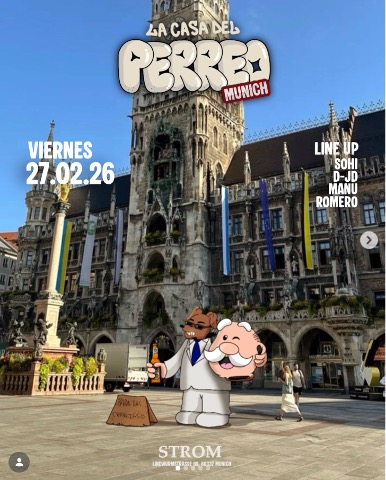
The venue, Fortuna Irgendwo, is situated in the heart of Frankfurt Ostend. The building used to be a boiler house built in 1906. From 1999 to 2013, it was the prestigious King Kamehameha Club, which won several awards in its heyday, such as “Bar of the Year.” After the pandemic, this venue became a disco. Instead of live music, it started to host various music events throughout the year, including La Casa del Perreo once a month.
I was alone on my way to the event because a couple of my friends had missed the train to Frankfurt. I took the tram to Hanauer Landstraße. At the stop, I heard different Latino accents. Then, I turned off my earphones. Everybody was going to the same farra. Suddenly, the woman who had been speaking on the phone on the train was standing in front of me. “Parce, even if we don’t make plans, we end up meeting each other,” Luis [2] told me out of nowhere. He appeared in front of me like a ghost. He is a Colombian friend. His friends, Sofía and Dana, who are German-Venezuelan, were with him. “Vamos a La Casa del Perreo, ¿sabes dónde es el bar?,” [3] Sofía asked me. “Of course, I know the way,” I said.
Reggaetón: Latin/Caribbean urban music from Puerto Rico. Born in the late 1990s and the mid-2000s. Reggaetón, says Zaire Zenit Dinzey-Flores, has “made public the plight of the urban poor in Puerto Rico and unearthed their potential.” [4] Currently, this Latino rhythm is recognized by its global impact in the cultural mainstream. The success of reggaetón can be seen in Bad Bunny’s recent glorious album, “DeBÍ TiRAR MáS FOToS.” According to Kelefa Sanneh, “[t]hanks in large part to Bad Bunny, Puerto Rican music is now a global phenomenon: you can hear his influence in the pop songs of Quevedo, a Latin-trap-inspired singer from Spain; in the echoey, propulsive tracks of Cris MJ, from Chile; in the danceable but bittersweet music of Beéle, from Colombia, whose intoxicating new album, “BORONDO,” draws inspiration from San Juan, Kingston, Lagos, and beyond.” [5]
_The Festive Experience in Latin América
Joy, hope, happiness, gozadera. In Latin America, the expression: vamos a celebrar, let’s celebrate, usually does not include a plan. There are a few exceptions of course, such as weddings, birthdays, and some catholic rituals, where planning is necessary. But I want to be honest: the best celebrations—I prefer to use the word fiesta or farra—I have experienced happened without a plan. That night, with Luis and his friends, we experienced this festive experience.
I, along with other Latino friends, have noticed that when we plan celebrations (or even meetings) with our European friends, we need to carefully plan everything in advance. Maybe I am overstating this behavior. Or I never stopped to think about this issue. I am aware that this idea could be a bit prejudiced. But the ‘no-planning’ element of Latin American festiveness always appears in our celebrations and festive times (except for music, as Latinos, we cannot imagine a celebration without it. In some regions, like Colombia and the Caribbean, we have traditional songs for celebrations, which differ from mainstream pop music. Music is necessary within this space of no-planning, like old radio stations where you listen to favorite music. Why? Well, it relaxes us). We experience this space as a joint improvisation. I know it can sometimes be tricky, but in improvisation we learn to handle things we did not anticipate. In Latin America, this space of uncertainty reveals a life aware of its environment, open to transforming its heart (in the negative or positive) because beyond this process, life remains and keeps moving forward. While writing these reflections, the absence of research on festive times in Latin American cultural studies surprised me. Going back to the main thought, as some reggaetón lyrics express, you do not know what will happen at the disco. But, if there is music, one thing is certain, there will be dance and enjoyment.
I remember being ten years old when I first listened to a reggaetón song. I remember trying to understand the beats and lyrics twenty years ago: “(Down!) Si no tengo de tu piel / (Down!) Si no tengo tu calor / (Down!) Si no tengo tu querer / Si no tengo de tu amor / Mami, yo me pongo down.” [6] I listened to it once, twice, three times. I did not understand the sexual references or the message about heartbreak because I had never fallen in love. Nevertheless, this music exploded in my ears, and I did not know why. I only knew that these vibes and bass lines were something attractive and a pleasure to listen to. Growing up, this song always made me reflect and connect with my inner self. These rhythms stay in my mind like an old treasure, an instant of my life when I was happy, free from adult concerns. I had never thought about this before, and it is only now while I am writing these lines that I have come to realize it.
Farra: also called fiesta, parranda, bonche, parranda, carrete, jolgorio, jarana, or, thanks to Bad Bunny, hangear, refers to hanging out with friends, alone, or unknown people, dancing for a couple of hours—or all night—and drinking alcohol or not. Sometimes a farra can be a special celebration, but it always requires music.
_How Reggaetón Became a Global Genre
As millennial Latinos, we live at the time of the rise and global explosion of reggaetón. The Latin American soul, if it exists, changed with this cultural and music movement. Something is bellacoso that resets our bodies and hearts and even affects those who refused to dance to reggaetón. (To understand what bellacoso means, I recommend watching the music video by Bad Bunny and Residente. [7]) I confess, I was one of those. I also recall my parents’ complaints when they listened to this music. Something immoral, unsuitable, illegal. These stigmas against reggaetón were born since its beginnings in Puerto Rico. Local authorities associated the music with drug dealers and criminality. As the music genre spread to other countries, these stigmas crossed the water and became ingrained in many Latin American families.
But now, we embrace the beat, the dembow (profane and highly seductive rhythms produced by Dominican DJs), and dancing hasta ‘bajo. Under late globalization, [8] this music has become a cultural symbol of our identity, accompanied by the tensions and contradictions that come with it—something that I will elaborate on later. I was able to fully enjoy the music once I stopped caring if I looked silly. Under the light of the dance floor, I remained as everybody sang each lyric from their heart, while dancing without fear. It was a place where I felt safe.
A recent study on reggaetón highlights the need to explore its socio-cultural expansion. Luisa Espinal, Silvia Díaz-Fernández, and Johnny Orejuela have noticed the lack of research on audiences and identity settings related to experiential practices, such as the perreo. [9] Moreover, while researching this _Perspective, I had difficulty in finding literature about the cultural meaning of reggaetón in recent years. Espinal, Díaz-Fernández and Orejuela observe that only 6 out of 69 academic articles explore the social and cultural dimensions of reggaetón. One insightful example is Ligia Lavielle-Pullés’ article. [10] In 2013, she conducted a series of interviews and focus groups with 75 young Cubans. She describes one of ambivalence I feel at the moment: I can enjoy the rhythm and the way my body moves while dancing, as well as the sexual aesthetic, but I dislike some of the lyrics. Additionally, Lavielle-Pullés notes that this ambivalence is more pronounced among young women than among men.
Among my friends, it is common to hear comments about the songs we do not like, but we still dance and enjoy them all night. Some of my feminist female friends are aware of the genre’s sexism. They criticize it, reflecting on the lyrics’ sexualization of their bodies, and dance hasta abajo, or as one of them told me, “Let’s embrace the contradiction perreando.” In my case, I am not a big fan of the first Bad Bunny album because I do not like trap music and could not connect with his lyrics. In comparison, I consider Bad Bunny’s sixth album “DeBÍ TiRAR MáS FOToS” to be a fantastic disco album and one of the best of its genre. Why? Because it is the first protest-political album since reggaetón became mainstream. He celebrates Puerto Rican culture and condemns the effects of U.S. domination over the island.
Returning to ambivalences, you learn to deal with them, especially when the girl or guy you like at the disco knows how to dance hasta el piso. In this context, the only way to meet is through dancing. Break the ice. Taking the risk and the first step within Latin American culture is inviting them to dance. How? Sometimes you ask; sometimes you look at them, and you just know. When I learned to perrear, my friend Monica told me: “To us, we like the guy who is convinced that he should be at the center of the dance floor.” Thereafter, I had to contend with the pressure of being that guy, although I never performed the role of a self-confident guy convinced of his own dance skills. However, as you listen to the beats, the rhythm, and lyrics, you see the movement of your dance partner and the flow lets you embrace the space between you.
“It is our first time in La Casa del Perreo,” said Sofía. “Well, I know where it is, so follow me,” I said. “Do you know where the venue is?” some Mexicans standing beside us asked. “Yes, follow me,” I answered. “Thanks a lot. And also, do you know if they sell tickets at the door?” another woman asked. “Don’t worry, this is a good time to arrive at the party if you want to buy last tickets. It will cost 20 euros, but you will get in,” I answered. “Thanks, parce, we’re following the Colombian.”
For twenty minutes during the ride, the tram only spoke Spanish. The few German people seemed to be looking at us askance. I recalled having the same feeling in January. Everybody laughed and shared their stories of being migrants. “I’m from Argentina, México, Uruguay, Ecuador, Colombia, Venezuela, Guatemala, Perú, Paraguay…” Despite our different backgrounds, we share this festive spirit. For a couple of minutes, the national boundaries disappeared. For us, this Latino party was not a simple farra. We shared the experience of traveling thousands of kilometers, learning a foreign language, and adapting to the German celebrations and holidays. But tonight, everyday German life was interrupted by some bailoteo.
Mexicans who were also looking for the venue (and whom we met on the tram) followed us to the farra. They were excited and wanted to get there quickly. “Are you sure this is the way?” said Dana. Hanauer Landstraße is a grey and old industrial area. One of the Mexicans told us that they did not have tickets. I explained again, “This is the appropriate moment to buy the remaining tickets.” The street was empty, and I could understand Dana’s concerns. “These alleys are safer than ours,” I said. When we arrived at Fortuna Irgendwo, the old factory chimney was not illuminated yet. It was 22:25. At this time, the farra had just started.
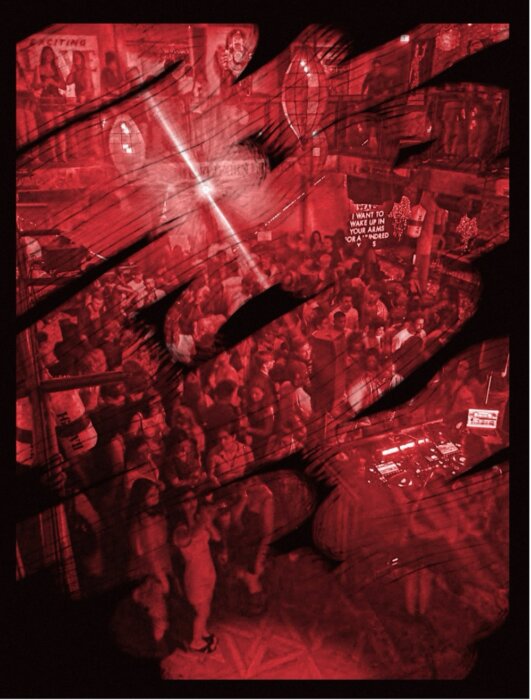
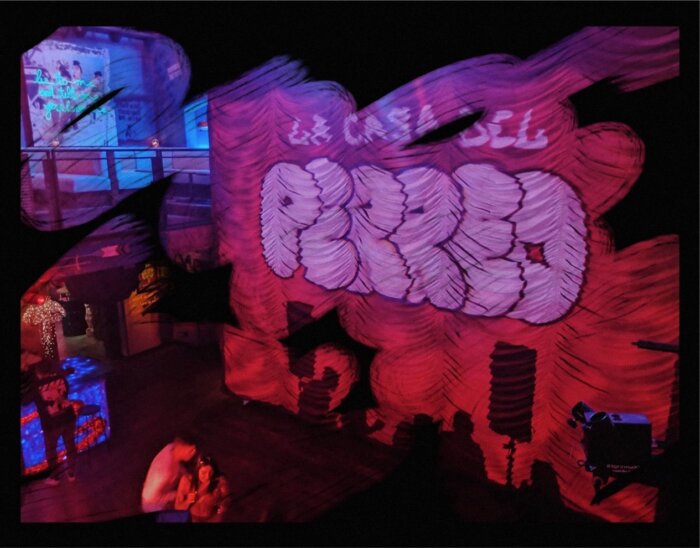
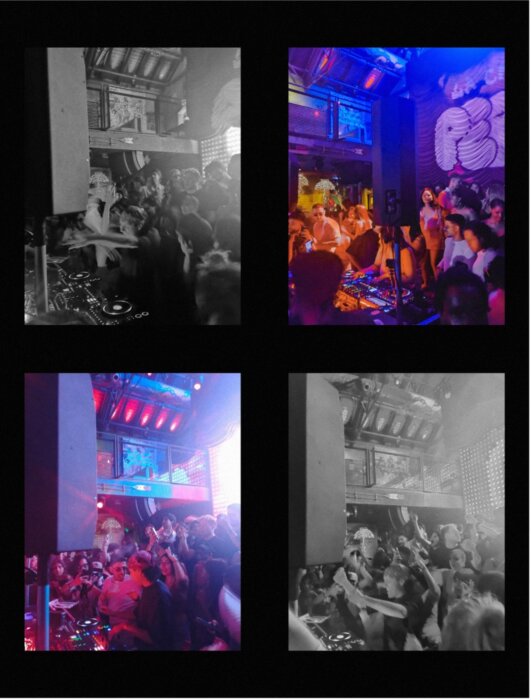
Together with Luis, Sofía, and Dana, I entered the building. The venue was still empty. “Some friends will join us later,” said Dana. A red light caught our eyes. A huge animation behind the DJs, with the brand La Casa del Perreo, invited everyone to dance. The space had two levels. The dance floor was in the center, with space to sit on the right. The smoking area was on the left. The second level had three balconies overlooking the dance floor, a wardrobe, and restrooms. Both levels had bars and tables where one could sit and chat over drink.
Perreo/perrear: if there is reggaetón music, there will be perreo. It is slow/fast hip movement, in a couple or alone, following the dembow and flow of the beat.
Hasta ’bajo/hasta el piso: A special hip and knee movement where your body must go down following the rhythm of the beat. Warning: if you are 30 or older, dance at your own risk.
_Why Did Reggaetón Spread to Germany? Tensions and Contradictions
When I discovered this community of DJs two years ago, I wondered how such events were possible in Germany. I remember the stories and joyful posts they made. Slowly but surely, the old rave and techno factories began to share their spaces with the Latin and Caribbean music scene. I wonder if the DJs of La Casa del Perreo were aware of the export of the Latin nightclubs experience.
I have read a few articles about the rave scene in Berlin and Frankfurt. In Techno Rebels, Dan Sicko writes that by the mid-1990s, “Germany was close to defining its own style of techno.” [11] Sicko describes that at that time Berlin was home to one of the most interesting music phenomena: the mythical group Basic Channel. At first, nobody knew their identities, as they avoided being photographed. According to Sicko, their music influenced the development of techno and house by incorporating Jamaican ‘dub’ principles.
German DJs were not the only ones hungry for musical experimentation. In Puerto Rico, marginalized young people started a music and cultural movement in the underground when the rave scene was at its peak. As told by Frances Negrón-Muntaner and Raquel Z. Rivera:
Drawing on U.S. hip-hop and Jamaican reggae, Spanish-language rap and reggae developed parallel to each other throughout the 1980s in both Puerto Rico and Panama. Although it was initially produced by and for the island’s urban poor, by the mid-1990s, reggaeton’s explicit sexual lyrics and commentary on the violence of everyday life had caught the ears of a wary middle class that responded to the new sound with its own brand of hostility. [12]
I find it fascinating how two different musical traditions interpreted the Jamaican dubs, and how their cultural and political backgrounds produced different forms of rituals and celebrations, centered around the collective experience at night, through dance and music.
While the differences and similarities between the techno-rave scene and reggaetón are not the object of this essay, I am, however, interested in the cultural function and shift that is at the heart of the development of both music movements. As Sicko writes in the conclusion of his book:
The real danger seems to lie with fetishism—when techno’s nostalgia and romanticism cross the line and inhibit its growth. Finding equilibrium may sound like a boring pursuit, but for techno it means existing at the center of a number of worlds, extremes, and paradoxes. [13]
What does this mean? When nostalgia emerges for electronic music, new DJs tend to romanticize the scene which hinders its growth. Well, is reggaetón also affected by this problem? No is the simple response; however, there is an unforeseen risk. Let us look at Bad Bunny’s rise to fame and the achievement of La Casa del Perreo to explain this idea better. The fact that Bad Bunny performed the 2026 Super Bowl halftime show demonstrates that reggaetón has reached mainstream status in culture. Bad Bunny appeals to Puerto Rico’s traditional music and re-signifies reggaetón values rather than coming down with nostalgia for ‘classic perreo,’ those lyrics and rhythms produced between 2000 and 2006. These songs spread the genre across Latin America and became instant hits. Even when he recycles one of these samples in the song EoO (the original rhythm belongs to “Perreo Baby,” by Hector & Tito, 2002) [14], the song seems original. Instead of fetishizing it, he mixes old traditions with his own new style. Rather than replaying mechanical samples, Tiny (Bad Bunny’s producer on this album) moved the melody to the next level.
In the case of La Cas del Perreo, the DJs disseminate the dembow across Germany and its neighbors (La Casa del Perreo has played sets in Paris, Amsterdam, Barcelona, and Vienna). It seems the reggaetón scene follows its path without apparent constraints. But what kind of farra are we recreating in the European night? What does dance mean outside of our barrios? And what does being Latino mean after all? I fear La Casa del Perreo’s DJs are falling into fetishism. To explain this idea, I want to share my experience. Together with my partner Katherine, I was traveling to Berlin, to attend two parties.
We travelled to Berlin in the spring. First, we went to a techno party together. Katherine wanted to experience the German rave scene, and I thought Berlin was the right place for it. We went to the OHM club at Köpenicker Straße on Maundy Thursday. At the main door, two bouncers looked at us for a few seconds. Then, they asked us: “Is this your first time here?” I answered them, “In this kind of club, yes.” One of them kept an eye on us while explaining some rules: we could not take photos or videos inside; we should dance respectfully with each other; and we should enjoy the night. They put stickers over our phone cameras.
I remember the vibrations of the bass rippling over my skin, the darkness of the long room, and the slow dance and jumps of the people. Each one maintained their distance, their private and safe space. ‘Dancing with myself.’ Everyone was in their own trance, lost in the basslines and the dry, deep beat produced by the DJs. They were each lost in their thoughts, liquid with passion for the red darkness of the dance floor. I recall there only being a few couples. We were one of them. We tried to follow ‘the rules’ of this club, but we kept braking them: we danced together, our skin melting together with slow hip movements to the rhythm of thumpers. I sensed eyes on us from every corner of the dark room. We were the only ones dancing in this mood.
The second farra was in Puro Barrio, also in Berlin, on Good Friday. This time, we did not sense any eyes on us. Everyone was dancing, pure perreo, bailoteo, sandungueo. Did I feel at home? But was that really it? Everybody danced to the commercial hits, on their own. I knew the songs and lyrics but they were not my favorites. Most of the songs was Colombian reggaetón. Of course, the DJs put on Bad Bunny songs, but these were the commercial ones. Even though I was excited with the farra, writing these lines, I am aware of some tension in regard to how we celebrate reggaetón culture here, in Germany. For instance, the DJs select songs and rhythms that are overproduced, a feature of Colombian reggaetón rather than the original from Puerto Rico.
Thirty years ago, techno developed because German DJs searched for new beats, experimenting with basslines, but the Jamaican dubs were the base for their inquiry. [15] At the time, their style privileged the abstraction rather than the body. By contrast, DJs from Panamá and Puerto Rico privileged the body and its possibilities of embodying the beats. [16] The distance between Jamaican dubs, dembow, and reggaetón seems minimal. In Latin music, the focus shifts to the body, its desires and landscapes of social and sexual marginalization. Beats function as expressions of excluded groups. These values, such as the exploration of sexual desire, reaffirmation of bodies, sense of belonging, were demeaned by the dominant Catholic culture, but DJs from Panamá and Puerto Rico embraced them as a starting point. [17] These DJs used samples, remixes of existing recordings, and electronically improvised sound effects to create the music for the marginalized and emerging youth from the caserios, los barrios, las residencias.
Reggaetón, says Dinzey-Flores, “emerged unsanctioned by society and grew out of the underground.” [18] At its beginning, Puerto Rico’s authorities blamed reggaetón for criminal conduct and linked it with drug trafficking. By the mid-1990s, police chased and repressed popular parties, local DJs, and producers. But the politics of morality could not bury the disco. [19]
Just like the rave and techno scene, reggaetón’s syncretism of multiple cultures attests to its limitless potentiality. Three features encapsulate reggaetón’s aura: first, its urban aesthetic. The Latin American city, with its violence and poverty, its gendered and racialized spaces, its ultra-masculine and patriarchal order, its redemption spaces and contaminated streets, constitute the core of the lyrics in reggaeton songs. [20] This urban aesthetic, says Dinzey-Flores, captures the experience of living in the cities of Puerto Rico, and by extension, in the cities of Latin America. [21]
Second, a masculine and heterosexual aesthetic. This feature has been the subject of severe criticism from a feminist and queer perspective. [22] In their music, the DJs and reggaetóneros construct a dualistic and complex urban landscapes in which the focus is on male sexual desire and their imaginaries through the city. For this reason, many reggaetón lyrics mention it as el barrio, caserío, la calle, and how they associate it with their maleness. For instance, on their home street, they feel like kings or the most popular among girls. How do they do this? The exploration of the body to the rhythm of dembow is inherently sexist. Many lyrics and temas are rooted in maleness. The genre privileges ultra-masculine landscapes. The disco, the bedroom, the home, women’s bodies are all regarded as territory dominated by men. [23]
Why then, despite its maleness and ultra-sexist lyrics, did reggaetón grow in popularity among young people? In their research, Escobar and Montalban find that young people are aware of the misogynistic lyrics, but the rhythms allow them to connect with and meet other people. [24] In other words, reggaetón promotes sociability among peers. In 2025, this misogyny in reggaetón culture and music constitutes a contradiction: people point out its sexist stereotypes, it’s “awful rhythm,” but they cannot refuse to dance to it. Instead of criticizing it and becoming moralistic, I prefer to live the contradiction while I am perreando hasta abajo.
Third, reggaetón music and culture celebrate themselves. Many temas focus on how people dance in the disco. La pista de baile [the dance floor], says Dinzey-Flores, has a double significance. On the one hand, the “[d]isco is a place to which to escape from the reality of the barrio, to rise above everyday problems, and reconstitute oneself as a powerful man in a Puerto Rican society that labels poor men or those living in barrios or caseríos as unworthy and threatening.” [25] On the other hand, Dinzey-Flores continues, reggaetón “is also a site for free expression and reflection, perhaps in ways that the educational system has not been for underprivileged youth.” [26] She also argues that the disco represents an opportunity for escape. I wonder how these values and meanings transform when the disco is not in Puerto Rico, but in Frankfurt?
Let us get back to Frankfurt. It was midnight. The disco was very crowded. We were on the dance floor beside the DJs. Luis said repeatedly that he did not expect it to be so crowded. In his experience (he came to Germany two years ago), these parties were always popular and well visited. Dana’s friends joined us thirty minutes prior, and we formed a circle to dance in our own space and in safety. At midnight, La Casa del Perreo was crowded. I remember having some difficulty walking in. While I was dancing, I observed the other couples, people dancing alone, not dancing, sitting and drinking, talking while dancing, losing themselves under the basslines and beats, singing with their whole heart when one of the sad reggaetón songs came on, drinking with pain, drinking without it, dancing hasta abajo, not dancing, and holding their beer, but above all men staring at girls, like vultures.
It was 1 AM. Our circle became tighter, but we could still dance. I saw a man handing out cards to girls. It seemed like his private data, looking like a black card marked with a special letter. What kind of man does that, I thought? Helena got one of these cards. She received it out of politeness, but she did not dance with him. He did not dance. Would he know how to dance? She only wanted perrear sola, as Bad Bunny sings. Other men tried talking to women without dancing. It was a courtship moment. European and Latino men are not so different when they want sex, I thought. The DJ played “Gasolina,” and everybody exploded, singing in collective chorus. How many times have I pretended to like this song, I wondered? Next song, different tune, same collective singing. People love commercial hits. The same three or five songs on Latin radio stations play over and over. We love it because it reminds us of the old days, when parties were in places forbidden by authorities and you tried to figure out how to dance. Maybe people idealized them, and for that reason, they go wild for them. I did the same thing.
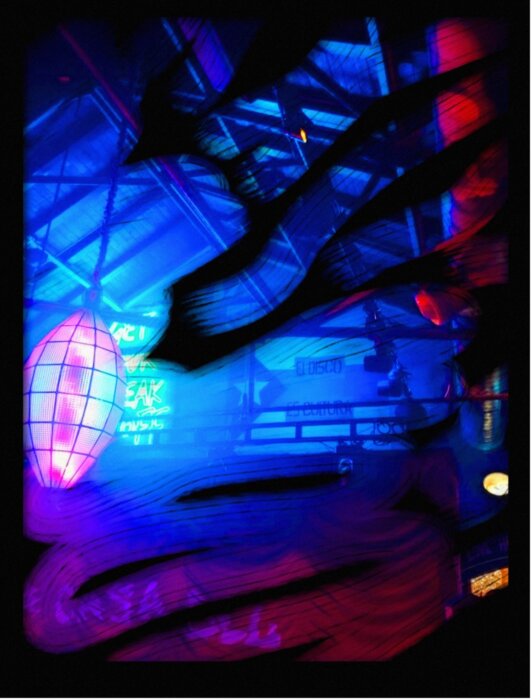
Sandungueo: To go out to a party and delight in nocturnal life. To celebrate with music.
Cábala: A ritual and superstition for good luck.
_What Remains After the Music Industry Exports Latin Products?
Reggaetón songs, their culture, and parties are self-referential. I had not thought about this feature before. “Dancing at the Disco” is a song I like. [27] Its lyrics are about sex, broken hearts, falling in love, love letters, betrayals, but they contain in themselves this festive experience at the disco, how to dance or ‘make love’ while we are dancing pegao. One criticism of reggaetón is that ‘all songs talk about sex’ or ‘all songs sound the same.’ [28] Both are true, but the ‘pop music formula’ explains this phenomenon. This hypothesis was developed by Panamanian DJ, Rodney Sebastian Clark Donalds, also known as El Chombo. He began his career at the age of 16 and became a producer of urban music in the 1990s, as well as an authority on reggaetón. His hypothesis suggests that the pop music industry in the mid-2000s required a new genre to sustain its global expansion and profitability. [29] Reggaetón, produced by Puerto Rican DJs, fitted the industry’s expectations. To understand this, we need to put the music in context.
The Jamaican dancehall developed a vast number of rhythms. In the mainstream, the best-known are “A who se me dun,” “Hot this year (or Tito in Panamá),” “Rich Girl,” “Bambam,” and “Pounder.” According to El Chombo, Puerto Rican DJs mixed the previous beats and used them as a music base for melodic rap. The new sound, a rhythm of ‘tum-pa tum-pa’ was put together and sold as reggaetón to the world. This formula repeats and repeats the music pattern until it is consolidated in different songs, such as “Gasolina,” “Atrevete-te-te,” and “Despacito.”
I remember turning on the radio in 2012 and hearing reggaetón’s ‘tum-pa tum-pa’ sound featured on Global Hits. In 2017, when “Despacito” became a global hit, the world sang along. However, it seemed that the Global North was only interested in Latino culture to merchandize it under the pop music industry’s formula. According to Petra Rivera-Rideau, the U.S. music industry emphasized reggaetón’s “newness,” since it “became marketed as the next big thing, a musical ‘revolution’ that would transform Latin music.” [30] Here, the pop music industry used the formula of eroticizing and exoticizing black and Latino performers in order to achieve broader success and reach the top charts. In this way, El Chombo put forward the argument that pop music is not a genre per se, rather it is the most popular music of any genre. [31] Pop music, for him, is a process where a music genre (like rock, R&B, reggaetón) is smoothed or diluted with the purpose of “sounding good” and reaching a broader audience. [32] Pop music industry globalized the male-dominated, sexually charged, urban Latin aesthetic, and its melodies and rhythms.
Bad Bunny began his career amid the wave of globalization of the genre, and he contributed to this process in his own style. Since 2019, he has dominated global music on Spotify and the Billboard Albums chart. Vanessa Diaz and Petra R. Rivera-Rideau have researched Bad Bunny’s success in their book P FKN R: How Bad Bunny Became the Global Voice of Puerto Rican Resistance. [33] They argue that a significant change took place with his last album, “DeBÍ TiRAR MáS FOToS,” which “celebrates Puerto Rican resilience and joy while simultaneously offering a searing political critique of US colonialism in Puerto Rico.” [34] The success of the album transformed him into a global phenomenon. They further argue, “Bad Bunny has deftly utilized his platform as a global superstar to advocate for Puerto Rico, building on the long tradition of infusing joy and protest into his music as a form of resistance. This is what makes him such an effective spokesperson for Puerto Rico.” [35]
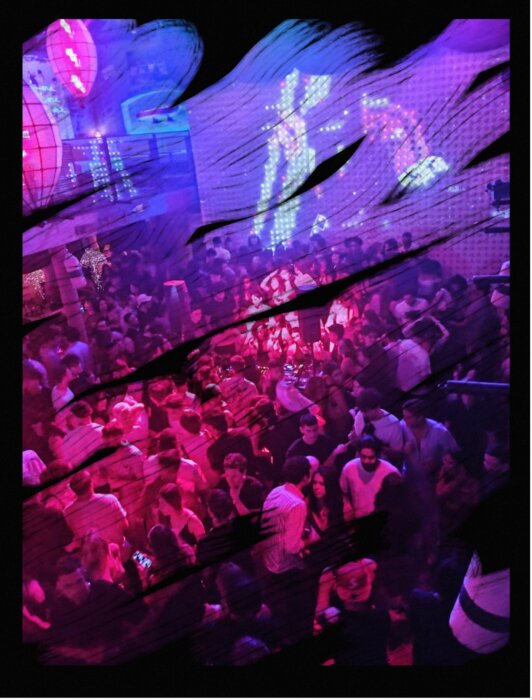
Bailar pegao/pegaito: Dancing at the disco with a partner, in close proximity, at a slow tempo, sexually charged.
_Last Words: The Nostalgia of Migrants when They Listen to Reggaetón
At La Casa del Perreo, I could not stop thinking that I was dancing to a product that a massive industry exported, where the festive experience is marketable. It is a farra for the Global North without el barrio, without racialized people. Of course, this thought was clearer while I was writing this essay. That night, we were a collective soul dancing to the Perreo Gods. This contradiction involves accepting that, as part of its globalization process, reggaetón music and its culture would lose the features that come from the people. I love something that is exported by the music industry and, to do it, reproduces its sexist stereotypes that I completely disagree with. As I previously mentioned, this music encapsulates expectations and desires of marginalized youths of Puerto Rican cities. After 20 years, these ‘underground’ values have become mainstream. I wondered whether we are celebrating their fetishization or some cultural process that we do not understand. Could it be a problem that DJs are playing the same reggaetón hits? Could the numerous comments on YouTube by Latino people claiming that no new music is made like old-school reggaetón be correct, and thus pointing to something symptomatic? Are we fetishizing our own culture, or is this phenomenon an emerging diaspora identity?
In La Casa del Perreo, I observed one tension and two contradictions. First the tension. This farra far away from our homes seems overproduced. Too many flashes with a lot of photos. And suggested to me sometimes the idea that I was here for superficial fun. A night for dancing, that’s all. A collision took place between the memories I had of my previous festive experiences and what was happening in front of my eyes. People here dance a little slower. Young Germans and Latin guys exoticize Latin American women, but they do not seem to want to dance with them. I observed many of them just standing in front of various groups of women, drinking and looking around, searching for something I did not understand. What was the reason they did not dance? Women, in contrast, loved every song and danced to all of them. Next, this space exposes a contradiction: men reproduced diluted values instead of absorbing the sexist attitude that some reggaetón songs promote. In other words, this means that at the reggaetón parties I’ve been to in Germany, men tend to reproduce a bad copy of the maleness that is so popular and necessary in the disco in Latin America. In Colombia, men, including myself, perform the roles suggested by the reggaetón lyrics. You take the first step and dance, flowing through the music. That night in Frankfurt, I could feel how some men tried to dance and seemed like a ‘macho,’ a ‘papi’ with the other girls. They looked for an opportunity to dance and being close to my friends, but they could not perform the vibes of Latin music.
Thus, the farra becomes a product to be consumed, to be enjoyed. It has the potential to disrupt everyday life, but it offers a superficial escape for one night. The second contradiction exposes how festive experiences from a migrant context are smoothed and readapted by the entertainment industry. For instance, this disruptive energy, which we can feel in Bad Bunny’s album “DeBÍ TiRAR MáS FOToS,” is diminished and reproduced as nostalgic imaginaries: the old barrio, childhood memories, old romances. On the album, Benito used his tradition and Puerto Rico’s history to create “forms of daily resistance to oppression and colonialism.” [36] In the migrant context, these values, even the sexist ones, are empty and disconnected from their context. I wonder if other Latin American migrants, like me, are aware of this stance, but the recent political circumstances, such as racism in Europe, ICE raids in the US, as well as the racist comments I experienced as a Colombian living in this country, make me think otherwise.
Despite these tensions and contradictions, I needed to dance hasta abajo. Everybody that night needed it. The reggaetón party is advertised as an inclusive event in Germany. These farras are creating a space where Latinos can get together (the problem of fetishization of experience requires more space to reflect it as we have seen in the previous section). One of the challenges I face as a migrant is a lack of spaces for socialization. La Casa del Perreo is a space where, for one night, I can recreate my old barrio, my old farras. I am aware that our nostalgia for home feeds this feeling of belonging to a community that in some moments seems an empty shell. I am aware that these parties perpetuate stereotypes about Latin Americans and promote ultra-masculinity and heterosexual values, flattening our festive experiences within the entertainment industry, and celebrating nostalgic memories disconnected from our social and political environment. As Escobar and Motabán argue, reggaetón music and its culture mediate Latin American socialization at such an event. These beats help social interaction among young people, although the lyrics do not represent their ways of thinking. Reggaetón music creates a feeling of belonging I cannot deny. This is one of the elements of celebrations and rituals; the festive experience produces a collective time, and that night, everybody was Latino.
The farra was over at 4 AM. The train back to Giessen was at 5:25 AM. The venue was still crowded. The lights went on. It showed on everybody’s faces that the farra had been as expected: bailar hasta el piso. On the dance floor, you have to keep moving until the last drop of sweat has fallen. Some people were still singing. On our ride back to Frankfurt Central, the whole tram spoke Spanish again. “When is the next party?” Luis asked me. “I don’t know,” I said. “The DJs announce it at the start of every month.”
_How to Cite

_Endnotes
- [1] On Instagram, these DJs are at @lacasadelperreo.eu. At time of writing, more than 42,000 people follow them. Every weekend, they post information about venues and future parties.
- [2] All names have been changed.
- [3] “We are going to La Casa del Perreo, do you know where it is?”
- [4] Zaire Zenit Dinzey-Flores, “De la disco al caserío: Urban Spatial Aesthetics and Policy to the Beat of Reggaetón,” Centro Journal XX, no. 2 (2008): 35–69, here: 44. <https://www.redalyc.org/pdf/377/37712148002.pdf>. Translations by author.
- [5] Kelefa Sanneh, “Bad Bunny’s Puerto Rican Homecoming,” in The New Yorker, September 15, 2025. <https://www.newyorker.com/magazine/2025/09/22/debi-tirar-mas-fotos-bad-bunny-music-review>.
- [6] “(Down!) If I don’t have your skin / (Down!) If I don’t have your warmth / (Down!) If I don’t have your wish / If I don’t have your love / Mami, I feel down.”
- [7] Residente and Bad Bunny (@Residente), “Bellacoso (Official Video)” YouTube, July 26, 2019, <https://www.youtube.com/watch?v=46rJ4y2kdow>.
- [8] The term late globalization describes that “globalization is also happening in informal ways in entities that cannot be considered as nation-states or industrial entities.” Romeo V. Turcan, “Exploring Late Globalization: A Viewpoint,” Markets, Globalization & Development Review 1, no. 2 (2016): 1–17, here: 8. I use this term to point out that global connections, the exchange of ideas and values, and economic transactions are unequal and heterogenous across the world. The current phase of globalization is characterized by digital connections and the rapid spread of cultural artifacts on social networks, such as reggeatón, which became popular almost instantly. For more insights into this discussion see Robert N. Gwynne and Cristóbal Kay, eds., Latin America Transformed: Globalization and Modernity (New York: Routledge, 2014).
- [9] Luisa Fernanda Espinal Ramírez, Silvia Díaz-Fernández, and Johnny Orejuela, “Research Trends about Reggaetón and Future Fields of Knowledge of an Expanding Sociocultural Phenomenon,” Cuadernos de Música Iberoamericana 37 (2024): 425–444, here: 437. <https://revistas.ucm.es/index.php/CMIB/article/view/99810/4564456571584>.
- [10] Ligia Lavielle-Pullés, “Del horror a la seducción: Consumo de reguetón en la conformación de identidades musicales juveniles,” Revista LiminaR: Estudios Sociales y Humanísticos 12, no. 2 (2014): 112–128.
- [11] Dan Sicko, Techno Rebels: The Renegades of Electronic Funk (Detroit: Wayne State University Press, 2010).
- [12] To follow the social and political context of Puerto Rico, I recommend the text “Reggaeton Nation” by Frances Negrón-Muntaner and Raquel Z. Rivera. In it, they describe how the music emerged amid political censorship. Frances Negrón-Muntaner and Raquel Z. Rivera, “Reggaeton Nation,” Nacla (blog), November 26, 2007,<https://nacla.org/reggaeton-nation/>.
- [13] Sicko, Techno Rebels, 143.
- [14] See <https://www.whosampled.com/Hector-%26-Tito/>.
- [15] Sam Jeans, “How Jamaican Sound Systems Influenced Modern Electronic Music,” Sample Focus Blog, December 9, 2025, <https://blog.samplefocus.com/blog/how-jamaican-sound-systems-influenced-modern-electronic-music/>.
- [16] Dinzey-Flores, “De la disco al caserío,” 57.
- [17] Clark Donalds Rodney Sebastian (@ElChombo_official), “El Chombo presenta: Quién inventó el patrón rítmico ‘Tumpa Tumpa’? (Dembow–Pounder)” YouTube, November 14, 2019, <https://www.youtube.com/watch?v=htkI1ZDcOs0>.
- [18] Dinzey-Flores, “De la disco al caserío,” 51.
- [19] Negrón-Muntaner and Rivera, “Reggaeton Nation.”
- [20] Dinzey-Flores, “De la disco al caserío,” 47.
- [21] Dinzey-Flores, “De la disco al caserío,” 48.
- [22] Anna Kopecka, “Feminism within Reggaeton Music: How do Female Artists Appropriate Reggaeton Scene as Space for Feminist Agency?,” Master’s Thesis (Leuven: Katholieke Universiteit Leuven, 2015). <https://www.academia.edu/13989113/Feminism_within_Reggaeton_Music_How_do_Female_Artists_Appropriate_Reggaeton_Scene_as_Spa-ce_for_Feminist_Agency>; Silvia Martínez, “A vueltas con el reggaeton: polémicas feministas en torno a las músicas latinas en España,” Trans26 (2022): 1–18, <https://www.sibetrans.com/trans/public/docs/10-silvia-reggaeton.pdf>; Arrieta Nancy Gómez and Toby Miller, “Reggaetoneras: Undermining or Embracing Male Fantasy?,” Feminist Media Studies 23, no. 8 (2022): 3832–3847, <https://doi.org/10.1080/14680777.2022.2140357>.
- [23] Dinzey-Flores, “De la disco al caserío,” 51.
- [24] Silvia Escobar Fuentes and Manuel Montalbán Peregrín, “Relaciones de género en el discurso del reggaetón entre adolescentes,” Athenea Digital: Revista de Pensamiento e Investigación Social21, no. 3 (2021): 1–20, here 16, <https://doi.org/10.5565/rev/athe-nea.2960>.
- [25] Dinzey-Flores, “De la disco al caserío,” 39, emphasis added.
- [26] Dinzey-Flores, “De la disco al caserío,” 40.
- [27] I remember hearing this song on the radio. Now, it is considered a classic of the genre. Daddy Yankee, Baby Rasta & Gringo, Kendo Kaponi, Ñengo Flow, Farruko, Kyza, Arcangel, De La Geezy (@Daddy Yankee), “Llegamos a La Disco (Video Oficial),” YouTube, September 10, 2011, <https://youtu.be/x6UODla2hqE?si=-LuN4vxz16fvEz5h>.
- [28] For instance, Carolina Gutiérrez-Rivas suggests that women often interpret reggaetón lyrics as promoting sexual violence and produce an image of women as objects. Carolina Gutiérrez-Rivas, “Estudio exploratorio sobre la construcción de la violencia de género en las letras del reggaetón interpretado por mujeres,” Núcleo 22, no. 27 (2010): 49–70.
- [29] During and after the pandemic, El Chombo presented a discussion within the Latin Pop music industry under the title “Is Reggaetón Over?” He released different videos on YouTube about this topic. His engagement and the millions of views confirm the debate around it. These videos reference internet jokes and memes to explain his arguments with humor. I share some of his views because he highlights a feature within the cultural history of this genre: its connection to market globalization and the dissemination of Latin American urban aesthetics through the pop music industry. Clark Donalds Rodney Sebastian (@ElChombo_official), “El Chombo presenta: El Fin del Reggaeton,” YouTube, February 4, 2021, <https://www.youtube.com/watch?v=GcLTPGu6uwE>; Clark Donalds Rodney Sebastian (@ElChombo_official), “El Chombo presenta hablemos de Música Urbana,” YouTube, October 28, 2021, <https://www.youtube.com/watch?v=TeSz9PZWkhg>.
- [30] Petra Rivera-Rideau, Remixing Reggaetón: The Cultural Politics of Race in Puerto Rico (Durham: Duke University Press, 2015), 131.
- [31] Clark Donalds Rodney Sebastian (@ElChombo_official), “El Chombo Presenta: La música que movió a la generación de los 00’s,” YouTube, February 15, 2022, <https://www.youtube.com/watch?v=Kspxm35hwbw>.
- [32] Molusco TV (@MoluscoTV), “El Chombo le contesta a Ozuna, Anuel y Molusco si el Pop es un género SI o NO,” YouTube, February 1, 2021, <https://www.youtube.com/watch?v=hwzVV3lzoXM>.
- [33] Vanessa Díaz and Petra Rivera-Rideau, P FKN R: How Bad Bunny Became the Global Voice of Puerto Rican Resistance (Durham: Duke University Press, 2026).
- [34] Díaz and Rivera-Rideau, P FKN R, 4.
- [35] Díaz and Rivera-Rideau, P FKN R, 10.
- [36] Díaz and Rivera-Rideau, P FKN R, 6.