Between Tulle and Tears
Ritual Practices of Bridal Fashion


1_Introduction
What should I wear? This may be an everyday question, but it becomes even more significant on special occasions—particularly during rites of passage, such as weddings. Above all, the choice of a bridal gown is at the center of attention, which is also reflected in diverse (social) media portrayals: guidebooks and fashion blogs offer advice on how to find the perfect wedding dress. Daily broadcasted TV series accompany brides-to-be on their search for a dress. [1]
This multitude of media formats, and the “heterosexual imaginaries” [2] depicted therein, have been the subject of extensive research in the Anglo-American world, [3] but have received comparatively little attention from German-speaking researchers. The few anthropological and sociological studies on contemporary marriage practices and rituals in German-speaking countries only consider wedding fashion marginally, if at all. [4] This _Article addresses this desideratum and focuses on the various levels of meaning and attributions of bridal fashion, expressed not only in the acquisition of bridal apparel, but also on the wedding day itself and after the marriage ceremony. My argument therefore moves along these three levels, starting with the acquisition of the bridal outfit as part of the wedding preparations, followed by fashion practices on the wedding day itself, and finally ending with the post-wedding phase. The following questions are central to this analysis: what kind of ritualized practices surrounding bridalwear can be currently observed? Which attributions of meaning—individual as well as medial—are recognizable and what role does the bridal gown play as a vestimentary object within the broader context of the wedding?
These research questions will be addressed through a multi-sited ethnographic approach, [5] accounting for the diverse backgrounds of the participants and incorporating queer perspectives as well as the experiences of (post)migrants. My work on this project has been ongoing since 2017; the material I have collected empirically therefore dates back to that point in time. My research focuses on the Augsburg area in Germany, which lends itself as a focal point for research, not least due to its transnational “Brautmodenmeile” [bridal fashion mile] [6] and its historical significance as a former center of the textile industry.
The aim of this _Article is to highlight the specific value of bridal fashion as a (vestimentary) ritual practice. By interweaving empirically collected data with approaches from ritual and fashion theory, I will argue that ritual fashion practices are clearly distinct from those of everyday fashion.
2_Starting Point: The Ideal of the ‘White Wedding’
It is worth examining statistics and the current state of research to contextualize the role of the vestimentary object of the bridal dress within the broader context of the wedding.
Although “die Ehe für alle” [marriage for all] [7] has been possible in Germany since 2017, the total number of marriages has fallen since then: While there were still 449,466 civil marriages recorded in 2018, there were only 349,216 marriages in 2024. [8] According to a market research study by WeddyPlace, 35.3 percent of respondents also had a non-religious wedding ceremony, while 30.9 percent had a wedding ceremony in a place of worship. The remaining 33.8 percent were married “only at the registry office.” [9] As the number of marriages declines, the budget that couples plan for their wedding is increasing. In 2013, a study commissioned by the mail-order company Zalando determined an average wedding budget of €8.272. [10] This figure had risen to €15.500 Euro in 2024, according to WeddyPlace. [11] Both studies also explicitly ask about the budget for the wedding dress (but neither of them asks about alternatives to ‘the white gown,’ or even about the spouse’s outfit). In 2013, respondents spent €973 on the dress (and €152 on shoes) and in 2024, an average of €1,358 was spent on the bridal dress. Given these surveys and their results, [12] it is hardly surprising that the wedding market has experienced a veritable boom since the 1990s. In addition, the range of wedding-related services has multiplied.
The same applies to media attention: in the German-speaking world of the 1990s, the extremely successful TV show Traumhochzeit [Dream Wedding] was particularly significant. Millions of viewers watched the surprise proposals and the wedding ceremony of the winning couple at the end of the show. Nathalie Iványi and Jo Reichertz show how the script of the ‘white wedding’ is enacted there through a variety of ceremonial practices and props. [13] The 2000s also saw the release of several Hollywood films such as The Wedding Planner (2001) and 27 Dresses (2008), complemented by additional TV formats. The U.S. documentary soap My Perfect Wedding Dress(since 2010), has been broadcast in Germany since 2013, both on the Sixx channel and on streaming platforms such as Joyn. The German counterpart Zwischen Tüll und Tränen [Between Tulle and Tears], which accompanies future brides as they shop for dresses, has been broadcast daily (!) on the VOX channel since 2016. To date, the series has produced over 1,500 episodes. [14] Due to this success, a spin-off Das Duell—Zwischen Tüll und Tränen [The Duel—Between Tulle and Tears] has aired since 2022. Online and social media offerings range from advice and inspiration platforms (such as Pinterest); to digital wedding planners and fashion, decoration, and lifestyle magazines; not to mention the media-staged royal weddings and celebrity weddings discussed in minute detail by the tabloid press.
At the center of this commercialization and mediatization of weddings outlined here is the ‘white wedding’ as the dominant cultural pattern. Cultural scientists agree that this is a “historisch gewachsene, geschlechtlich codierte und kulturell hegemoniale Form der Verheiratung” [historically evolved, gender-coded, and culturally hegemonic form of marriage]. [15] Following this heteronormative ideal, the bride dressed in white takes center stage, while the groom in a dark formal suit, tuxedo, or tailcoat recedes into the background—and not only visually. Bridesmaids and groomsmen, wedding rings, floral arrangements or decorations, the handing over of the bride, and the honeymoon are further components of this idealized script. “Whether or not the gown is white, the pervasive ideal expressed through the gown is the ‘fairy tale’ or ‘princess’ wedding dress. The widely held view in Western culture is that the wedding day is the bride’s day to shine,” [16] as Australian marketing researchers Katherine Sykes and Jan Brace-Govan note.
British and U.S. costume historians locate the beginnings of this cultural pattern in the nineteenth century, linked to the growing influence of commercialization processes on ritual practices and dress:
The increasingly commercialized and fashion-driven aspects of socially-appropriate or moral dress is made particularly manifest in the industries that develop around two of the most profound social rituals in the nineteenth century: weddings and funerals. Both have traditionally held familial, religious, and legal significance, and these […] codifications have long given form to the practices and attire. Yet it is within this period that we see industries developing in order to create and then serve the needs for both these rituals, with appropriate consumption and display in many ways replacing what had been legal or moral obligations. [17]
Parallel to these developments, one can also observe a (non-linear) process of the bridal gown’s becoming white. Victoria, Princess of Great Britain and Ireland, is invariably cited as a forerunner. She married Prince Albert of Saxe-Coburg and Gotha in 1840. Her bridal robe—a dress of cream-colored silk satin with lace trim, a narrow waist, and a wide, flared skirt—is considered a trendsetter for western European wedding fashion. [18] In the mid-nineteenth century, urban brides who followed the neoclassical style often wore white chemise dresses. After that fashion subsided, the white dress was taken up in bourgeois circles at the end of the nineteenth century. It was attributed a higher moral symbolic value as an emblem of purity and chastity. [19]
However, historical (bridal) dress research faces a source problem that makes it difficult to trace the development toward the white wedding gown: only the clothing of the wealthy social classes is documented from the early modern period. Until the 1940s, wedding garments of the poorer, rural population were often worn throughout life as festive and/or mourning attire and were accordingly worn down. [20] Until the beginning of the 20th century, there was no widespread use of light-colored or even white wedding dresses in German-speaking areas. For a long time, there were significant differences between urban and rural populations. So called Trachten (traditional costumes in rural areas) were varied and colorful. Dark colors, however, were often the basis of festive attire or churchgoing dress. Black increasingly became the color of high ecclesiastical or private celebrations and holidays, with a primary focus on the reusability of clothing. [21] Only after the Second World War, and with increasing societal prosperity, did white assert itself as the exclusive bridal color. The bridal dress then moved further into the center, while the distinguishing feature of head adornment receded.
Headwear provided the primary distinction between the bride and the rest of the female wedding party. The bridal crown, for instance, remained an important component of bridal apparel into the nineteenth century: the more splendid and valuable, the higher the standing of the bride and her family. Until the seventeenth century, it was reserved for daughters of the nobility and patriciate; among brides of the middle bourgeoisie one spoke merely about an Aufsatz [cap] or a niedriger Perlenkranz [low pearl wreath]. From the eighteenth century, urban brides increasingly replaced crowns with floral wreaths, especially made from myrtle and orange blossoms. And while the crown or bonnet (in its many variations) continued to be worn in rural areas until the nineteenth century, among bourgeois brides the white veil also came into fashion. Its spread, however, varied regionally: in Berlin, for example, the veil was not established until the early/mid-twentieth century. [22] Head adornment thus changed from bridal crown to a wreath, then to a white veil (combined with a black dress). [23] In a study on wedding apparel in southern Germany in the 1930s and 1940s, cultural scientist Helga Hager provides the following definition:
Das Hochzeitshabit hat einen zeremoniellen Charakter; es ist mit festen Bedeutungszuschreibungen belegt und wird mit Bedacht gewählt. Als wichtiges ‚Requisit‘ eines herausragenden „rite de passage“, eines bedeutsamen „Akt(es) sozialer Kommunikation“ unterliegt es einem besonderen Anspruch von Würde und Angemessenheit.
[The wedding attire has a ceremonial character; it is endowed with fixed attributions of meaning and is chosen with deliberation. As an important ‘prop’ of an outstanding “rite de passage,” a significant “act of social communication” it is subject to particular demands for dignity and appropriateness.] [24]
Hager deliberately avoids identifying color schemes here, and instead points to the ceremonial character of wedding apparel and the associated ritualized practices in the context of the rite of passage. She describes historical bridalwear as an important prop, but not (yet) the central focus of a wedding.
Since the postwar period, however, the global economic and commercial mechanisms mentioned above have an increasing impact on the production and distribution of fashion, and thus also on bridal fashion. The media dissemination of ‘white weddings’ through film and television has also gained significance. To this day, references to the famous Sissi trilogy starring Romy Schneider and Karlheinz Böhm (1955, 1956, 1957) can be found in the German-speaking bridal fashion industry. So-called Sissi-Brautkleider [Sissi-dresses] stand synonymous for expansive, richly decorated, glittering robes akin to a fairy-tale princess. [25]
However, the institution of marriage and therefore also the traditionally valued white wedding dress lost significance because of the social movements of the late 1960s, particularly the women’s movement. The 1980s saw the continuation of this trend. Nevertheless, the ‘white wedding’ in its expansive, commercialized and sometimes extravagant form has been on a global triumphal march since the late 1990s. [26] Cele Otnes and Elizabeth Pleck, whose study focuses primarily on North America, also emphasize regional and cultural inflections of this global phenomenon:
For if the lavish wedding does attract most of the world’s couples to the offerings of luxury consumption, it also reinforces and transforms multiple meanings embedded in local culture, from the importance of prestige to ideas about beauty, fertility, kinship, social obligation, and national belonging. [27]
Hilde Schäffler—with regard to Austria—rather speaks of a circulation of images, imaginations, and elements consisting of diverse cultural fragments, often traced back to European regions and strongly influenced by the U.S. wedding industry. [28] Following U.S. sociologist Chrys Ingraham, this wedding-industrial complex is strongly influenced by the “heterosexual imaginary,” [29] which partially contrasts with diverse forms of contemporary relationships. She argues, “the wedding market ‘needs’ the fantasy of the once-in-a-lifetime extravaganza/spectacle or it would cease to exist.” [30] Nevertheless, Fleur Weibel’s current micro-sociological study of wedding practices in Switzerland confirms that this ‘heterosexual imaginary’ is not just fiction, but also a practice that has been realized—at least in terms of clothing:
Während mit den symbolisch aufgeladenen, ebenso romantisierten wie traditionell-heteropatriarchalen Praktiken der Hochzeit unterschiedlich umgegangen wird, lässt sich bezüglich der Kleidung der heterosexuellen Brautpaare eine ausgeprägte Betonung von Weiblichkeit und Männlichkeit, von deren Differenz und Komplementarität beobachten. Dass die Inszenierung der Braut in Weiß (wieder) sehr beliebt ist, zeigt sich nicht zuletzt daran, dass sich neben acht heterosexuellen Bräuten auch drei lesbische Bräute für ein weißes Brautkleid entscheiden.
[While the symbolically charged, romanticized, and traditionally heteropatriarchal practices of marriage are dealt with in different ways, the clothing worn by heterosexual couples shows a pronounced emphasis on femininity and masculinity, their differences and complementarity. The fact that the bride in white is (once again) very popular is evident not least in the fact that, in addition to eight heterosexual brides, three lesbian brides also opted for a white wedding dress.] [31]
Further indications that the partially individualized concept of a white wedding still exists today is provided by a 2024 study conducted by a German wedding planning platform, in which 88.7 percent of the 634 bridal couples surveyed stated that they had married “in Weiß” [in white]. [32]
Although the total number of marriages in Germany has been decreasing, reaching its lowest level since 1950 in 2024 with only 349,200 registered weddings, [33] marriage continues to hold social significance in the 21st century. It has not declined to the extent that scientists had predicted in view of increased separation, divorce rates and the “teilweise als dramatisch wahrgenommenen Wandels im intimen Zusammenleben” [sometimes perceived-as-dramatic transformation of intimate living arrangements]. [34]
Therefore, it would be short-sighted to equate the described (commodification) processes of the ‘white wedding’ only as a product of commercial exploitation. Rather, these are shifts in meaning and changed monetary as well as cultural valorizations evoked by ritualized practices, which still suggest that marriage is considered an extraordinary event. However, this is not just a single event, but a ritualized process. Ronald Grimes directs attention especially to the phases before and after the wedding:
Both the preparation and aftermath of a wedding are ritualized, patterned like filings dancing around a magnet, pulled into orbit by the force of ceremony and celebration. If we consider ritual only the momentary and concentrated action in a set-aside place, we overlook the more diffuse wake of its ritualization. [35]
These (fashion) rituals, which are performed partly individually and partly collectively, will be examined in more detail below.
3_Theoretical Context: The Bridal Dress as Ritual Object
Bridal fashion cannot be considered apart from the overarching framework of marriage as a rite of passage, which is why a ritual-theoretical classification is provided here.
Scholars currently discuss to what extent a marriage—under conditions of commercialization, globalization, digitalization, individualization, and eventization—can still constitute a profound, lifelong transition. [36] Rosemarie Nave-Herz characterizes marriage rather as a “rite de confirmation,” [37] that attests to the couple’s intention to enter a lasting love relationship and thus eludes social uncertainties. The sociologist Stephanie Bethmann adds the following observation:
Die Heirat, eine in der Gegenwart allen anderen Voraussagen zum Trotz immer noch mächtige Institution, weist den Liebenden einen sichtbaren und anerkannten Platz in der Gemeinschaft zu—und produziert dabei Ausschlüsse. Sie ist ein Anerkennungsritual par excellence.
[Marriage, an institution that remains powerful despite all current predictions to the contrary, assigns lovers a visible and recognized place in the community—and in doing so produces exclusions. It is a ritual of recognition par excellence.] [38]
Folklorist Andreas Bimmer points out both the change and the current relevance of transitions:
Dennoch, Übergänge sind keine Fiktion, es gibt sie und sie haben relevante Funktionen im Kulturprozess. Es sind aber teilweise andere geworden als die, mit denen sich van Gennep beschäftigt hat. […] Die Übergänge haben zugenommen, sie sind jedoch weniger eindeutig geregelt. Es sind nur Übergänge in neue Teilwelten.
[Nevertheless, transitions are no fiction; they exist and have relevant functions in the cultural process. However, some of them have changed from those van Gennep dealt with. […] Transitions have increased, but they are less clearly regulated. They are only transitions into new sub-worlds.] [39]
Following this observation, Arnold van Gennep’s tripartite approach to rites of passage is still valid, albeit in a modified form. This approach consists of “ceremonies whose essential purpose is to enable the individual to pass from one defined position to another which is equally well defined.” [40]
They mark extraordinary events that are experienced by the actors as transitions from one social and/or physical state to another. Van Gennep divides rites of passage (ideally) into separation, liminality and integration phases. The first signifies a farewell to the previous social status (e.g., being single); the second, a state of in-betweenness (e.g., the engagement period); and the last, the integration into the new community (as married). In broader terms, this model also proves useful for the present analysis. “But the notion that rites are built on tradition is half the truth. The other half is that rites of passage are constantly being reinvented in the very process of being enacted.” [41] This becomes clear in the following, as the respective brides refer to stereotypical ideas of traditions (even rejecting them), but also adapt ritual actions and objects to contemporary and individual needs.
Rituals in general are “Handlungen oder Handlungskomplexe, deren Abläufe formalisiert, zeitlich und räumlich begrenzt sind sowie durch die Verwendung symbolischer Äußerungen und/oder Objekte spezifische Zwecke verfolgen” [actions or sets of actions whose sequences are formalized, limited in time and space, and pursue specific purposes through the use of symbolic expressions and/or objects]. [42] Mirko Uhlig additionally advocates an expanded concept of rituals to do justice to the complex and pluralistic developments in contemporary society. This broadened understanding of rituals encompasses not only religious or spiritual collective actions, but also secular phenomena, such as fashion and shopping practices. [43]
Mode geht nicht nur in den materiellen Objekten auf, sondern sie ist das, was wir mit diesen Objekten machen. Mode entsteht in sozialem und ästhetischem Handeln; sie realisiert sich […] in ‚cultural performances‘ wie Modenschauen, Filmpreisverleihungen, Vernissagen etc.
[Fashion does not only reside in material objects, but it is about what we do with these objects. Fashion arises from social and aesthetic activity; it manifests itself […] in ‘cultural performances’ such as fashion shows, film award ceremonies, vernissages, etc.] [44]
Fashion theorist Gertrud Lehnert’s understanding of fashion focuses primarily on the interaction between people and vestimentary objects and therefore on the process of symbolic action with artifacts. [45] This approach is particularly well-suited to the analysis of ritualized practices of bridal fashion.
As dress historian Lou Taylor indicates, in the context of Anglo-American dress and fashion history, the terms ‘dress’ and ‘fashion’ [46] are considered to have different meanings since they have emerged out of different disciplinary bases. [47] The former has by large been studied within an art historical approach in relation to the interpretation of dress in the context of museums. [48] ‘Fashion’ is mainly associated with the rise of modernity in the West, with its accompanying social and political change and a quickening of time, which has been criticized for privileging fashion as Western construct. [49] Taylor notes: “Thus, today dress history and fashion studies are now subject areas that embrace the study of dress and textiles from all over world with equal respect, seeking an equal understanding of their specific forms of tradition, modernity, and fashion.” [50]
As this study takes an empirical approach and focuses on contemporary practices surrounding Westernized bridalwear (rather than an historical, object-based analysis), the term fashion is preferred here. Following Lehnert’s understanding of fashion, as a “Kombination aus spezifischen, nämlich verstimentären materiellen Artefakten und der sich in ihnen manifestierenden Dynamik” [combination of specific, namely vestimentary material artifacts and the dynamics manifested in them], I argue that contemporary wedding apparel is part of an overarching fashion system consisting of production, distribution, and reception. [51] Nevertheless, there are variations, which will be further outlined below.
Extraordinary events like weddings are particularly marked by occasion-specific fashion practices. Regarding ritualized forms of sociability, or “rauschhafte Vergemeinschaftungen” [ecstatic communalization], sociologist Yvonne Niekrenz points to specific, self-referential, and extraordinary aesthetics beyond constraints of functionality and utility. [52]
Rituals are thus accompanied not only by symbolic actions and/or language and music, but (vestimentary) objects also play a significant role. “Artifacts, which can often take the form of consumer products, communicate symbolic messages that are integral to the meaning of the ritual. […] the role of the wedding gown is significant beyond being a garment,” emphasize Katherine Sykes and Jan Brace-Govan. [53] They state: “It is also the Western bride’s responsibility to choose and direct the component parts of the wedding ritual. […]. Thus, the bridal gown is a key decision around which other choices and facets of the wedding celebration revolve.” [54] The elements of bridal fashion are consequently central ritual objects within the wedding rite of passage. For that reason, I deliberately use the term ritual fashion, because my focus is on ritualized practice. The extent to which ritualized fashion practices already manifest during the acquisition of the wedding outfit will now be illustrated in greater detail.
4_The Acquisition of Bridal Fashion as a Rite of Passage
As marketing scholar Susanne Friese argues, “the proposal or more generally the decision to get married can be regarded as the first/initial stage of the transitional process into marriage and sets women on a journey towards a new social group.” [55] Accordingly, the time prior to the wedding can already be marked by ritualized (fashion) practices, ideally beginning with the engagement and the subsequent wedding preparations. This is confirmed by an ethnographic study of a ‘bridal fashion mile’ in Augsburg. The shops there are primarily owned and operated by second- or third-generation Turkish immigrants and cater to a diverse (post)migrant clientele. Some customers and their relatives shop there for the nişan [engagement party]: “Aufgrund der häufig in ebenfalls eleganter Abendmode gekleideten Verlobungsgesellschaft, wird darauf Wert gelegt, dass die angehende Braut durch ihr Erscheinen heraussticht.” [Because the engagement party is often dressed in elegant evening wear, it is important that the bride-to-be stands out with her appearance.] [56] This also applies to the kına gecesi [henna night], during which the future bride, as an as-yet-unmarried girl, symbolically bids farewell to her parental home and prepares for the new phase as a married woman. She is accompanied by female relatives, friends, and acquaintances and usually wears two dresses that evening: “Ein Kleid, womit sie den Abend beginnt und abschließt und eines, welches sie bei der namensgebenden Hennazeremonie trägt.” [One dress in which she begins and ends the evening and one which she wears during the eponymous henna ceremony.] [57] This is also confirmed by the ethnographic observations I was able to make while attending a henna evening as a guest:
Nachdem sich ca. ein Drittel der Festgesellschaft (ca. 300 Frauen und Kinder) eingefunden hatte, betritt R. um 18.20 Uhr tanzend, mit musikalischer Untermalung und gefolgt von neun Freundinnen den Saal. Sie trägt ein auslandendes, rotes, mit Strasssteinen besetztes Abendkleid (in A-Linie) mit Schleppe. Durch diesen Einmarsch und das auffällige Kleid wird ihre besondere Stellung als Hauptperson des Abends deutlich. […] Ab diesem Zeitpunkt tanzt R. fast durchgehend auf der Tanzfläche, meist steht sie in der Mitte und wird umringt von den Halay tanzenden Gästen. Sie macht nur während des Abendessens um 20 Uhr eine kurze Pause. […] Für die Hennazeremonie, die um 22 Uhr beginnt, hat sie sich umgezogen. Sie trägt ein weißes Kleid, worüber sie ein so genanntes Bindallı trägt, ein Art Kaftan aus grünem Samt—reich verziert mit Goldbordüren und (glitzernden) Goldapplikationen.
[After about a third of the party guests (around 300 women and children) had arrived, R. entered the hall at 6:20 p.m., dancing to musical accompaniment and followed by nine friends. She wore a flowing red A-line evening gown with rhinestones and a train. This entrance and her striking dress clearly signaled her special status as the star of the evening. […] From this point on, R. danced almost continuously on the dance floor, mostly standing in the middle and surrounded by guests dancing the halay. She only took a short break during dinner at 8 p.m. […] She has changed for the henna ceremony, which begins at 10 p.m. She is wearing a white dress, over which she wears a so-called Bindallı, a kind of caftan made of green velvet—richly decorated with gold borders and (glittering) gold appliqués.] [58]
Wedding planner, decorator, and bridal boutique owner A. explained to me that she also offers packages with different combinations. In addition to henna dresses, customers often choose outfits for the civil marriage ceremony and/or the subsequent large wedding celebration. If relatives also outfit themselves for the festivities, further discounts can be negotiated. [59]
For another interviewee, B., who with her husband decided to have a small celebration after the civil wedding, the engagement and subsequent appointment at the registry office marked the start of the wedding preparations:
Ja, genau. Ich hab dann schon gleich natürlich nachgeschaut. Also, das war das Erste, was ich gemacht hab, eigentlich, nach ah Kleidern gekuckt, ähm, aber eben nicht nur nach Kleidern sondern nach einem Outfit.
[Yes, exactly. I checked right away, of course. So that was really the first thing I did, actually, looking for, um, dresses, but not just dresses—an outfit.] [60]
Since fashion plays an important role in B.’s life, putting together a wedding outfit was the most important step. In addition to online research, she also cited the well-known TV series as inspiration:
Also ich hab JEDEN Abend gegoogelt, am Handy gesessen und, ähm, die ganzen Shops durchgeschaut, Zwischen Tüll und Tränen natürlich dann ganz exzessiv auch, ähm, als ich dann zuhause war bei der Mama nochmal.
[So I googled EVERY evening, sat on my cellphone and, um, looked through all the shops, Zwischen Tüll und Tränen[Between Tulle and Tears], of course, quite excessively, um, when I was back home with my mom again.] [61]
This series serves as an important point of reference—not only in conversations with former brides and boutique owners but also at wedding fairs (Fig. 1). There is thus a reciprocal relationship between media representation and expectations regarding this mode of acquiring a bridal dress. Not least because numerous bridal boutiques, nearly 70 shops from Germany and Austria, participate in the production and thereby engage in self-promotion, for instance at wedding fairs. [62]
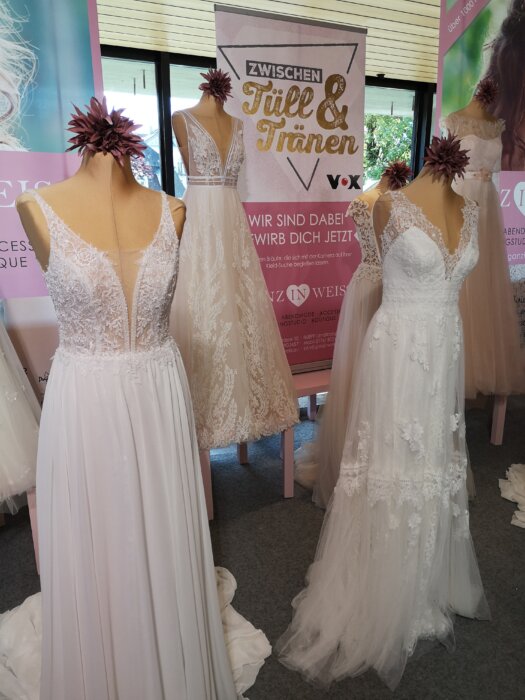
Audience ratings fluctuate between 700,000 and 900,000 viewers per day. [63] An episode of this reality soap often consists of a compilation of several shopping processes, usually featuring three different future brides who search for dresses in different shops. They are advised by the respective store owners, who have themselves become stars of the show.
A closer analysis reveals that this media representation of the shopping process can be seen as a kind of shopping ritual, as the episodes are clearly structured. It also suggests that the wedding dress is the most important dress in a woman’s life and must therefore be perfect. Following this logic, its procurement is also something extraordinary and requires intensive preparation and consultation in a specialty store. The medial representation of buying a wedding dress as an emotional act is central, which is particularly noticeable in the statements of future brides; they always weigh whether the dress they are wearing feels good or not. The aim is not only to feel authentic and beautiful in ‘the perfect dress,’ but above all to perceive oneself as a ‘real bride.’
The sequence of events in an episode is based on the sales process, which itself follows a set pattern: it usually begins with the bride-to-be and her mostly female companions entering the shop and being greeted personally. The kinship or friendship relationship between the companions and the bride is explained. Mainly female reference persons such as the mother, grandmother, sister, friend, and/or maid of honor accompany the bridal shopping. After everyone is seated, the consultant asks about the bride’s ideas for the dress and her budget. The selection of dresses is then made: either the bride-to-be may participate, or the consultant suggests models; sometimes it is a combination of both. During the subsequent fitting, scenes from the changing room are often shown. This allows viewers to observe how the bride is helped into the dress, which also creates excitement; the bride-to-be then steps out of the fitting area—without having seen herself first. With the help of the consultant, who may carry and then arrange the train, the bride walks past her companions and steps onto a platform positioned in front of a large mirror. Now she may see herself in the mirror. After opinions from the shopping entourage and the bride are voiced, further dresses are tried on according to this pattern, usually between two and five gowns. During the try-ons, the question of how the couple met and the engagement is also addressed.
Once there is a favorite among the dresses, it is tried on again at the end. For this final appearance, a veil and desired accessories are often added. Ideally, the brides and their companions react very emotionally to this overall image; tears of joy often flow. This is also the case with L., whose shopping process is featured in the TV series Zwischen Tüll und Tränen. She explains her final choice of wedding dress as follows:
Ich fühl mich superwohl, ich musste keine Kompromisse machen, ich bin superglücklich, es war total aufregend und spannend, und ich, ja, bin einfach nur happy, das ist mein Kleid. Und [hebt einen Finger] ich weiß endlich, was es heißt, dieses Brautgefühl zu haben, jeder spricht davon, und jetzt hab ich‘s verstanden, das kommt einfach so in einem hoch und dann, man weiß einfach, das is es, traumhaft, ja, ich bin überglücklich.
[I feel great, I didn’t have to compromise, I’m super happy, it was totally exciting and thrilling, and I, yes, I’m just happy, this is my dress. And [raises a finger] I finally know what it means to have that bridal feeling, everyone talks about it, and now I understand it, it just comes over you and then you just know, this is it, it’s wonderful, yes, I’m overjoyed.] [64]
There are several terms in wedding dress rhetoric for this phenomenon, which means the inner and outer transformation: the aha effect, the bridal moment, or the magic moment. Otnes and Pleck also refer to the ‘Cinderella effect’ which exaggeratedly refers to the transformation of a woman in everyday clothes into a princess in a wedding dress. [65] This transformation, which is above all emotional, is achieved through the embodiment of the dress (including headdress).
The obligatory conclusion to the purchase process, and thus also the end of an episode, is “die Frage der Fragen” [the question of all questions] asked by the salesperson: “Ist das dein Kleid?” [Is this your dress?], to which the bride usually responds with an enthusiastic “Ja!” [yes!]. [66] Applause and congratulations from the entourage often follow, some salespeople ring a bell or set off a confetti bomb to mark the completion of the sale. The formalized closing question (reminiscent of a marriage ceremony) is based on the almost iconic Anglo-American model: do you “say yes to the dress?” [67]
These schematic, repetitive, self-contained actions in combination with the transformative moment—this inner and outer change—clearly point to characteristics of rites of passage. In addition, the search for a bridal dress is practiced as a group-dynamic process with communalization effects. Here, the transition of a (still) unmarried woman in jeans to a future bride is accompanied by relatives and friends. The practices of searching for and trying on the bridal outfit can be understood here as rites of passage, and wedding fairs as well as online forums function as (commercialized, digitalized) meeting places of a communitas [68] of brides-to-be.
Scholars such as Otnes, Pleck, Friese, Sykes, and Brace-Govan also identify the symbolic transitional character of acquiring bridalwear outside of TV formats. Friese documents it in her empirical study in the American Midwest as early as 1997: “The physical crossing of the doorstep to enter a bridal store can be viewed as the tangible equivalent of the emotional crossing of the intangible boundary a bride experiences when she leaves her social group […]. In other words, crossing this first boundary started the transformation process to adopt the bridal identity.” [69] Wedding preparations and the ritualized shopping practices that take place therein can, according to Otnes and Pleck, be understood as the gathering of “sacred artifacts,” that can unfold “talismanic power”: “Some brides even claim that items seem to magically reveal themselves as they shop […], help fulfill the fantasies for their wedding day, are imbued with tradition, have communicative power, and ‘contaminate’ the wedding with positive energy.” [70]
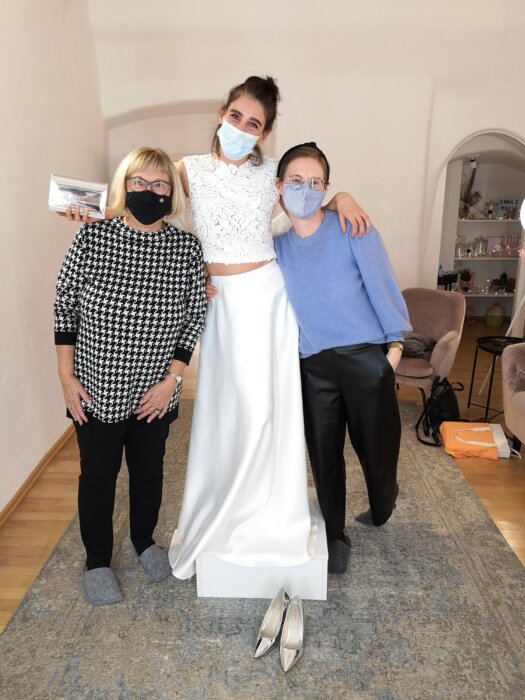
My research and interviews revealed that the ideal form of bridal gown acquisition, as presented in Zwischen Tüll und Tränen, can vary from person to person. While some consciously distance themselves from this mode of purchase, for others it represents an ideal. [71] At the fittings I was able to attend, there was a euphoric mood and growing anticipation of the wedding day. Elements of the ideal process were indeed recognizable, such as the scheduling of exclusive consultation appointments, the elaborate interiors of the bridal boutiques, the provision of beverages, and the accompaniment by (female) reference persons—all of which made the fitting an extraordinary event. Often, the successful purchase was captured in photographs (Fig. 2). [72]
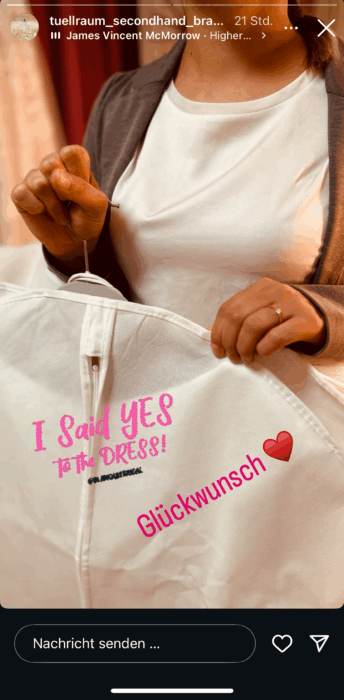
The final documentation of the successful purchase process is also observed on social media platforms, for example as Instagram posts or status updates showing the protagonists, sometimes with their entourage, and their commitment to the dress, represented by a corresponding sign or lettering (Fig. 3).
However, some of my interviewees set themselves apart by ordering their outfit online or purchasing it in a department store rather than from a bridal boutique:
Ich weiß nicht. Also dieses (Pause), da war halt so ein Klischee und auch wie die anderen Gruppen, die da waren, haben dann Alkohol getrunken und alle waren erstaunt, dass wir keinen Alkohol wollen zur […] Anprobe und zur Begrüßung. Und das “Mit wem sind Sie da?,” und was weiß ich. Dann muss man diese Handschuhe anziehen und kriegt diese Ringe und soll sich damit was aussuchen. Und, und dann kamen wir zurück und hatte halt an kein Kleid einen Ring gesteckt, weil es nichts gab, was mir gefallen hat. […] Also das war, das war einfach… Ich habe mich da auch gar nicht wohl gefühlt… Und dann bin ich eher frustriert wieder raus. So… Ja, dann wusste ich nicht, was ich tun soll. War so ein bisschen ratlos. Dann habe ich so ein bisschen rum gegoogelt […] Und dann hat halt irgendwann die A. [Trauzeugin] geschrieben: “Du, ich bin hier gerade im Peek & Cloppenburg. Da hängt dein Kleid.” (Lachen) Und dann sind wir, glaube ich, gleich am nächsten Tag da hin und das war dann eigentlich auch so, dass es fast, fast dieses Kleid war.
[I don’t know. So this (pause), there was such a cliché, and the other groups that were there drank alcohol, and everyone was surprised that we didn’t want alcohol for the fitting and the welcome. And the “Who are you here with?” and whatnot. Then you have to put on these gloves and you get these rings and you’re supposed to choose something with them. And then we came back and I hadn’t put a ring on any dress because there was nothing I liked. […] So that was, that was just… I didn’t feel comfortable there at all… And then I left feeling rather frustrated. So… Yes, then I didn’t know what to do. I was a bit at a loss. Then I googled around a bit […] And then at some point, A. [maid of honor] wrote: “Hey, I’m at Peek & Cloppenburg right now. Your dress is hanging there.” (Laughter) And then I think we went there the very next day, and it turned out that it was almost, almost that dress.] [74]
Yet, even here, individual elements of the ideal acquisition ritual were evident: intensive research into possible styles, sharing outfits with friends and/or relatives, alterations by a tailor (which is especially common in the case of inherited or second-hand dresses). The involvement of female role models (usually the mother or maid of honor) proved to be particularly important. Often, the dress or accessories are paid for by the parents or parents-in-law and thus also serve as wedding gifts:
Und mit dem Schmuck, […] ich wollte mir da immer schon irgendwas kaufen aber dann ach, ja, ist mir das halt doch wieder zu teuer und dann dachte ich, ok, jetzt bei der Hochzeit, das war das Teuerste. […] Und da bin ich mit meiner Mama nämlich nach Konstanz gefahren und von der hab ich dann ähm den Schmuck bekommen. Genau, Ohrringe und ein Armband, so.
[And with the jewellery, […] I always wanted to buy something, but then, oh well, it was too expensive for me, and then I thought, okay, now for the wedding, that was the most expensive thing. […] And so I went to Konstanz with my mom, and she got me the jewelry. Exactly, earrings and a bracelet.] [75]
My assumption is that with the increasing commercialization and eventization of weddings, pre-wedding consumption practices are becoming increasingly important as well. As Gertrud Lehnert notes: “Die Kreativität der Konsumierenden hat sich verlagert auf die Auswahl aus dem vorgefertigten Angebot.” [The creativity of consumers has shifted to choosing from a pre-made selection.] [76] Consequently, various purchasing rituals are practiced, which are associated with processes of valorization that assign exceptional significance to the respective objects.
Even during the COVID pandemic, efforts were made to maintain this ritualized shopping practice, depending on the situation and official regulations: from reducing the entourage to one or two persons at exclusive appointments, to pop-up stores and video consultations with subsequent delivery of selections, the alternatives were wide-ranging and inventive. [77]
5_Ritualized Fashion Practices on the Wedding Day
Ritualized fashion practices can be observed not only during the acquisition of a wedding dress, but also on the wedding day itself. This is illustrated by the following ethnographic anecdote, which describes a situation before my sister’s civil wedding. As the maid of honor, I was supposed to help the bride with her makeup and hair:
Es ist ungefähr 9 Uhr morgens an einem Freitag im April 2021, also mitten in der so genannten dritten Welle der Coronapandemie. Makeup- und Haarutensilien sind auf einem Tisch ausgebreitet, vor mir sitzt die Braut. Da nicht klar war, ob die Friseur-Salons an diesem Tag geöffnet haben werden, haben wir beschlossen, Makeup und Brautfrisur selber zu machen. Als Trauzeugin kam mir diese verantwortungsvolle Aufgabe zuteil. Auf Internetportalen hatten wir schon Wochen zuvor nach Brautfrisuren recherchiert und anschließend Frisuren ausprobiert, es lief gut—das Konzept stand. Einige Tage vor der Trauung haben wir uns einen Zeitplan überlegt und drei Stunden für Haare, Makeup und Ankleidung anberaumt. Wir wollten es gemütlich angehen, die Zeit genießen können—dachten wir zumindest. Doch es kam alles anders: Die Haare wollten nicht, wie wir, mal war es zu bieder mal zu streng, die Aufregung stieg, die Nervosität auch, eine Stunde verging und die Verzweiflung der Braut wurde merklich größer, bis sie mir unter Tränen erklärte: “Weißt Du, während der ganzen Ungewissheit, dachte ich, dass ich wenigstens mein Outfit im Griff hätte, wenn schon alles andere unklar war.” Mir tat es leid, dass ich die Erwartungen nicht erfüllen konnte, versuchte aber Ruhe zu bewahren und versicherte der Braut gebetsmühlenartig, dass sie trotz Planänderung super aussehen würde. Schlussendlich blieben die Haare offen und die Braut verließ (eine halbe Stunde zu spät) aber strahlend die Wohnung. Gemeinsam machten wir uns auf den Weg. Braut und Bräutigam hatten sich nämlich auf einer Brücke verabredet um sich dort zum ersten Mal in voller Montur als Braut und Bräutigam entgegenzutreten. Obwohl sie bereits seit einigen Jahren zusammenleben, hatten sie die Nacht zuvor getrennt voneinander verbracht.
[It’s around 9 a.m. on a Friday in April 2021, in the midst of the so-called third wave of the coronavirus pandemic. Makeup and hair accessories are spread out on a table, and the bride is sitting in front of me. Since it wasn’t clear whether hair salons would be open that day, we decided to do the makeup and bridal hairstyle ourselves. As maid of honor, this responsible task fell on me. Weeks earlier we had searched online for bridal hairstyles and then tried out hairstyles, which went well—the concept was set. A few days before the wedding, we came up with a schedule and set aside three hours for hair, makeup, and dressing. We wanted to take it easy and enjoy the time—at least that’s what we thought. But everything turned out differently: the hair didn’t want to cooperate, sometimes it was too conservative, sometimes too severe, the excitement grew, as did the nervousness, an hour passed and the bride’s despair became noticeably greater until she explained to me through tears: “You know, during all the uncertainty, I thought that at least I had my outfit under control, even if everything else was unclear.” I was sorry that I couldn’t meet expectations, but I tried to stay calm and assured the bride over and over again that she would look great despite the change of plan. In the end, her hair remained loose, and the bride left the apartment (half an hour late) but beaming. Together we set off. The bride and groom had arranged to meet on a bridge to see each other for the first time in full bridal apparel. Although they had been living together for several years, they had spent the night before apart.] [78]
This note once again shows the importance of the bridal outfit for S. In this case, the detailed planning—from purchasing and tailoring the outfit, to makeup and hairstyle—promised a certain security in the face of ever-changing pandemic regulations.
Elaborate bridal styling before the wedding ceremony is an important part of the preparation process and is often scheduled as a separate program item on the morning of the wedding day. The so-called getting ready by the bride often marks the beginning of the documentation by a professional wedding photographer. Under the heading “Getting ready Hochzeit: Geheimtipps für einen perfekten Start,” [Getting ready for the wedding: insider tips for a perfect start] the online magazine Braut.de explains the overarching importance of elaborate bridal adornment: [79]
“Getting Ready Hochzeit”—das klingt nach Styling, Schminke und schicken Klamotten, aber es ist so viel mehr! Es ist das gemeinsame Lachen mit den besten Freundinnen, während ihr eure Haare hochsteckt. Es ist der stolze Blick eures Vaters, der euch zum ersten Mal im Brautkleid sieht. Es ist der Moment, in dem ihr als Team zusammenkommt und euch gegenseitig unterstützt. Das “Getting Ready Hochzeit” ist das Fundament für eure Erinnerungen an diesen einmaligen Tag. Diese Momente vor der Zeremonie sind unbeschreiblich wertvoll. Sie sind voller Intimität, Liebe und persönlicher Bindungen. Das “Getting Ready Hochzeit” gibt euch die Chance, kurz innezuhalten, durchzuatmenund jeden Pinselstrich auf der Haut, jeden gesetzten Lockenwickler und jeden liebevoll zugeknöpften Knopf bewusst zu erleben. […] Umgeben von Nahestehenden oder in stiller Reflexion, ist es eine Zeit für emotionale und ästhetische Vorbereitung, damit sie sich von ihrer besten Seite präsentieren kann.
[“Getting Ready for the Wedding”—it sounds like styling, makeup, and fancy clothes, but it’s so much more! It’s laughing together with your best friends while you put your hair up. It’s the proud look on your father’s face when he sees you in your wedding dress for the first time. It’s the moment when you come together as a team and support each other. “Getting Ready for the Wedding” is the foundation for your memories of this unique day. These moments before the ceremony are indescribably precious. They are full of intimacy, love, and personal bonds. Getting ready for your wedding gives you the chance to pause for a moment, take a deep breath, and consciously experience every brush stroke on your skin, every curler placed, and every button lovingly buttoned. […] Surrounded by loved ones or in quiet reflection, it is a time for emotional and aesthetic preparation so that you can present yourself at your best.] [Emphasis in the original] [80]
Direct comparison with the ethnographic anecdote mentioned above reveals that this characterization is a highly romanticized and idealized narrative, which may describe a desirable ideal state, but is not always completely compatible with reality (shaped by the COVID pandemic). Nevertheless, the sheer length and effort involved, as well as the mostly professional support provided by makeup artists and hair stylists, suggest the importance of this getting ready. Both examples cited illustrate in different ways the physical and emotional preparation for the wedding ceremony (whatever form it may take). The ritualized styling can be interpreted as a further step in the “transitional process into marriage,” [81] once again preparing for the change in status to a married woman. The elaborate process of getting ready often goes hand in hand with the gradual embodiment of the outfit and the new social role as a married person, as literature and fashion scholar Barbara Vinken observes:
Die Hochzeit, vor allem aber das Anlegen des Kleids, markieren einen Schnitt mit dem Alltagsleben. Üblicherweise bekommt der Bräutigam, von dem die Braut sich—auch wenn man schon jahrelang zusammenlebt—oft in der Zeit unmittelbar vor der Hochzeit trennt, das Kleid erst am Tag der Hochzeit zu Gesicht. Das Kleid restauriert in gewisser Weise Jungfräulichkeit; allein auch schon deshalb, weil es nur einmal getragen und dann konserviert wird. Es produziert durch die theatralische Inszenierung, das Schminken, das Frisieren, eine neue Frau. [82]
[The wedding, but above all the donning of the dress, marks a break with everyday life. Usually, the groom, from whom the bride often separates in the period immediately before the wedding, even if they have been living together for years, does not see the dress until the day of the wedding. In a way, the dress restores virginity, if only because it is worn only once and then preserved. Through the theatrical staging, the make-up, the hairstyling, it creates a new woman.]
Sociologist Fleur Weibel also refers to “Praktiken des Frisierens, Schminkens und anschließenden Anziehens des Brautkleids” [practices of hairstyling, applying makeup, and then putting on the wedding dress], [83] which several brides stage as a special part of the program and use as an opportunity to enjoy their first glass of champagne. As the opening anecdote also shows, most couples separate beforehand. The reasons are not only the different “Praktiken des (Sich-)Schönmachens” [practices of making (oneself) beautiful], [84] but also to create excitement for the first meeting, often referred to as the ‘first look’ in full wedding apparel. “Unabhängig davon, ob sich das Paar zur Trauzeremonie oder zum vorgängigen Fotoshooting zum ersten Mal sieht, gilt dieser Moment des Aufeinandertreffens als emotional intensiver Moment und erster ‚Höhepunkt‘ der Hochzeit.” [Regardless of whether the couple is seeing each other for the first time at the wedding ceremony or at the photo shoot beforehand, this moment of meeting is considered an emotionally intense moment and the first ‘highlight’ of the wedding.] [85]
To stage this moment as a surprise, the bride’s outfit is often kept secret beforehand, as is the case with M. Although she was very critical of the highly ritualized shopping process at bridal boutiques and therefore decided to buy a dress at a department store, she kept her dress a secret from her future husband:
Ne. Der durfte es nicht sehen. […] Bewusst. Also es wäre jetzt auch nicht schlimm gewesen, aber irgendwie haben wir uns da auch so (Pause) einen Scherz draus gemacht. […] Also ich habe ihm schon sein Outfit ausgesucht, sozusagen. […] Aber er durfte meines nicht sehen. Da haben wir uns geärgert, gegenseitig.
[No. He wasn’t allowed to see it. […] On purpose. I mean, it wouldn’t have been a big deal, but somehow we just (pause) made a joke out of it. […] So I already picked out his outfit, so to speak. […] But he wasn’t allowed to see mine. We teased each other about it.] [86]
B. justifies keeping her dress secret as follows: “Das war einfach nur, weil man es halt so macht. Und weil es Unglück bringt oder, ja, man muss es ja nicht provozieren.” [It was simply because that’s how it’s done. And because it brings bad luck, or, well, you don’t want to tempt fate.] [87] This reveals both an appeal to tradition (“because that’s how it’s done”) and the symbolic—indeed magical—agency of the dress. In fact, the question of whether misfortune ensues if the fiancé is present during dress selection and/or sees it before the ceremony is a recurring topic. The online magazine WeddyPlace, after explaining this “alte Tradition” [old tradition] and weighing pros and cons, arrives at a pragmatic conclusion: “Eure Hochzeit, Eure Regeln.” [Your wedding, your rules.] [88] A 2013 online survey by Zalando shows that 78 percent of respondents kept their dress secret from their future partner until the wedding; unfortunately, their reasons are not further elaborated. [89]
In my research and conversations, the harmful object-agency extended not only to the dress but also to jewelry. M., for example, deliberately refrained from wearing pearls:
Weil, wenn man Perlen trägt an der Hochzeit, dann muss man weinen, in der Ehe, sagt meine Oma. (lacht) […] Ich wollte sie zur kirchlichen anziehen und dann habe ich sie aber nicht angezogen.
[Because, if you wear pearls at a wedding, you’ll cry during your marriage, according to my grandmother. (laughs) […] I wanted to wear them to the church ceremony, but then I decided not to.] [90]
Subtle symbolic power also surfaces with respect to the color of the gown. Since B. was unsure whether a large celebration would follow the civil marriage, she opted for a white, or rather cream-colored, dress. One should marry in white at least once, she argues:
und zwar aus dem Grund, weil ich ja standesamtlich geheiratet habe und ich unbedingt kirchlich heiraten möchte noch. Ähm, aber ich schon ganz, ganz oft gehört habe, also diesen Spruch gehört habe, ja, wenn ihr standesamtlich heiratet, dann heiratet ihr eh nicht mehr kirchlich, also in ein paar Jahren und ich, also wir können uns das halt momentan überhaupt nicht leisten so eine kirchliche Hochzeit und auch zeitlich ähm haben wir keine Zeit das zu planen, jetzt. Ähm, weswegen ich mir dann immer vorstelle, so noch in zwei drei Jahren zu heiraten, kirchlich. Und dann natürlich schon auch mit einem schönen weißen Kleid. Und dann hab ich auch gesprochen mit meiner Mama und ja, soll ich denn ein buntes oder welche Farbe? Und ja, falls es wirklich die einzige Hochzeit sein sollte, dann wollte ich das in Weiß machen und ich bin auch wirklich ganz froh über die Entscheidung. Also, dass ich in Weiß geheiratet habe, falls es das einzige Mal bleiben sollte.
[because I got married in a civil ceremony and I really want to get married in a church. Um, but I’ve heard this saying so many times, that if you get married in a civil ceremony, then you won’t get married in a church anyway, at least not for a few years, and I, well, we just can’t afford a church wedding at the moment, and we don’t have time to plan it right now. Um, which is why I always imagine getting married in a church in two or three years. And then, of course, with a beautiful white dress. And then I talked to my mom and asked, should I have a colorful one or what color? And yes, if it really was going to be my only wedding, then I wanted to do it in white, and I’m really happy with that decision. That I got married in white, in case it was going to be the only time.] [91]
As a lesbian couple, S. and C. discussed at length how they wanted to position themselves to the norm of the white wedding. While C. preferred white dresses for the civil and the free ceremony, S. wanted to set herself apart from that. Ultimately, they compromised by choosing white sheath dresses for the civil marriage.
Ja, wir haben ziemlich viel drüber geredet, wie wir das haben wollen. Und haben uns dann aber für weiße Kleider, also auf weiße Kleider ja geeinigt. C. war das ja auch eigentlich wichtiger, dass wir weiße Kleider anziehen, auch auf der Hochzeit. [92]
[Yes, we talked about it a lot, how we wanted it. And then we agreed on white dresses, that is, we agreed on white dresses, yes, also for the wedding. C. actually found it more important that we wear white dresses for the wedding as well.]
For the large-scale celebration following the free ceremony, they chose black ball gowns with gold appliqués. They purchased the costly dresses together at a bridal boutique.
The elaborate getting ready, the carefully planned first meeting of the outfitted couple, as well as the color scheme and/or secrecy surrounding the dress until the wedding day, all testify to the extraordinary, special handling of bridal fashion. The magical attribution is particularly characteristic of ritual objects, because “material objects that are employed in rituals are not merely passive carriers of attached meanings. […] As ritual agents they achieve important performative functions in the field of transformations.” [93] Ethnologist Anne-Christine Hornborg also shows that “rituals can animate objects […] with agency and performative qualities.” [94] Apparently, the ritualized charging (and thereby valorization) of bridal fashion observed here occurs primarily before the wedding ceremony. As my research revealed, during the ceremony itself (in whatever form it takes), hardly any ritualized actions centered on the bridal outfit. Ritual practices during the wedding ceremony (such as lifting the veil) or the celebration (such as the garter auction) were not mentioned in my empirical fieldwork, even though such practices are indeed described in sources such as guides or lifestyle magazines. [95]
6_Fashion Practices after the Wedding
In many a woman’s wardrobe, there is one piece of clothing that, having been worn once, is seldom worn again but is often highly treasured and especially cared for. This piece of clothing is her wedding dress. [96] The special handling of wedding fashion after the ceremony is often evident in the mode of storage (Fig. 4). Garments are packed for protection in a garment bag or in special boxes (for headpiece, bridal shoes, etc.).
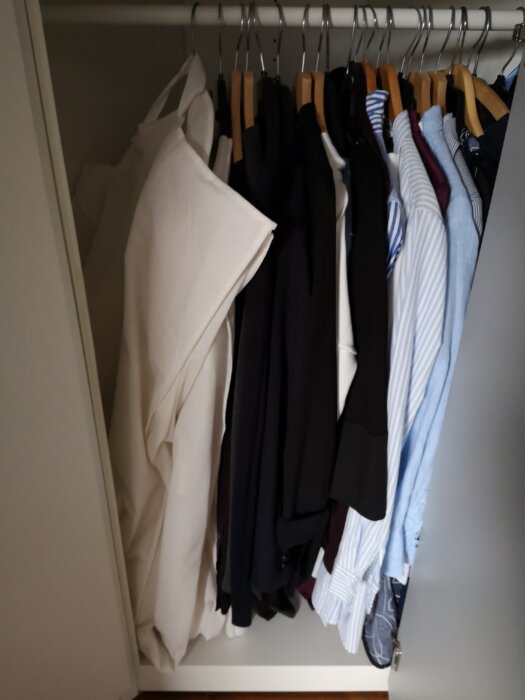
This mode of storage alone suggests a sentimental as well as monetary preciousness. Consequently, the elements of bridal fashion (dress, shoes, head adornment, etc.) function as objects of memory not only in wedding photos but also through their mere presence in the wardrobe. Following the ethnologist Hans Peter Hahn, such biographical objects with emotional significance differ markedly from everyday things. [97] Consumer behavior experts Michael R. Solomon and Punam Anand likewise assume “that products which serve as ritual artifacts may endure beyond the normal product life-cycle.” [98]
Not only careful storage, but also wearing wedding apparel again can also be understood as a practice of remembrance. This can occur in private, while slipping into the outfit at home, looking in the mirror, and recalling the wedding. It can also take place on a larger scale, outside private space. There are evidently differing viewpoints on whether and in what context one should wear bridalwear again. S. and C., for example, had different opinions about the dresses they wore for their civil ceremony:
Ja ich hatte die/ wir waren mal auf Ibiza und da hatte ich meines mal an. Und ansonsten hatte ich es noch nicht an. C. wollte das eigentlich nicht, dass man das nochmal anzieht, weil sie fand, man zieht das nur ein einziges Mal an. […] Ne, sie hat ihrs noch nicht angehabt und ich hab dann meins trotzdem angezogen.
[Yes, I had/ we were once in Ibiza and I wore mine there. Otherwise, I haven’t worn it. C. actually didn’t want it to be worn again, because she thought you only wear it once. […] No, she hasn’t worn hers again and then I wore mine anyway.] [99]
Beyond the discussion of whether to wear the wedding dress again, the question of suitable occasions arises: the more exclusive and expansive the gown, the fewer the occasions afterwards. For this reason, so-called ‘Brautkleidbälle’ [bridal dress balls] [100] or ‘Weddingrevival-Bälle’ [wedding revival balls] [101] are offered. These events usually take place annually in cities such as Nuremberg, Herne, or Berlin—and in Augsburg. About thirty years ago, a bridal boutique there identified this need and initiated such a ball. [102] This event explicitly invited guests to wear their wedding outfit again and integrated wedding-typical elements such as a photo booth, photographer, or a show act. A live band offered the opportunity for set-pattern dances. The highlight was a quadrille—called by a dance teacher who rehearses the steps with participants beforehand. [103] Some couples reported receiving tickets for the ball as a wedding gift, others attend regularly. The following quotes are from interviews a TV journalist conducted with anonymous couples at the gala ball on October 27, 2018. After noticing that a camera crew was filming there, I contacted the editor and asked him to provided me with the unpublished video material for my research project.
Ehefrau (EF)1: Also es is jetzt so dreizehn Jahre her, dass wir geheiratet haben und mir waren so ungefähr jetzt elf Mal hier, genau (nickt). […]
Interviewer (I): Und, ähm, wie is es dann immer wieder das anzuziehen oder, also auch nach dreizehn Jahren, was is das für’n Gefühl?
EF1: Immer was ganz Besonderes, man erlebt so a’ bissl den Tag, äh, noch einmal, oder? (fragend zu EM1) […]
Ehemann (EM)1: Richtig, ja. Einmal mal wieder sich so, ja, a’ bissl zurückversetzt fühlen, so von der Zeit her, echt schön, ja, macht Spaß.
[Wife (W)1: So it’s been about thirteen years since we got married and we’ve been here roughly eleven times now, right (nods). […]
Interviewer (I): And, um, what is it like to put it on again and again, or after thirteen years, what does that feel like?
W1: Always something very special; you relive the day a little, right? (looks at husband questioningly) […]
Husband (H)1: Exactly, yes. Once again to, well, feel transported back a bit in time, it’s really nice, yes, it’s fun.] [104]
The second couple likewise attends the ball to deliberately remember their wedding day:
EF2: Ähm, es ist bewusster, weil bei der Hochzeit selber bekommt man eigentlich gar nicht mehr/ gar nicht so viel mit, also das zieht an einem vorbei und jetzt, das ist unser Tag.
[W2: Um, it’s more intentional, because at the wedding itself you don’t really/ you don’t take in so much, it just sweeps past you and now, this is our day.] [105]
Another couple uses the ball as an occasion to celebrate their silver wedding:
EF3: Eigentlich sechsundzwanzig, letztes Jahr hatten wir standesamtliche Silberhochzeit und dieses Jahr kirchlich (EM3 bestätigt). Des [Brautkleid] war eigentlich ’n Traum, ich wollts damals nach der Hochzeit eigentlich verkaufen, ich habs in Secondhandshop gebracht und dann is es fast verkauft worden, aber ich habs mir dann wieder abgeholt, weil i dacht hab “Nein, ich muss des behalten.” Und des nochmal anzuziehen is schon/ war heut eigentlich bisschen komisch, aber […] is toll, des nochmal anzuziehen. Ich habs vorher schon mal probiert, obs noch passt (beide lachen), des schon. Und wenns dann passt, freut ma sich natürlich schon. Aber ja, man erinnert sich so viel an/ an damals, wies halt war, dieser Tag.
EM3: Ist doch wunderschön, des sieht noch genauso gut aus wie vor sechsundzwanzig Jahren […] Oder vor fünfundzwanzig Jahren (lacht).
[W3: Actually twenty-six, last year we had our civil silver anniversary and this year the church one (EM3 confirms). The [bridal dress] was actually a dream; I actually wanted to sell it after the wedding, I brought it to a second-hand shop and then it was almost sold, but then I picked it up again because I thought, ‘No, I have to keep it.’ And putting it on again is, was actually a bit strange today, but [..] it’s great to wear it again. I tried it on beforehand to see if it still fits (both laugh), that too. And if it fits, of course you’re happy. And yes, you remember so much of back then, how it was, that day.
H3: It’s wonderful, it looks just as good as twenty-six years ago […] Or twenty-five years ago (laughs).] [106]
For the couples quoted here, attending the ball constitutes a (decelerated) practice of remembrance. Removed from everyday life, they can reminisce about their own wedding in a festive ball setting—together with numerous other couples. The ball thus also becomes a meeting point for the communitas: like-minded married couples participating in this embodied practice of memory. This shows that elements of wedding fashion can function as objects of embodied memory, even years after the wedding. Hornborg recognizes this potential of reanimation: “Outside the ritual field the objects may lose their agency, but in some cases they still maintain the potential to become animate again.” [107]
There are other examples of ritualized fashion practices after the wedding, such as destroying the wedding dress (called ‘trash your dress’ or ‘crash the dress’) or passing on bridal fashion (following the credo ‘something old, something new, something borrowed, something blue’), but I hope that my argument remains clear even without further elaboration.
7_Bridal Fashion as Ritual Fashion
My research shows, that it is not least the ritualized, clearly non-everyday practices that constitute the specificity of bridal fashion. These ritualized actions were elaborated on three levels: in bridalwear acquisition, in practices on the wedding day itself, and in the handling of wedding apparel after the ceremony. In assembling the complete outfit, the gown is always central, yet shoes, bouquet, and/or veil also form part of the bride’s overall appearance. Through ritualized actions, these elements of wedding fashion are endowed with special significance as ritual objects within the rite of passage. This charging with meaning, and thus the valorization of bridal fashion, occurs above all through ritual practices before the actual ceremony. In specific settings, and through (embodied) practices of remembrance, this agency can be reactivated. Hence, the diverse elements of bridal fashion function as ritual objects that can exert their transformative effect already at the time of acquisition. In the case of bridalwear, the specificity of ritual fashion is not only evident in ritualized practices, but also through the following aspects:
First, there is higher demand regarding material and/or fit, which are reflected in price. Bridalwear is typically altered by a professional tailor—quite literally fitted to the body. Characteristic materials such as tulle, lace, and/or silk are likewise costly. As the example of bridal fashion acquisition showed, however, the preciousness of the outfit is expressed not only through monetary or material value but also through immaterial practices of valorization.
Second, wide skirts and precious embellishments point to diminished demands for functionality and/or wearing comfort. This correlates with heightened demands for an “außeralltägliche Ästhetik” [extraordinary aesthetic] not necessarily shaped by utility. [108] While one should be able to dance in the robe, it is usually accepted that, for example, the hem of a floor-length dress (possibly with a long train) can become soiled, or that a helping hand may be needed when using the restroom. [109] Consequently, wearing a bridal gown on the wedding day is described not only as a wonderful feeling, “sondern auch als Einschränkung und als mit der Zeit durchaus schmerzhafte Angelegenheit” [but also as restrictive and, over time, quite painful.] [110]
Third, because the main wedding season runs from May to August, bridalwear follows a different rhythm than everyday fashion—largely independent of categorizations such as winter and summer fashion, in which “[a]lle paar Monate soll die alte Mode der neuen weichen” [every few months the old fashion is to give way to the new.] [111] This credo may hold for everyday apparel; in bridal fashion the change occurs more slowly, in an annual rhythm.
Fourth, wedding fashion is subject to high demands for distinction and exclusivity. In contrast to their everyday look, the bride/the couple should be clearly recognizable as protagonists. For this reason, much time and effort are invested in assembling the outfit and in the ritual practice of getting ready. This exclusivity is also expressed in materiality, price, and not least the color of the dress.
Fifth, the emphatically heteronormative ritual and fashion practices in the context of weddings are particularly striking. Bührmann and Thiele-Manjali likewise observe this type of re-traditionalized staging of hierarchical gender relations at a symbolic level, which actually contradicts the empirically practical lifestyles of heterosexual as well as queer couples. This doing gender is manifested not least in wedding apparel. [112] Focusing on heterosexual couples, Weibel confirms this “ausgeprägte Betonung von Weiblichkeit und Männlichkeit, von deren Differenz und Komplementarität” [emphatic accentuation of femininity and masculinity, of their difference and complementarity.] [113] In this context, Bethmann points to the close interconnection between the “Vergeschlechtlichung” [genderization] [114] and a “Re-Ritualisierung” [re-ritualization] [115] of weddings.
The white bridal gown is “affirmativ angeeignet und steht weder im Widerspruch zur nicht gegebenen Jungfräulichkeit noch zu einer emanzipierten Haltung” [appropriated affirmatively and is seen neither in contradiction to non-existent virginity nor to an emancipated posture.] [116] The post-feminist bride who presents herself on the extraordinary stage of the wedding, is not at odds with the figure of the independent woman. Franka Heise states, furthermore:
Within postfeminist bridal culture, the performance of traditional femininity through the figure of the bride […] is framed in terms of individual choice, depicted as standing outside the political and ideological struggles surrounding gender, equality, class, sexuality and race. […] Instead, the patriarchal customs of the white wedding are now actively embraced by the women themselves in the name of tradition and choice. [117]
In contrast, queer couples need to negotiate more about heteronormative marriage practices, explains S.:
Ja, da gibt’s unglaublich viele Normen, bei Hochzeiten. Und uns sind die anfangs auch gar nicht aufgefallen, […] Und deswegen haben wir alles diskutiert, was macht man bei einer Hochzeit? Wollen wir das machen? Und dann kamen wir auf die Kleider, wir kamen auf die Zeremonie, wer die Zeremonie hält, wie eine Zeremonie auszusehen hat. (atmet hörbar aus]
[Yes, there is an incredible number of norms around weddings. And we didn’t notice them at first, […] And so we discussed everything: What do you do at a wedding? Do we want to do that? And then we got to the dresses, we got to the ceremony, who conducts the ceremony, what a ceremony should look like. (audible exhale)] [118]
Nevertheless, gay couples often wear gender-conforming wedding outfits, a trend that Weibel also notes in the bouquets and floral decorations. For the couples she interviewed, it was not a matter of subversively playing with gender roles, but rather of emphasizing same-sex relationships and togetherness. This goes hand in hand with the claim to be an equal bridal couple. [119]
In summary, the extraordinary status of rites of passage becomes clearly apparent, not least through the overemphasis on gender-stereotypical fashion practices. This overemphasis stands in stark contrast to everyday realities and fashion practices. Because ritualized bridal fashion practices differ markedly from everyday fashion practices, I advocate here for the analytical category, of ‘ritual fashion’ within fashion studies. Ritual fashion is worn during rites of passage and displays the characteristics of ritual objects outlined above. Due to the (ideally) one-time nature of the occasion in a person’s life, ritual fashion has a high emotional (memory) value, which is also expressed above all through ritualized actions. I assume that this particular status of vestimentary ritual objects can also be observed in other rites of passage, such as baptisms, prom/graduation balls, or mourning rituals, but this thesis requires further research.
_How to Cite
Ina Hagen-Jeske. “Between Tulle and Tears: Ritual Practices of Bridal Fashion.” On_Culture: The Open Journal for the Study of Culture 20 (2026). <https://doi.org/10.22029/oc.2026.1547>.

_Endnotes
- [1] I would like to thank Sabrina Schwarz-Klein and Marie-Claire Timmermann for their expert input and research assistance, as well as their constructive comments.
- [2] Chrys Ingraham, White Wedding: Romancing Heterosexuality in Popular Culture (London: Routledge, 2008), 224.
- [3] Ilya Parkins, “‘You’ll Never Regret Going Bold’: The Moods of Wedding Apparel on a Practical Wedding,” Fashion Theory 25, no. 6 (2021): 799–817.
- [4] E.g. Fleur Weibel, Die Praxis des Heiratens: Über die Anerkennung verbindlicher Liebesbekenntnisse (Bielefeld: transcript, 2025); Annette Remberg, Wandel des Hochzeitsbrauchtums im 20. Jahrhundert, dargestellt am Beispiel einer Mittelstatt: eine volkskundlich-soziologische Untersuchung (Münster: Waxmann, 1995); Hilde Schäffler, Ritual als Dienstleistung: Die Praxis professioneller Hochzeitsplanung (Berlin: Reimer, 2012).
- [5] This includes participating observations at weddings, at a henna night, several wedding trade fairs, during the shopping for wedding dresses in bridal boutiques, ero-epic conversations (based on Roland Girtler) with wedding professionals (mainly shop owners) and former brides, as media analysis of TV shows, as well as (auto-)ethnographic notes.
- [6] Astrid Engel, Ayşe Özkan and Alexandra Rudnew, “Zwischen Tüll und Türkei? Die Augsburger ‘Brautmodenmeile’ in der Ulmer Straße,”Augsburger Volkskundliche Nachrichten 48 (2019): 6–55.
- [7] Anna Katharina Mangold, “Stationen der Ehe für alle in Deutschland,” Bundeszentrale für politische Bildung, accessed July 30, 2025, <https://www.bpb.de/themen/gender-diversitaet/homosexualitaet/274019/stationen-der-ehe-fuer-alle-in-deutschland/>.
- [8] “Code: 12611-0001. Eheschließungen, Eheschließungen je 1000 Einwohner: Deutschland, Jahre,” Statistisches Bundesamt, accessed July 30, 2025, <https://www-genesis.destatis.de/datenbank/online/url/40908d87>.
- [9] “Die große Hochzeitsstudie 2024,” WeddyPlace GmbH, accessed July 30, 2025, <https://www.weddyplace.com/de/hochzeitsstudie/2024>
- [10] “Internationale Zalando Hochzeitsstudie: Wer trägt weiß, wer küsst fremd und wer gibt am meisten aus?,” Zalando SE, accessed July 30, 2025, <https://corporate.zalando.com/de/fashion/internationale-zalando-hochzeitsstudie-wer-traegt-weiss-wer-kuesst-fremd-und-wer-gibt-am>.
- [11] “Die große Hochzeitsstudie 2024,” WeddyPlace GmbH.
- [12] The market research studies cited here were conducted for the commercial benefit of their clients. Due to their quantitative approach, these studies leave respondents with little flexibility in their answers. In some cases, the questions themselves reflect a preconceived understanding of weddings. Several such surveys are conducted by wedding portals and service providers. Many of these are conducted and updated annually. They are then cited by other service providers, such as banks, wedding speakers, and wedding planners, to contextualize or justify their offerings and prices. For this multi-sited ethnography, these surveys provide interesting data on wedding perceptions and practices. Furthermore, their mere existence points to a broad, market-driven interest. Additionally, there is an interaction between the survey results and their recipients.
- [13] Natalie Iványi, “Die Traumhochzeit im Alltag: Zu den subjektiven Voraussetzungen theatralischer Trauungen im Alltag,” in Liebe (wie) im Fernsehen. Eine wissenssoziologische Analyse, eds. Natalie Iványi and Jo Reichertz (Wiesbaden: VS, 2002), 255–298, here: 255.
- [14] “Zwischen Tüll & Tränen: Episoden,” fernsehserien.de, accessed July 30, 2025, <https://www.fernsehserien.de/zwischen-tuell-und-traenen/episodenguide>.
- [15] Schäffler, Ritual als Dienstleistung, 74; Weibel, Die Praxis des Heiratens, 168–214; Ingraham, White Weddings; Ewa Glapka, Reading Bridal Magazines from a Critical Diskursive Perspektive (Basingstoke: Palgrave Macmillan, 2014), 206.
- [16] Katherine Sykes and Jan Brace-Govan, “The Bride who Decides: Feminine Rituals of Bridal Gown Purchase as a Rite of Passage,” Australasian Marketing Journal 23, no. 4 (2015): 277–285, here 277–278. <https://doi.org/10.1016/j.ausmj.2015.10.009>
- [17] Denise Amy Baxter, “Belief,” in A Cultural History of Dress and Fashion: In the Age of Empire, ed. Denise Amy Baxter (London et al.: Bloomsbury, 2017), 81–98, here: 86.
- [18] Baxter, “Belief,” 87.
- [19] Maya Zumdick and Katharina Schlimmgen-Ehmke, Die Braut in Schwarz: Fotografische und textile Erinnerungen (Materialien des Westfälischen Freilichtmuseums, Landesmuseum für Volkskunde) (Detmold: Westfälisches Freilichtmuseum, 2006).
- [20] Helga Hager, Hochzeitskleidung—Biographie, Körper und Geschlecht: Eine kulturwissenschaftliche Studie in drei württembergischen Dörfern (Tübingen: Tübinger Verein für Volkskunde, 1999), 41.
- [21] Hager, Hochzeitskleidung, 14, 40.
- [22] Max von Boehn, Modespiegel (Berlin et al.: Westermann Verlag, 1919), 97–112, here: 100–104.
- [23] Ina Hagen-Jeske, “Say yes to the Dress! Auf der Suche nach dem perfekten Brautkleid,”Bayerisches Jahrbuch für Volkskunde (2019): 163–183, here: 165.
- [24] Hager, Hochzeitskleidung, 13.
- [25] E.g. Marittas HochzeitsWelt by Cecile, “Sissi-Brautkleid: SO könnt ihr heiraten!,” YouTube, December 7, 2018, <https://www.youtube.com/watch?v=EMQeMM8BZ1Y>.
- [26] Vicky Howard, Brides, Inc. American Weddings and the Business of Tradition (Pennsylvania: Pennsylvania Press, 2006), 141–219; Schäffler, Ritual als Dienstleistung, 56–70.
- [27] Cele C. Otnes and Elisabeth H. Pleck,Cinderella Dreams (Berkeley et al.: University of California Press, 2003), 266.
- [28] Schäffler, Ritual als Dienstleistung, 77–78.
- [29] Ingraham, White Weddings, 112.
- [30] Ingraham, White Weddings, 113.
- [31] Weibel, Die Praxis des Heiratens, 195.
- [32] “Die große Hochzeitsstudie 2024,” WeddyPlace GmbH.
- [33] “Press Release No. N010, February 5, 2026,” Statistisches Bundesamt, accessed February 23, 2026, <https://www.destatis.de/DE/Presse/Pressemitteilungen/2026/02/PD26_N010_126.html>
- [34] Weibel, Die Praxis des Heiratens, 20.
- [35] Ronald L. Grimes, Deeply into the Bone: Re-inventing Rites of Passage (Berkeley et al.: University of California Press, 2002), 157.
- [36] In doing so, they often overlook the diverse living situations of a (post)migrant society. In devout Muslim or Orthodox Christian families, the engaged couple often live with their parents until the day of the wedding.
- [37] Rosemarie Nave-Herz, Die Hochzeit. Ihre heutige Sinnzuschreibung seitens der Eheschließenden: eine empirisch-soziologische Studie (Würzburg: Ergon, 1997), 48.
- [38] Stephanie Bethmann, Liebe—eine soziologische Kritik der Zweisamkeit (Weinheim: Beltz Juventa, 2013), 217.
- [39] Andreas C. Bimmer, “Von Übergang zu Übergang—Ist van Gennep noch zu retten?,” Österreichische Zeitschrift für Volkskunde, Vol. LIV/103 (2000): 15–36, here: 36.
- [40] Arnold van Gennep, The Rites of Passage (Chicago et al.: The University of Chicago Press, 2019), 3.
- [41] Grimes, Deeply into the Bone, 214.
- [42] Mirko Uhlig, “Ritual,” in Kulturtheoretisch Argumentieren, eds. Timo Heimerdinger and Markus Tauschek (Münster et al.: Waxmann, 2020), 433–466, here: 436.
- [43] Uhlig, “Ritual,”440.
- [44] Getrud Lehnert, “Mode als kulturelle Praxis,” in Kleiderfragen: Mode und Kulturwissenschaft, eds. Christa Gürtler and Eva Hausbacher (Bielefeld: transcript, 2015), 29–44, here: 40.
- [45] Lehnert, “Mode als kulturelle Praxis,” 29.
- [46] Although the term ‘costume’ refers to exceptional dress outside the context of everyday life (e.g. Halloween costumes), it is more associated with masquerade and theatre. In contrast, my interview partners made it explicitly clear, that they do not want to feel dressed up [sich verkleidet fühlen] in their bridal dress. Taking this emic perspective (by the participants interviewed) into account, the term costume is not suitable for this analysis. For further discussion of terminology, see Lou Taylor, “Fashion and Dress History: Theoretical and Methodological Approaches,” in The Handbook of Fashion Studies, eds. Sandy Black, May de la Haye and Joanne Entwistle (London: Bloomsbury, 2020), 23–43.
- [47] Taylor, “Fashion and Dress History,” 24–18.
- [48] Consequently, the term ‘dress’ is employed when the focus is more likely on the vestimentary object itself.
- [49] Sandy Black, May de la Haye and Joanne Entwistle, “Introduction,” in The Handbook of Fashion Studies, eds. Sandy Black, May de la Haye and Joanne Entwistle (London: Bloomsbury, 2020), 1–13, here 3.
- [50] Taylor, “Fashion and Dress History,” 28. To make matters worse, there is also a translation problem: in German, there is no such nuanced distinction between dress, clothing, and fashion. “Mode” is commonly translated as “fashion.”
- [51] Lehnert, “Mode als kulturelle Praxis,” 30.
- [52] Yvonne Niekrenz, “Rauschhafte Vergemeinschaftungen: Soziologische Anmerkungen zu Fest und Exzess,” in Rauschdiskurse: Drogenkonsum im kulturgeschichtlichen Wandel, eds. Burkhard Kastenbutt, Aldo Legarno and Arnold Schmieder (Berlin: LIT, 2016), 143–152, here: 145.
- [53] Sykes and Brace-Govan, “The Bride who Decides,” 279.
- [54] Sykes and Brace-Govan, “The Bride who Decides,” 278.
- [55] Susanne Friese, “The Wedding Dress: From Use Value to Sacred Object,” in Through the Wardrobe: Women’s Relationships with Their Clothes, eds. Ali Guy, Eileen Green and Mara Banim (New York: Berg, 2001), 53–69, here 57.
- [56] Engel, Özkan and Rudnew, “Zwischen Tüll und Türkei,” 34.
- [57] Engel, Özkan and Rudnew, “Zwischen Tüll und Türkei,” 34
- [58] Memory log of my attendance “Henna Evening by R.” at Rosenaugaststätte in Augsburg on March 6, 2020.
- [59] Conversation with A. on November 14, 2019, #00:16:34# and on November 11, 2024, #00:39:55#.
- [60] Conversation with B. on December 14, 2017, #00:11:12#.
- [61] Conversation with B. on December 14, 2017. #00:12:14#.
- [62] “Alle ‘Zwischen Tüll und Tränen’—Läden und Brautmodenexperten im Überblick!,” TV Movie Redaktion,accessed August 26, 2025, <https://www.tvmovie.de/news/zwischen-tuell-und-traenen-laeden-liste-geschaefte-bewerben-experten-verkaeufer-uwe-herrmann-maritta-emser-134517>.
- [63] The series has between 700.000 and 900.000 viewers daily, giving it a market share (depending on viewer ratings) of between 6 and 10 percent, Felix Maier, “Quotennews—Der ‘Goodbye Deutschland!’-Freitag ist zurück,” Quotenmeter GmbH, accessed August 26, 2025, <https://www.quotenmeter.de/n/163403/der-goodbye-deutschland-freitag-ist-zurueck>; Manuel Weis, “Auch die Sachsenklinik mit Rekord—‘Zwischen Tüll und Tränen’ stark wie seit 2018 nicht,” DWDL.de GmbH, accessed August 26, 2025, <https://www.dwdl.de/zahlenzentrale/88541/zwischen_tuell_und_traenen_stark_wie_seit_2018_nicht/>.
- [64] “Zwischen Tüll und Tränen—Fließende A-Linie gesucht!,” no. 5, September 16, 2025, RTL Plus, accessed September 17, 2025, <https://plus.rtl.de/video-tv/shows/zwischen-tuell-und-traenen-748498/2025-9-1041684/episode-5-fliessende-a-linie-gesucht-901253>, 37:01–37:23.
- [65] Otnes and Pleck, Cinderella Dreams, 97–104.
- [66] An example of this can be seen in the episode of “Zwischen Tüll und Tränen—Theorie und Praxis,” no. 31, August, 20, 2025, RTL Plus, accessed August 21, 2025, <https://plus.rtl.de/video-tv/shows/zwischen-tuell-und-traenen-748498/2025-8-1040644/episode-31-theorie-und-praxis-901279>, from minute 20:15.
- [67] “Say Yes to the Dress” is the title of an American reality television series, which follows events at Kleinfeld Bridal in New York City. This series was first broadcasted in October 2007 and still airs on TLC network. There are now numerous spin-offs in various countries across the UK.
- [68] Victor Turner defines a communitas as “a spontaneously generated relationship between leveled and equal total and individuated human beings, stripped of structural attributes.” Victor Turner, “The Center out There: Pilgrim’s Goal,” History of Religions 12, no. 3 (1973): 19–230, here: 216.
- [69] Susanne Friese, “A Consumer Good in the Ritual Process: The Case of the Wedding Dress,” Journal of Ritual Studies 11, no. 2 (1997), 47–58, here: 50.
- [70] Otnes and Pleck, Cinderella Dreams, 82, 101.
- [71] Memory log of my attendance at the wedding dress fitting of S. on December 12, 2020; minutes taken from memory of my attendance at the wedding dress fitting of S. and L. on July 4, 2019, and July 30, 2019.
- [72] Memory log of my attendance at the wedding dress fitting of S. on December 12, 2020; minutes taken from memory of my attendance at the wedding dress fitting of S. and L. on July 4, 2019, and July 30, 2019.
- [73] Tüll*Raum (@tuellraum_secondhand_brautmode), “I said yes to the dress,” Instagram, September 9, 2025, <https://www.instagram.com/tuellraum_secondhand_brautmode?igsh=MXNnbzFnZmJxOTZyZA>.
- [74] Conversation with M. on June 14, 2018, #00:19:48#.
- [75] Conversation with B. on December 14, 2017, #00:17:16#.
- [76] Lehnert, “Mode als kulturelle Praxis,” 34.
- [77] E.g. Emma the bride (@emmathebride), “Emma kommt zu Dir”, Instagram, January 14, 2021, <https://www.instagram.com/p/CKBZSKDDGW2/?igsh=MWo4cnl0cnUxandxdw>.
- [78] Memory log of my attendance at S.’s and L.’s wedding day on September 9, 2021.
- [79] “Getting Ready Hochzeit: Geheimtipps für einen perfekten Start,” braut.de, accessed August 28, 2025, <https://www.braut.de/planungstipps-hochzeit/hochzeitsfeier/getting-ready-hochzeit-geheimtipps-fuer-einen-perfekten-start/>.
- [80] “Getting Ready Hochzeit,” braut.de.
- [81] Friese, “A Consumer Good in the Ritual Process,” 56.
- [82] Barbara Vinken, “Von der Investitur zur Travestie: Die Braut,” in Braut Moden Schau: Hochzeitskleider und Accessoires 1755–2005 (Katalog zur gleichnamigen Ausstellung des Altonaer Museums im Jenisch Haus), eds. Bärbel Hedinger and Julia Berger (München et al.: Prestel, 2005), 10–21, here: 18.
- [83] Weibel, Die Praxis des Heiratens, 172.
- [84] Weibel, Die Praxis des Heiratens, 172.
- [85] Weibel, Die Praxis des Heiratens, 172.
- [86] Conversation with M. on June 14, 2018, #00:23:49#.
- [87] Conversation with B. on December 14, 2017, #00:22:56#.
- [88] Ina Krüger, “Warum darf der Mann das Brautkleid nicht sehen?,” WeddyPlace GmbH, accessed September 19, 2025, <https://www.weddyplace.com/magazin/warum-darf-der-mann-das-brautkleid-nicht-sehen/>.
- [89] “Internationale Zalando Hochzeitsstudie: Wer trägt weiß, wer küsst fremd und wer gibt am meisten aus?,” Zalando SE.
- [90] Conversation with M. on June 14, 2018, #00:02:06#.
- [91] Conversation with B. on December 14, 2017, #00:06:28#.
- [92] Conversation with S. on November 4, 2019, #00:46:34#.
- [93] Anne-Christine Hornborg, “Objects as Subjects: Agency and Performativity in Rituals,” in The Relational Dynamics of Enchantment and Sacralization, ed. Peik Ingman (Bristol et al.: Equinox Publishing Ltd., 2016), 27–45, here: 27.
- [94] Anne-Christine Hornborg, “Objects as Subjects,” 41.
- [95] In her study, Fleur Weibel also mentions that the bridal outfit is changed again for the evening party; Weibel, Die Praxis des Heiratens, 201.
- [96] Friese, “The Wedding Dress,” 53.
- [97] Hans Peter Hahn, Materielle Kultur: Eine Einführung (Berlin: Reimer, 2014), 44.
- [98] Michael R. Solomon and Punam Anand, “Ritual Costumes and Status Transition: The Female Business Suit as Totemic Emblem,” in Advances in Consumer Research 12 (1985): 315–318, here: 315.
- [99] Conversation with S. on November 4, 2019, #00:45:15#.
- [100] E.g. in Nuremberg, “Der Brautkleiderball 2025 & 2026 in Nürnberg. Am 15.11.2025 & 02.05.2026 VINERIA-Brautkleiderball 2025/2026. Noch einmal den schönsten Tag erleben.,” Events by VINERIA GmbH, accessed September 23, 2025, <https://www.vineria.de/brautkleiderball/>; or Berlin “Brautkleiderball / Hochzeitsball 2026—Ein ‘Deja-vu’ Ihrer Hochzeit. 25.04.2026,” CTS EVENTIM AG & Co. KGaA, accessed September 23, 2025, <https://www.eventim.de/eventseries/brautkleiderball-hochzeitsball-2026-ein-deja-vu-ihrer-hochzeit-3860033/?srsltid=AfmBOopf_RXmHWoRFBrFsa-GLRCyfZGByROmPuxtGX8YRu1ilWOLGAxb>)
- [101] Such as in Pfäffikon (Switzerland), “EINLADUNG ZUM HOCHZEITSKLEIDER BALL / WEDDING REVIVAL BALL am Samstag 15. November 2025 Hotel Seedamm Plaza, Pfäffikon/SZ,” weddingrevivalball.ch, accessed September 23, 2025, <https://www.weddingrevivalball.ch>.
- [102] This ball had been held 27 times by 2022, “Lautenbacher blog. Brautkleiderball Augsburg—Traumwelt Gala Ball,” Traumwelt Lautenbacher, accessed September 23, 2025, <https://traumwelt-lautenbacher.de/brautkleiderball-augsburg-traumwelt-gala-ball/>.
- [103] Memory log of my attendance at the Traumwelt Gala Balls on October 27, 2018 and on October 30, 2019.
- [104] Kamera Zwei, Interviews with Gala-Ball Visitors (unpublished documentary, October 30, 2019), 0:01–0:41.
- [105] Kamera Zwei, Interviews with Gala-Ball Visitors, 1:24–1:27.
- [106] Kamera Zwei, Interviews with Gala-Ball Visitors, 2:16–3:09.
- [107] Hornborg, “Objects as Subjects,” 41.
- [108] Niekrenz, “Rauschhafte Vergemeinschaftungen,” 145.
- [109] Hagen-Jeske, “Say yes to the Dress,” 178–180.
- [110] Weibel, Die Praxis des Heiratens, 199.
- [111] Lehnert, “Mode als kulturelle Praxis,” 32.
- [112] Andrea D. Bührmann and Ulrike Thiele-Manjali, “Hochzeiten und Heiraten als ‘rite de confirmation’: performative Herstellung geschlechtlicher Eindeutigkeiten in Zeiten des Wandels,” Gender—Zeitschrift für Geschlecht, Kultur und Gesellschaft 6, no. 2 (2014): 9–23, here: 20.
- [113] Weibel, Die Praxis des Heiratens, 195.
- [114] Bethmann, Liebe, 209.
- [115] Jo Reichertz, “Die Theatralisierung der standesamtlichen Trauung. Oder: Wider das Ritenmonopol der Kirchen,” in Liebe (wie) im Fernsehen: Eine wissenssoziologische Analyse, eds. Natalie Iványi and Jo Reichertz (Wiesbaden: VS, 2002), 239–254, here: 249.
- [116] Weibel, Die Praxis des Heiratens, 195.
- [117] Franka Heise, “‘I’m a Modern Bride’: On the Relationship between Martial Hegemony, Bridal Fictions, and Postfeminism,” M/C Journal 15, no. 6 (2012). <https://doi.org/10.5204/mcj.573>.
- [118] Conversation with S. on November 4, 2019, #00:47:36#.
- [119] Weibel, Die Praxis des Heiratens, 210.