Ancient Roman Columns, Eagles, Sciences, and Other Representations
Centerpieces and the Ornamentation of the Early Modern European Festive Table Setting


1_Introduction
Diachronically speaking, humans have adorned their dining tables with fascinating objects and ensembles for all sorts of reasons and on all sorts of occasions. This is especially the case when a grand celebration is involved, when a manifestation needs to take place, when one seeks to provide an intensely pleasurable experience for their guests, or even when appearances have to be kept within certain social and political circles. These reasons, and many more, can often be simultaneously ‘responsible’ for the decorative choices in a single feast: the further one looks back into European history, the more food and its consumption reflected one’s position in the social hierarchy.
From the Renaissance to the end of the long eighteenth century in Europe, the imagery and apparatus of festive dining served to narrate, enhance, and reiterate the occasion for that feast, or layers thereof. The affluent social groups did not simply afford a variety of foods in great quantities for their everyday diet; they afforded to host feasts featuring dishes with expensive and rare ingredients; to employ complex rituals; finally, to make use of costly objects belonging to the dining material culture of the time. Those European elites (whether political, social, or economic), thus practiced a highly distinctive festive dining culture throughout the early modern period: a culture whose reverberations are still felt and experienced today, in the westernized societies of the twenty-first century. It was this distinctive dining culture that led to the creation of numerous fascinating, highly artistic objects often conceived specifically for a diverse array of occasions, from politically charged events to much ‘simpler’ events of a private nature.
One crucial observation about this festive dining material culture is that it featured a plethora of shared features among the vastly diverse European early modern states; similarities that persisted until at least the beginning of the nineteenth century, when it underwent multiple transformations, and before the concept of dining at a restaurant, a practice that fundamentally altered Western dining. These shared features are observed on many levels, particularly those of symbolism, iconography, and conception. They are also primarily encountered in centerpieces today, with singular objects or ensembles placed in the middle of a dining table. From the smaller or larger states of the Italian peninsula and the Holy Roman Empire to France, Spain, England, and beyond, hosts and diners alike were indulged and immersed in such a shared material culture of dining that a guest from Rome could grasp the meaning of a banquet and a centerpiece in London or Versailles. Similarly, a workshop in Vienna could be commissioned to create an object or ensemble, only for it to be transported for use at a feast in Madrid.
Out of the numerous known centerpieces produced around the continent, I have chosen four cases to discuss in this paper, two of which are discussed in greater detail. The primary case is the 1674 piece constructed at Versailles for a feast to celebrate Louis XIV’s military victory that same year; the second, a porcelain ensemble made in 1768 for the jubilee of the Abbot at the Zwettl Cistercian Monastery in Austria. Two additional cases are examined: the decorative dishes created for the nuptial banquet of a Neapolitan prince in 1687, and a 1768 Venice banquet to honor the visit of the Queen of Naples, Maria-Carolina of Augsburg-Loraine.
Although these four examples appear to be disconnected geographically, temporally and thematically, thus seemingly disconnected, they are in fact tightly linked by a shared system of signifiers, constituting powerful manifestations of their endlessly diverse iconography. In the time period under discussion here, that iconography always served a purpose. These cases of European elite dining are also chosen to represent different and important spheres within organized societies to further highlight the shared use of that system: a military/political event (Versailles, 1674), an ecclesiastical jubilee (Zwettl Monastery, 1768), a secular wedding (Naples, 1687), and a diplomatic visit (Venice, 1768).
This paper aims to bring forward and discuss the rationale behind the utilization of this system and iconography for the creation of meaning and the communication of ideas. In this respect, several questions become central here: first, how was the material culture for special dining occasions perceived by its contemporaries, and what were some key concepts characterizing it? Second, what did these ensembles signify, under which logic, and why were they integral for any such occasion? What was their function besides mere ornamentation and functionality on the dining table? Furthermore, what was the function of such diversity in iconography? Also, what are the connotations of dining experienced as a special event rather than a mundane practice for sustenance, and why does this matter in this discussion? Finally, what details can we observe in the centerpieces when examined relative to the discussion of celebration?
Four main sections comprise this paper. “The Material Culture of Early Modern Dining,” aided by the two lesser cases discussed here, provides the necessary context, as well as an exploration of the artistry and diversity in the centerpieces created for special dining occasions at the time. The following section, “Dining and the Culture of Celebration,” presents the social connotations of gathering around the table as an integral part of the early modern celebration. The third section exposes and explores the two main cases, with the aim of unveiling the many specificities of its conception and use. The argument culminates with “Representation as the Mechanism for the Creation of Narrative and Meaning,” which sheds light on the rationale for such elaborate creations.
2_The Material Culture of Early Modern Dining
Conspicuous consumption characterized early modern European elite dining. In the genealogy of dining practices leading to the long eighteenth century, there are countless accounts of single banquets throughout the continent for which, quite literally, entire populations of fowl in a region were slaughtered. Such excess and abundance were meant primarily for display: not everything would be consumed during the meal, with leftovers given away or sold the next day as part of the usual cycle of food during that period. As the historian Felipe Fernández-Armesto argued, food and rank had been inextricably linked since the distant past, and they created a powerful social differentiator that could operate in both the literal and metaphorical sense. [1] On a more pragmatic level, conspicuous consumption was also valuable in the broader order of things at the time: “the rich man’s table was a part of the machinery of wealth distribution,” as his demand attracted supply, and the waste after a lavish banquet could feed the poor for several days following. [2]
A related but distinct framework is offered by Georges Bataille’s concept of “unproductive expenditure” (la dépense), developed in La Part Maudite. Where conspicuous consumption foregrounds social competition and the performance of status, Bataille argues that the deliberate destruction of wealth (consumption without return) constitutes a fundamental human impulse, one that finds its highest expression in feasting, sacrifice, and festival. For Bataille, the extravagant banquet is not primarily a social signal but an act of sovereign excess: the very wastefulness of the feast, the deliberate depletion of resources, is itself the point. Such irrecuperable expenditure was an integral part of early modern elite dining, and as such is a productive complement to the conspicuous consumption framework, as will be demonstrated in this paper. [3]
However, conspicuous consumption was (and still is) about much more than sheer quantity, and European early modernity is an exemplary period of this. Food ideologies—which are distinct from cuisines [4]—were intended to set the individual or group apart from others, reflecting “an entire world outlook encompassing aesthetic, political, and social values.” [5] Taking into account the social norms and behaviors in Europe at the time, and considering Pierre Bourdieu’s concept of habitus, one could argue that belonging to the highest social rank was also signaled by eating, dressing, and speaking in accordance with one’s peers. [6]
Displaying wealth, power, and rank were only some of the many layers involved in interpreting those festive dining events. Several authors who have theorized on the topic have attested to the broader significance of an early modern feast. The exaltation of the banquet remained the case for much of the seventeenth century on the European continent, together with the triumphal entry, the tournament, and the carnival (so, the four main European festivals), with variations primarily due to differences in state or regional practices. [7] Barbara Kirschenblatt Gimblett argued that in the case of the Renaissance banquet—the festival that gave way to the era of the ensembles discussed here—the formal meal was the most complete of all festival types, as it not only activated all senses but also made use of all available media and resources. [8]
Writing about courtly banquets and their published accounts, Albala argued that hosting a successful and fashionable banquet was not only a matter of overt competition, but also a way to “present an image of taste and sophistication.” [9] We see the same dynamic at work in the two secondary cases examined in this paper: the 1687 wedding in Naples and the 1768 banquet in Venice.
Much like the feasts of the Renaissance period, “a seventeenth-century banquet—as a seventeenth-century altar, palace, or opera—was intended as a broad assault on all the senses,” notes the historian Tommaso Astarita. [10] In his book on the Italian baroque table, Astarita introduced the renowned Neapolitan steward Antonio Latini (1642–1692), who ingeniously conceived and served an impressive menu at the nuptial dinner of the Prince of Feroleto and the daughter of the Duke of Mirandola in 1687, when the newlyweds took up residence in the city. Although there are no known depictions of the banquet, Latini recorded the impressive menu of multiple courses in Lo scalco alla moderna, overo l’arte di ben disporre i convitti, published in 1694. [11]
The detailed description of just one of the courses at the Feroleto-Mirandola wedding feast reflects the visual effect that their fifty-four guests must have experienced: gilded meat pies in the shape of a sun, under a nest of gilded bay leaves and with gilded pears; the coats-of-arms of the bride and groom retouched in gold and silver on the top of candied fruit pies with a marzipan base; a plate of eggs shaped like sea rocks, and around it, bees made of sugar paste in the act of making honey; cooked capons, their heads made of marzipan, pecking at each other and surrounded by jelly which looked like slices of pork belly; a blancmange shaped as a bas-relief; naturalistic figurines made out of butter; and a mountain of sugar-sprinkled fried pastries surrounded by gilded coats-of-arms made from sugar paste and little flags made from taffeta. While no visual evidence of this Neapolitan wedding feast survives, the description of the exceptionally high level of skilled craftsmanship in a variety of materials, from cooked meat and pastry dough to sugar, cloth, and gold, confirmed not only the rank and status of the hosts but also the extent to which food itself could feature on the table, transformed into highly expressive art. [12]
This late-seventeenth-century wedding feast is an excellent example of figurative food; in other words, ephemeral sculpture made of mostly edible materials, intended either for display only or for eventual consumption. It was a practice dating back to the late Middle Ages that became a fully codified art during the eighteenth century, with multiple publications for pastry chefs and confectioners, such as the highly influential 1750 publication Le Cannameliste français, ou Nouvelle instruction…, by Joseph Gilliers.
Figurative food was not the only way to ornament a festive dining occasion. In fact, high-quality figurative artistic production, made of more durable materials, was the norm at least until the end of the long eighteenth century. To celebrate the 1768 visit of the Queen of Naples, Maria-Carolina of Augsburg-Loraine, to the Republic of Venice, the city authorities offered her a banquet. A variety of table decorations were made, constituting so-called trionfi da tavola. [13] In the surviving inventory, one can read the extensive list of the small-scale representations of larger man-made structures and natural elements, including rounded mirrors of twenty-seven pieces for each centerpiece; an unknown number of carriages; a ship; cedar tree trunks; curved fountain basins; ornate doorways; a volute cast for pillars; pilasters with pedestals; a crystal eagle; balusters and leaves in white; bells; and jasmine flowers made of crystal. [14] The list continues, with more than a hundred items in total. Although the exact final composition configurations are not known, the interplay of nature and artifice through craftsmanship to create what must have been an astonishing scene on the dining table is more than apparent.
These two Italian cases—the 1687 Feroleto-Mirandola wedding banquet and the 1768 banquet in honor of Queen Maria-Carolina—together with the two main case studies demonstrate the high level of craftsmanship and the multilayered semantics that characterized the ornamental culture of the formal table. Crucially, figurative food and non-edible artistic objects were not mutually exclusive: both could appear on the same occasion. Across the period studied here, they frequently coexisted, having complementary functions of display and meaning-making.
3_Dining and the Culture of Celebration
The practice of elaborate celebratory dining among European elites did not emerge simultaneously or uniformly across the continent. Its roots lay in the ceremonial banquets of late medieval courts. Formal dining, always associated with some form of celebration or commemoration, became widespread from the sixteenth century onwards, driven by a combination of factors: the consolidation of absolutist and aristocratic power structures that demanded visible performance of hierarchy; the rise of printed culinary literature and stewardship manuals that codified and spread practices across regions; and the increasingly dense diplomatic and cultural networks connecting the European upper echelons and the artistic production associated with them. Together, these factors facilitated the rapid transfer of fashions in food, tableware, and festive display. By the beginning of the long eighteenth century, the culture of festive dining had become genuinely pan-European, even as it retained distinctive regional inflections—in materials, in the balance between edible and non-edible display, and in the degree of symbolic elaboration on any given occasion, to name but a few.
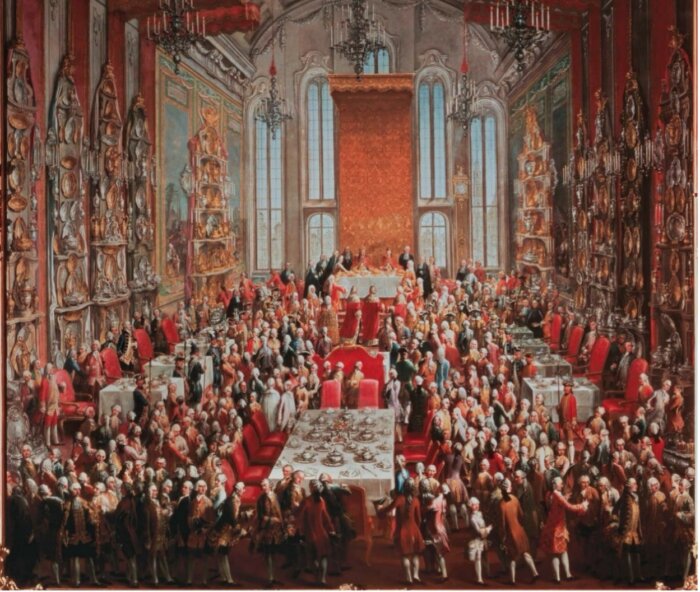
Eating and drinking are activities inextricably linked to the culture of celebration across all human societies. The art historian Axel Gampp concludes in his essay Feast versus Celebration that, despite the plethora of accounts of such events at the time and the numerous instruction manuals for any festivity, there is a strange lacuna in contemporaneous theorization of festivities; there are plenty of descriptions, but no theory of the feast. [15] Gampp drew an exhaustive tree model of the different kinds of early modern festivities, in which dining appears under multiple sub-categories of the “profane” branch, encompassing courtly and private settings, indoor and outdoor occasions, and events open to all or by invitation only. One of the rare visually documented examples from this branch is the coronation banquet of Emperor Joseph II of the Holy Roman Empire inside the Römer in Frankfurt, 1764 (see fig. 1); it was a profane, courtly, indoor, and closed-frame festive event integral to the secular ceremonies of the new ruler’s ascension to the throne.
The inclusion of dining in all types of celebrations is not at all surprising, and Gampp highlighted another commonsense aspect of festivities: that every event is, almost by definition, an interruption of daily life and routine. [16] Reflecting on Kristiaan Aercke’s well-known Gods of Play: Baroque Festive Performances as Rhetorical Discourse, Gampp maintained that a festivity as something “marvelous is […] an indicator that the feast and everyday life are quite different, that they are in fact separate worlds.” [17] The occasions considered in this paper are precisely of this extraordinary character.
There is also a crucial distinction associated with the social nature of this type of material culture, a nature that is linked to the cultural significance of these artefacts and designs. This distinction is made possible only through the German language and via the work of modern scholars on two terms used to denote a festivity in it: Fest, and Feier. The word Fest refers to a revelry that is somewhat uncontrolled and inherently excessive. Feier refers to occasions that are primarily about “forming groups, about justifying, about meaning, and about a lack of emotion, or perhaps a sort of ‘choreography of emotions,’ as Doris Kolesch once called it,” and these occasions are “based on a consciously elaborated idea or a world view that is updated in it.” [18] Interestingly, the formal dining of the elites appears to have been balanced between these two notions as the eighteenth century progressed. A meal ‘of extraordinary character’ featured a carefully choreographed, meaningful layout, with a table surface crowned by a centerpiece. With its unruly consumption—of the sort described in the previous section—the perfection of the meticulously created food displays would be utterly destroyed. At the end of the meal, the only part that remained relatively unaltered was the centerpiece itself, and even this was only in cases when no parts of it were meant for consumption.
4_Two Exceptional Cases
The examples of Naples, Venice, and Vienna were certainly not the only European regions with a festive material culture, whether for social or political events. On the contrary, these examples reflect the characteristic diversity associated with festive dining across the continent at the time. They highlight the level of effort and expense for the purpose of strategically communicating curated narratives and ideas about the host and the occasion.
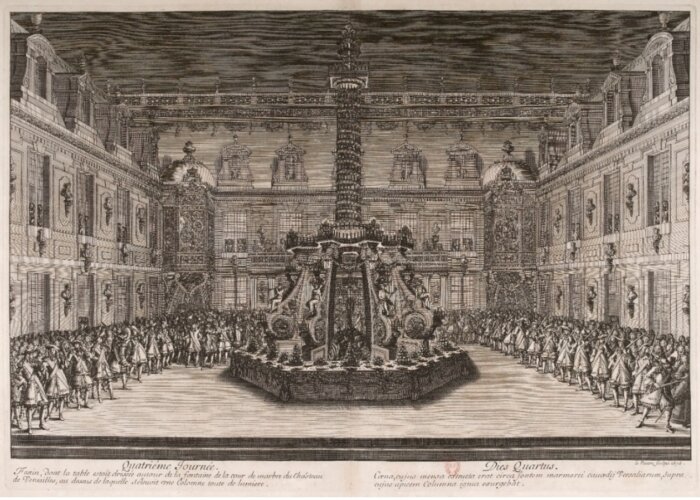
On the night of 28 July 1674, the former inner court of Louis XIII’s hunting lodge that became the inner courtyard of Louis XIV’s expansive palace of Versailles, known as the Cour de Marbre, served as the backdrop for a celebratory medianoche (a supper served after midnight). [19] The occasion was one in a series of festivities to celebrate the French king’s recent victorious expansion of French territory into the formerly Spanish-ruled Franche-Comté region. The medianoche, as depicted in fig. 2, followed a buffet-style banquet, theatrical performance, and fireworks display in the palace’s formal gardens, and was the final celebration for the day. The meal unfolded to the sounds of the court’s gurgling fountain and a string ensemble, lasting until two in the morning.
At the time, the center of this courtyard featured a fully functioning black marble fountain, most likely octagonal in shape and adorned with a group of gilded figures. [20] The designer of the setting, Luigi Vigarani, ingeniously incorporated the fountain into a gigantic, ephemeral, illuminated structure he erected in the middle of the Cour de Marbre. He also added illuminations on the surrounding pillars, cornices, and roofs of the palace to accentuate the design’s visual effect while meeting practical needs at night. [21] An octagonal table was built around the fountain, with a perimeter of at least twenty-five meters, laden with food as well as festoons of orange flowers, roses, and carnations. [22] Inside the octagon’s circumference stood an enormous, highly ornate construction consisting of two main parts, whose details were captured by André Félibien in the festival book published after the festivities had concluded. [23]
In the lower part of the structure, eight fourteen-foot-high principal consoles of lapis rested on the eight corners of the laden table, carrying an octagonal ceiling and holding hanging festoons of fruits and flowers. [24] Eight large figures of silver, draped in gold, lingered on the eight principal consoles and appeared to be playing country instruments. [25] The ceiling above those consoles was divided into panels of gold and azure, with substantial gold roses supporting crystal chandeliers. [26] The entire cornice and all the edges of that ceiling were marked with candles, and on each of its edges stood a candelabrum. [27]
The upper part of the celebratory structure was an enormous Tuscan-order hollow column. It was modelled on the Roman Emperor Trajan’s triumphal column, erected in Rome in 113 CE to commemorate his victory in the Dacian Wars. In Vigarani’s design, the ephemeral and wireframe column was eighteen feet high, with a shaft formed by a continuous festoon of golden flowers that spiraled to the column’s capital; the festoon carried six hundred candles, according to Félibien. [28] On top of the column was a large vase with a crown, a direct reference to Louis’s reign and strongly associated with the military victory, which was, after all, the main reason for the celebration. The choice of imagery was deliberate and legible to any informed observer at the table. The Trajanic column, a monument explicitly commemorating a Roman emperor’s foreign military conquest, translated Louis’s victory in Franche-Comté into the language of ancient imperial triumph, positioning him as heir to Rome’s military tradition. The crown placed atop the structure completed this message: in this context, the crown unambiguously asserted sovereign dominion, which lent the temporary dining structure the weight of a permanent monument, immortalized in a circulated engraving.
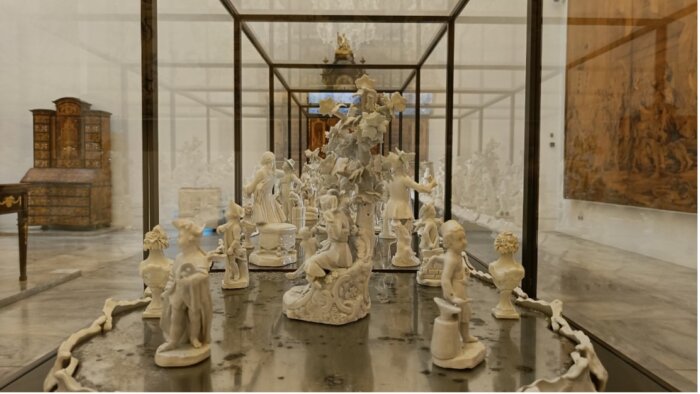
Almost a century later, in 1767, another ensemble was created for a festive dining occasion, which remains to this day one of the most impressive porcelain ensembles conceived as a centerpiece that has reached our times intact. It is the so-called “Zwettl Centerpiece,” now on permanent display in the Baroque-Rococo-Classicism Hall in the Museum of Applied Arts in Vienna (MAK), as seen in figures 3 and 4. [29] The ensemble was commissioned as a complete set (Desserte in the original related documents) from the Vienna Imperial Porcelain Manufactory in 1767 to commemorate the fiftieth anniversary of the day Rayner Kollman, Abbot of the Zwettl Cistercian Monastery in modern-day Lower Austria, made his final vows and devoted himself to the abbey. The commissioner was the abbey’s prior, P. Placidus Assem, the mastermind behind the celebrations in 1768. The feast itself was to take place in the Festsaal of the abbey, a space with illusionistic frescos depicting outdoor settings and the Allegory of Temperance made by Joseph Schitz. Nearby stood the abbey’s library with frescos of the Labors of Hercules, famously painted by Paul Troger, the leading Austrian Baroque fresco artist.
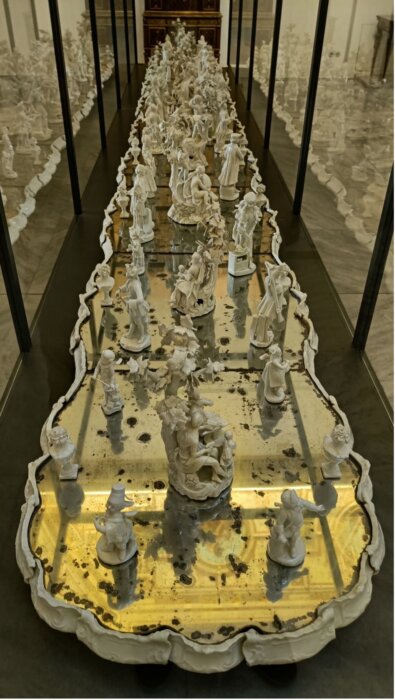
The ensemble’s iconographic program, admittedly secular in theme, was carefully layered to operate on multiple levels simultaneously, addressing the diners as both celebrants of a specific occasion and members of a broader educated culture. At its center was a group of figures glorifying the production of porcelain, the very material of which the centerpiece was made. This was a self-referential gesture that would not have been lost on an eighteenth-century audience attuned to the renowned prestige of Vienna’s Imperial Manufactory. Surrounding this central group, the figures of Architecture, Poetry/Literature, Drama, Astronomy, and Geography evoked the liberal arts and sciences, framing the Abbot’s jubilee within a world of learning and cultivation befitting a monastic context. The four large subgroups depicting divine couples under trees—Paris and Venus, Neptune and Amphitrite, Apollo and a muse, and Venus and Vulcan—give it an elevated, Arcadian register thoroughly conventional in aristocratic decorative programs of the period, yet here unusually incorporated into an ecclesiastical setting. Accompanying these were four smaller sub-groups with similar mythological themes; eighteen figures of singing tradespeople; chinoiseries; cupids in various attires; and eighteen miniature flower vases. [30] The tableware completing the set included forty-eight soup bowls, seventy-two sweetmeat dishes, eight saltcellars, and two saucières: an admittedly magnificent gift for the Abbot’s jubilee, and one whose iconographic richness made clear that this was no generic commission, but rather an ensemble conceived with careful attention to its occasion and setting. In Andreas Gamerith’s words, the ensemble was commissioned with the intention of showcasing “the worldly representation and religious identity as an inseparable union.” [31]
A few months after the original delivery of the centerpiece, an additional delivery of four tall figures was made to the abbey, the four cardinal virtues (prudence, justice, fortitude, and temperance). [32] Gamerith maintained that this addition was an attempt to “recalibrate” the overly secular theme of the centerpiece into something more pious and fitting for the jubilee of an aged abbot. In an alternative interpretation by Matthew Martin, these custom-made figures arrived later than the original shipment because they were not in stock at the Imperial Manufactory and therefore had to be specially produced. This group of figures played an integral role in connecting the ensemble with the abbey itself, since the center of the Festsaal’s ceiling features a fresco of Temperance. In addition, ceiling frescoes depicting the personifications of those exact four virtues were executed in 1733 by the same artist in the library of the prestigious Benedictine monastery of Melk, just before the artist’s commission for the library at (the Cictercian) Zwettl. The resonance between the porcelain figures and the painted personifications would have been immediately apparent to anyone familiar with the frescoes, which is to say to every guest present at the feast. Diners seated at the Festsaal table, around the porcelain ensemble, would have experienced a form of iconographic rhyming between the objects before them and the images they knew from the two monasteries’ most prestigious interior spaces: the same virtues, rendered in two different media, in different parts of the buildings, converging on the occasion of the Abbot’s jubilee. This layering of meaning, a secular festivity inflected by monastic virtue, and the luxury of white porcelain tempered by the gravity of Prudence, Justice, Fortitude, and Temperance, is precisely what makes the Zwettl centerpiece an exceptional case of ensemble here: it was commissioned and specially curated for the needs of one celebratory dining occasion. [33]
The Italian cases described above both confirm and extend the picture offered by the two main case studies here, while also revealing the range of contexts within which this shared visual culture operated. Where Vigarani’s structure at Versailles was conceived for a single night’s political theater and was dismantled immediately after, Latini’s elaborate figurative food was equally ephemeral but belonged to the private, festive sphere of a noble wedding. The Venice trionfi da tavola, by contrast, were commissioned by civic authorities for a diplomatic occasion, demonstrating that the same material vocabulary (mirrors, architectural elements, heraldic and naturalistic objects) could be deployed across royal, ecclesiastical, civic, and private contexts alike. Taken together, these four cases make visible not a uniform practice but a shared system of signifiers, flexibly adapted to the specific demands of each occasion, host, and guest of honor. Notably, the contrast between the military/political register of Versailles and the ecclesiastical one of Zwettl does not imply a fundamentally different visual vocabulary. As all four cases demonstrate, the same repertoire of symbols, materials, and iconographic strategies circulated across secular and religious contexts alike, each time adapted to reflect specific needs and goals.
I would like to highlight a couple of crucial observations in the two main cases. The first one concerns the evidently site-specific character of the ensembles. For both commissions, efforts were made to appear linked to the spaces where they would temporarily become visual highlights of the feasts. Vigarani’s creation used the existing marble fountain as the literal center around which the entire structure would be anchored, with the water cascade as an added feature, astonishing the guests. The choice of the fountain as the literal anchor of the structure was far from incidental: water management was among Louis XIV’s most celebrated engineering achievements at Versailles, and the hydraulic systems supplying the palace’s numerous water features were a source of royal pride and a marvel that visitors from across Europe came to witness. By making the existing marble fountain the physical and symbolic heart of the medianoche setting, Vigarani tightly linked his spectacular temporary centerpiece to an already iconic permanent feature, merging the two spectacles of tamed nature and military triumph. The Zwettl centerpiece equally included such figural elements in its overall composition so as to link it to the very edifice that housed it at the feast and in which the abbot had spent the largest part of his life.
The second observation is that both ensembles exhibit an event-specific character. Core design elements of Vigarini’s ensemble, on the one hand, alluded to Louis’s military victory, glorifying him: the octagonal shape of the table directly related to the frequently-used shape in military fortifications at the time; the impressive triumphal column rising from the very geometric center of that octagon an allusion to Trajan’s column, the monument reminding the Romans of the victorious battles of their Emperor. The Zwettl centerpiece, on the other hand, had much less grand statements to make, but its grandeur marked the 50-year jubilee accordingly. The material was porcelain, called ‘white gold’ at the time due to its price, and reflected the high honor and significance of the Abbot. Also, the number of celestial and earthly figures in the composition created a bedazzling effect on the diners gathered around the feast’s centerpiece.
In Gampp’s vocabulary, the Versailles medianoche belongs unmistakably to the register of Feier: leaving nothing to chance, every element of Vigarani’s construction—the triumphal column, the octagonal table, the crown atop—was consciously elaborated to communicate a specific idea, that of Louis’s victory and sovereignty over a region. The Zwettl jubilee, by contrast, navigated the boundary between the two terms with particular subtlety: the sheer abundance and variety of the porcelain ensemble—over a hundred figures and tableware pieces—tilted it toward Fest, while the deliberate iconographic program tying elements to the Abbot’s anniversary, specific monastic spaces, and their values firmly anchored it in Feier.
The site-specific and event-specific characters render the two main cases truly unique, leaving a singularly powerful, if fleeting, impression. These compositions epitomized celebration in the most overt, impactful, and tangible way, materializing before one’s very eyes.
5_Representation as the Mechanism for the Creation of Narrative and Meaning
The characters of the centerpieces examined above were integral in shaping the participants’ understanding and experience of the celebration. They could only be materialized through the representational logic of the artefacts in this family of objects.
Nobility Dines: The Laden Table as a Projection Plane is the revealing title of a paper on the dining practices of modern German nobility. It details how hosts of such status chose to project specific attributes by selecting certain colors, figures, materials, inherited/collected objects, and arrangements. [34] Individual choices about the appearance and experience of a formal meal mattered greatly for the correct communication of ideas through a dining event invested with any significance, a truth as valid today as it was in the long eighteenth century.
The system of creating mental links between the iconographic content of an ensemble and particular qualities of the owner was materialized and demonstrated via display; it was also profoundly expressed in the dining practices of the time. Forms of display, such as the ones used in Louis XIV’s nocturnal banquet and the Zwettl Centerpiece, render tabletop compositions the ideal media to communicate ideas and allusions, “signposting” them in the very middle of all activity during the meal. In other words, the individual elements used to build those ensembles demonstrate their ability to perform one crucial function in addition to any element of practicality: to ‘represent,’ either by displaying what is already there or by alluding to something absent.
Besides any practical function, centerpieces were also placed in the middle of a table setting to be displayed. This display had the double sense of unfolding the host’s riches and, by extension, taste, but also in the sense of an object put on show to be looked at. Because of their iconic design, centerpieces were ‘representational’: they represented fruit, foliage, gods, heroes, edifices, etc. But they were also ‘representative’: they were representations of their host’s status and attributes. This is perhaps more clearly expressed in German than in English: the term Representation in German can have a clear ceremonial connotation, not just a semiotic one, where the stress lies on an object representing something absent, which is perhaps more dominant in English usage. [35]
The French understanding of représentation in the same period is equally instructive, and particularly relevant given that the Versailles case examined here belongs squarely to French court culture. Antoine Furetière’s Dictionnaire universel, published in 1690, lists among the meanings of représentation the act of presenting something or someone before an audience to witness—a meaning that is at once theatrical, political, and social, and that maps closely onto the practice of elite festive dining. [36] The ceremonial dimension of the concept was further analyzed by Louis Marin in Le Portrait du roi, where he demonstrates how representation in the French absolutist context functioned as a mechanism of royal power: the king’s image, whether in portraiture, pageantry, or festive display, did not merely depict royal authority but actively constituted and performed it. [37] Applied to the festive dining context, Marin’s argument illuminates why an ensemble such as Vigarani’s structure at the Cour de Marbre in 1674 was not simply decorative but genuinely political: it did not represent Louis XIV’s power so much as enact it.
The word repraesentare first appeared in late Roman Antiquity to describe the concept and act of (vividly) representing someone or something absent, i.e. in place of that someone or something. The meanings of the root verb praesentare and the prefix re- are essential to our discussion: praesentare meant to ‘present,’ literally ‘to place before (one’s eyes)’; the prefix re-, ‘again,’ ‘back,’ ‘anew,’ or ‘against’ added intensification to the act. [38] The complete verb thus entailed the acts of ‘making present,’ ‘setting in view,’ ‘showing,’ ’exhibiting,’ and ’displaying,’ often to convey a message, or make something visible.
In Latin rhetoric, especially, repraesentatio was one of many powerful devices at hand to achieve persuasion and was closely related to concepts such as evidentia and illustratio. [39] Although the term was not very common in Latin before the first century CE, its documented usage in rhetoric and writings on politics and history give a sense of this double meaning. In politics, it was used to make present, discuss, or refer to who or what is absent; in rhetoric it was used, for instance by Quintilian, to describe the orator’s capacity to recall or evoke powerful emotions, and thus to add to the persuasive power of his speech. [40] In medieval Latin and in modern languages, repraesentatio and its German cognate acquired a broader meaning, and could mean, depending on the context, ‘Vorstellung,’ ‘Darstellung,’ ‘Abbild,’ ‘Bild,’ or ‘Stellvertretung.’ [41]
The concept of ‘representation’ was even more significant in the use of the centerpiece for state occasions, given the political nature of the context. Representation was profoundly understood and consciously practiced within the courts and political centers across the continent. [42] In the kitchens of Hofburg, the administrative center of the Holy Roman Empire in Vienna, for example, staff would often work for weeks (if not longer) to produce ephemeral ornamental compositions for important public dining events. [43] Similar intensive work took place in the workshops at Versailles for the production of Vigarani’s ingenious structure at the Cour de Marbre in 1674, involving carpenters, engineers, set designers, sculptors, and painters, among many other crafts. Evidently, similarly intensive labor was needed for the creation of the other ensembles discussed.
In this context, finally, it is worth remembering that any member of the nobility at the time was expected to “maintain a lifestyle that was self-evidently noble”: actual or aspiring members of these ranks were expected to dedicate enormous funds to dining as part of this noble lifestyle. [44] Thus, the material culture produced for these social groups during the early modern period had to represent their lifestyle and status, encompassing all the developments, values, and characteristics that those entailed.
6_Conclusion
The examination of festive dining culture in early modern Europe reveals a complex interplay of material, symbolic, and socio-political distinction in the elaborate compositions produced to adorn table centers on celebratory occasions. The two main cases considered here, Louis XIV’s nocturnal banquet of 1674 at Versailles and the Abbot’s jubilee celebration at Zwettl Monastery in 1768, along with the comparative examples of the Feroleto-Mirandola wedding in 1687 and the Queen of Naples’ visit to Venice in 1768, demonstrate that festive dining went far beyond the provision of sustenance or the straightforward marking of elite identity. The material culture created for these occasions, centerpieces in particular, performed the functions of representation, epitomization, and reiteration. Centerpieces did not merely reflect the values and hierarchies of the occasion; instead, they actively enacted them before all those present. In Gampp’s terms, these events, and the material culture associated with them, belonged to a world categorically separate from ordinary life, one defined by consciously elaborated meaning rather than spontaneous excess.
In terms of design, the centerpieces for the festive events examined here were not only site-specific but also event-specific: their features were tightly bound to a given spatial setting and occasion, outside of which they made little sense as objects. This dual characteristic is what distinguishes them within the broader culture of celebrations in early modern Europe. Such compositions signposted the concepts and values associated with each occasion at the very center of the dining experience—in the midst of the gradual unfolding of the feast itself. And because they represented, narrated, and epitomized those values in tangible, material form, they constitute exceptionally rich evidence for the historian: objects through which unknown or underexplored facets of European elite culture become legible in ways that written sources alone cannot achieve.
The material culture of festive dining in the early modern period created compositions and rituals whose reverberations extend well into the dining practices of later Western societies, including our own. Understanding its significance means recognizing that the centerpiece was never merely decorative: it was a statement, made in silver, porcelain, sugar, even light, about who the host was, what the occasion was about, and what kind of ‘world’ the feast, however briefly, brought into being.
_How to Cite
Panagiotis Doudesis. “Ancient Roman Columns, Eagles, Sciences, and Other Representations: Centerpieces and the Ornamentation of the Early Modern European Festive Table Setting.” On_Culture: The Open Journal for the Study of Culture 20 (2026). <https://doi.org/10.22029/oc.2026.1545>.

_Endnotes
- [1] Felipe Fernández-Armesto, Near a Thousand Tables: A History of Food (New York: The Free Press, 2002), 101–108.
- [2] Fernández-Armesto, Near a Thousand Tables, 103.
- [3] Georges Bataille, La Part Maudite (Paris: Éditions de Minuit, 1949); trans. by Robert Hurley as The Accursed Share (New York: Zone Books, 1988). For the concept of unproductive expenditure (la dépense), see also Bataille’s earlier essay “La Notion de dépense,” La Critique Sociale, no. 7 (1933), 167–181.
- [4] For Ken Albala, cuisine can be defined as “generally recognized sets of ingredients, procedures, and flavour combinations handed down through generations.” In Eating Right in the Renaissance (Berkeley/London: University of California Press, 2002), Albala uses the word with particular reference to gastronomy, a term that emerged in the English language around the beginning of the nineteenth century and has come to mean “the art and science of delicate eating,” see Oxford English Dictionary, “gastronomy (n.),” July 2023, <https://doi.org/10.1093/OED/2179970750>.
- [5] Albala, Eating Right in the Renaissance, 2.
- [6] Albala, Eating Right in the Renaissance, 2; for the concept of habitus, see Pierre Bourdieu, Distinction: A Social Critique of the Judgement of Taste, trans. by Richard Nice (Cambridge MA: Harvard University Press, 1984), 169–225.
- [7] Roy Strong, Art and Power: Renaissance Festivals 1450–1650 (Woodbridge: Boydell & Brewer, 1999), 42.
- [8] Barbara Kirshenblatt-Gimblett, “Making Sense of Food in Performance: The Table and the Stage,” in The Senses in Performance, eds. Sally Banes and André Lepecki (London: Routledge, 2006), 71–88.
- [9] Ken Albala, The Banquet: Dining in the Great Courts of Late Renaissance Europe (Urbana: University of Illinois Press, 2007), 6.
- [10] Tommaso Astarita, The Italian Baroque Table: Cooking and Entertaining from the Golden Age of Naples (Tempe: ACMRS Press, 2014), 111.
- [11] Antonio Latini, Lo scalco alla moderna, overo l’arte di ben disporre i convitti…. (Naples: nella nuova stampa delli socii Dom. Ant. Parrino, e Michele Luigi Mutii, 1694), 555–63; Astarita, The Italian Baroque Table, 144–149.
- [12] For this summary of the banquet, see also Panagiotis Doudesis, “Wedding Feasts,” in Feast & Fast: The Art of Food in Europe 1500–1800, eds. Victoria Avery and Melissa Calaresu (London: Bloomsbury, 2019), 170.
- [13] Lina Urban, Banchetti veneziani dal Rinascimento al 1797 (Venice: Strategy & People, 2007), 163–167.
- [14] Urban, Banchetti veneziani dal Rinascimento al 1797, 164–167; according to Urban, the original item is found in Venice, Archivio di Stato B. 592, Savio Cassier.
- [15] Axel Gampp, “Feast (Fest) versus Celebration (Feier): Towards a Theory of the Baroque Festival,” in Revista de História da Arte: Baroque Festivals Between the Sacred and the Profane: Europe and the Atlantic, no. 10 (2021), 6–12. Gampp appears to have used the term “baroque” for the period extending well beyond the strict art-historical boundaries of the term, as he also uses the Encyclopedie and other eighteenth-century publications in his argumentation. Despite that, his arguments are relevant for this discussion.
- [16] Gampp, “Feast (Fest) versus Celebration (Feier),” 6–12, here: 9–10.
- [17] Gampp, “Feast (Fest) versus Celebration (Feier),” 6–12, here: 9–10; see also Kristiaan Aercke, Gods of Play: Baroque Festive Performances as Rhetorical Discourse (New York: State University of New York Press, 1994).
- [18] Gampp, “Feast (Fest) versus Celebration (Feier),” 6–12, here: 10–12. Gampp is heavily reflecting the sociologist Winfried Gebhardt for these notions. For the quotes and the argument, see Winfried Gebhardt, “Vom Verschwinden der festlichen Freiheit. Über das ‘Management’ der Gefühle in hybriden Events,” in Hybride Events: Zur Diskussion zeitgeistiger Veranstaltungen, eds. Gregor J. Betz et al. (Berlin/Heidelberg: Springer, 2017), 37–47, here: 38–39; for Doris Kolesch’s phrase, see Doris Kolesch, Theater der Emotionen. Ästhetik und Politik zur Zeit Ludwigs XIV (Berlin: Campus Verlag, 2006), 95–104.
- [19] La Curne de Sainte-Palaye et al, Dictionnaire Historique de L’ancien Langage François, Ou, Glossaire de La Langue Françoise Depuis Son Origine Jusqu’au Siècle de Louis XIV (Paris: NIORT, 1875).
- [20] For the adornment of the fountain, see André Félibien, Description Sommaire Du Chasteau de Versailles (Paris: Imprimerie Royale, 1674), 15. For the octagonal shape, see François Souchal, Françoise de La Moureyre and Henriette Dumuis, eds., French Sculptors of the 17th and 18th Centuries: The Reign of Louis XIV, vol. III (London: Faber and Faber, 1977), 52.
- [21] André Félibien extensively described the complex design in the text of the well-known festival book published only a few months after the celebrations: see André Félibien, Les divertissements de Versailles, donnés par le roi à toute sa cour, au retour de la conquête de la Franche-Comté, en l’année 1674 (Paris: J.-B. Coignard, 1674), 13–18. For an additional description of Vigarani’s design, see Jérôme de la Gorce, Carlo Vigarani, Intendant Des Plaisirs de Louis XIV (Paris: Perrin, 2005), 156–158. The engraving shown here is accompanying Félibien’s text, and is in fact the only event of the day chosen to be depicted out of the four events in total. What is more, the publication’s engraving shows no illuminations on the palace walls, unlike the accompanying text where a description of these illuminations can be read. Also, see for this note: Élisabeth Caude, Béatrix Saule, and Jérôme de la Gorce, Fêtes et Divertissements à la Cour (Paris: Gallimard and Editions du Château de Versailles, 2016), 328.
- [22] For the original description, see Félibien, Les divertissements de Versailles, 13–18. As for the units used here, the feet correspond 1:1 to the pied (du roi), the unit used by Félibien.
- [23] Félibien, Les divertissements de Versailles, 13–18.
- [24] Félibien, Les divertissements de Versailles, 13–18.
- [25] Félibien, Les divertissements de Versailles, 13–18.
- [26] Félibien, Les divertissements de Versailles, 13–18.
- [27] Félibien, Les divertissements de Versailles, 13–18.
- [28] Félibien, Les Divertissemens de Versailles, 13–18.
- [29] For discussions on this centerpiece, see Andreas Gamerith, “At a Loss for Words: The Zwettl Centrepiece and its Origins,” in 300 Jahre Wiener Porzellanmanufaktur, eds. Christoph Thun-Hohenstein and Rainald Franz (Stuttgart: MAK Wien/Arnoldsche, 2017), 32–41; also, Gary Schwartz, The Emotional Turn, 18 April 2017, <http://www.garyschwartzarthistorian.nl/351-the-emotional-turn/>; also Jakob von Falke, “Kunstgewerbemuseum: Wiener Porzellanplastik,” in Berliner Museen 41, no. 3 (1920): 1–8; also, Matthew Martin, “Porcelain and Catholic Enlightenment: The Zwettler Tafelaufsatz,” in Eighteenth-Century Life 45, no. 3 (2021): 116–134.
- [30] Gamerith, “At a Loss for Words,” 35 & 39. No known sources indicate how the centrepiece was used and received during the actual celebrations, or how it was used in feasts inside the monastery in the subsequent years before the institution’s dissolution.
- [31] Gamerith, “At a Loss for Words,” 41.
- [32] Gamerith, “At a Loss for Words,” 37.
- [33] Contrastingly, Gamerith argues that the overall theme of that same centrepiece was loosely connected to the celebration, an argument that stands when the ensemble is examined based on the overtly secular theme of the majority of its elements. Gamerith, “At a Loss for Words,” 32–41.
- [34] See Josef Mazerath, “Adel isst: Der Gedeckte Tisch als Projektionsfläche,” in Projektionsflächen von Adel (Historische Zeitschrift / Beihefte), eds. Silke Marburg and Sophia von Kuenheim (Oldenbourg: De Gruyter, 2016), 25–48.
- [35] I am indebted to Professor Caroline van Eck for directing my attention to those concepts and for clarifying these complex linguistic distinctions.
- [36] Antoine Furetière, Dictionnaire universel, contenant généralement tous les mots françois tant vieux que modernes (La Haye and Rotterdam: Arnout et Reinier Leers, 1690), s.v. “Représentation,” 1793, <https://gallica.bnf.fr/ark:/12148/bpt6k50614b/f3.item>. The entry defines représentation in many terms alongside its semiotic sense. The semiotic definition appears as follows: “Image qui nous remet en l’idée et en la mémoire les objets absenes (sic.), & qui nous les peint tels qu’ils sont” [an image which brings back to mind and memory the absent objects, and which paints them for us as they are], trans. by the author. The other terms concern the concept in relation to ecclesiastical and theological affairs; painting as an artistic medium that depicts activities, events, and stories, ‘whether true or false’; juridical affairs, in terms of proving and enacting; finally, a person’s trait of being.
- [37] Louis Marin, Le Portrait du roi (Paris: Minuit, 1981), trans. by Martha Houle as Portrait of the King (Minneapolis: University of Minnesota Press, 1988), 6–7 for the argument on representation as ‘power-effect.’ For Marin’s central argument that royal representation does not merely depict but enacts power, in fact it constitutes representation itself, see in particular the chapter “Third Entrance: ‘A portrait of Caesar is Caesar’ or the King in his Frame,” 169–214.
- [38] The use and meaning of this prefix are very complicated to trace with extreme accuracy, even within the Latin tradition: see Online Etymology Dictionary, “re-,” accessed January 25, 2024, <https://www.etymonline.com/word/re->; see also Oxford English Dictionary “re- (prefix),” March 2026, <https://doi.org/10.1093/OED/1031113569>.
- [39] “Repräsentation,” in Historisches Wörterbuch der Philosophie, eds. Joachim Ritter and Karlfried Gründer (Basel: Schwabe Verlag, 1992), 790–791.
- [40] See James Ker, “Roman Repraesentatio,” American Journal of Philology 128, no. 3 (2007): 341–365.
- [41] See Eckart Scheerer et al., “Repräsentation,” in Historisches Wörterbuch der Philosophie online, accessed October 22, 2023, <https://www.schwabeonline.ch/schwabe-xaveropp/elibrary/start.xav?auth=pwd&start=%2F%2F*%5B%40attr_id%3D%27verw.reprasentation%27%5D>.
- [42] On the highly significant “public eating” practice of European rulers and the links to representation, see also Michaela Völkel’s writings connecting Jürgen Habermas’ concept of “repräsentative Öffentlichkeit” and Ernst Kantorowicz’s concept of the “king’s two bodies” in Völkel, “Die öffentliche Tafel an den europäischen Höfen der frühen Neuzeit,” in Die öffentliche Tafel: Tafelzeremoniell in Europa 1300–1900, eds. Hans Ottomeyer and Michaela Völkel (Berlin: Deutsches Historisches Museum, 2002), 10–21, here: 10–11; for a discussion on ceremonials as a system of signs, see Thomas Rahn, “Herrschaft der Zeichen: Zum Zeremoniell als ‘Zeichensystem,’” in Die öffentliche Tafel: Tafelzeremoniell in Europa 1300–1900, 22–31.
- [43] Ingrid Haslinger, a prominent scholar of dining practices in the Holy Roman Empire, is one of the many to acknowledge the ‘representational character’ of public eating events. See Ingrid Haslinger, Küche und Tafelkultur am kaiserlichen Hofe zu Wien: Zur Geschichte von Hofküche, Hofzuckerbäckerei und Hofsilber- und Tafelkammer (Bern: Benteli Verlag, 1993), 9.
- [44] Jerzy Lukowski, The European Nobility in the Eighteenth Century (London: Palgrave Macmillan, 2003), 122–123; for the quote, see Hamish M. Scott and Christopher Storrs, “Introduction: The Consolidation of Noble Power in Europe, c.1600–1800,” in The European Nobilities in the Seventeenth and Eighteenth Centuries, vol.1: Western Europe, ed. H.M. Scott (London/New York: Longman, 1995), 9–10.