Coffee, Cocaine, and Roller Coasters
The Making of Memory in Colombian Theme Parks


1_Introduction
“Coffee, cocaine […] That’s what the tourists expect when they come [to Colombia],” offered Gabriel with a half-smile. [1] A self-described hippie and lifelong resident of the region that hosts the Parque del Café, he has witnessed waves of tourists arrive in search of a country they thought they already knew: its rolling hillsides draped with coffee trees, the pastoral charm of campesino life, and the lingering, perfumed shadow of narcotic excess. One a celebrated patrimonial crop, the other the country’s most infamous export, coffee and cocaine are among the most powerful material symbols through which Colombia is imagined from the outside and within. They are stereotypes, commodities, and mythologies.
This _Article follows what happens when mythologies are given gates, entrance fees, and roller coasters at two of Colombia’s most emblematic tourist destinations. The first, Parque del Café, nestled in the verdant hills of Quindío, offers visitors an idyllic vision of Colombian coffee culture, Antioqueño architecture, sprawling plantations, and cultural museums embalmed in nostalgia in the UNESCO-recognized Coffee Cultural Landscape. [2] The second, Hacienda Nápoles in Antioquia—built on the former estate of notorious narcotrafficker Pablo Escobar—has been reconfigured into a family-friendly spectacle, with water parks, a safari, and curated historical exhibits. Parque del Café emerged in 1995 from the first wave of Colombian tourism rebranding, converting coffee’s economic collapse into cultural capital, while Hacienda Nápoles opened in 2007 as an instrument of government securitization, transforming a land of narco terror into a narrative of state triumph. The first park was built to celebrate what Colombia claimed to be; the latter to declare what it had overcome. Together, they convert two of Colombia’s most globally recognizable and historically freighted symbols into carefully staged spaces of leisure, pedagogy, and national celebration.
In Colombia, representations of national identity can never be politically benign. As Bushnell argues, the persistence of strong regional loyalties, from the Andean interior to the Caribbean coast, the Llanos to the Pacific, has complicated efforts to articulate a unifying national history or identity. [3] Layered on these divisions are the legacies of internal conflict that have shaped and scarred the landscapes this _Article examines. La Violencia, the mid-twentieth century civil war, left an estimated 300,000 dead and hundreds of thousands dispossessed across the coffee-growing regions of Antioquia, Caldas, and Quindío. [4] The guerrilla wars and narco violence that followed brought new waves of forced displacement and land-grabbing as armed groups seized territory, destabilized state authority, and reorganized entire regional economies. [5] And this ongoing violence, as many historians argue, never fully disappears, but is constantly reanimated in new and familiar forms. [6] As a result, Colombia’s memory landscape remains fractured, with victims, perpetrators, and institutions advancing competing versions of history that resist resolution. [7] In a country shaped by a mosaic of violence that refuses to go away, the acts of remembering, forgetting, and writing history take on a heightened and unfinished political charge.
The theme park may seem an unlikely arena for the writing of history. But amidst an assemblage of roller coasters, safari rides, birthday songs, and family photos, narratives are authored, memories curated, and histories rewritten. As I argue, these moments of manufactured joy become mechanisms through which contested and violent histories are domesticated and claims are made to Colombian identity. Birthdays and anniversaries become the social containers within which the unfinished business of nationhood is temporarily sealed. Past the turnstiles, these parks attempt to usher visitors into a world scrubbed clean of complexity and perfectly staged for collective consumption.
The theme park emerged in the mid-twentieth century, evolving from earlier traditions of pleasure gardens, world’s fairs, and amusement parks. [8] While prior forms of public celebration prioritized thrill and joy, the theme park carried a new ambition to construct coherent narrative worlds. Attractions became components of a larger story, carefully designed to immerse visitors in stylized environments where entertainment was suffused with meaning. As Hoffstaedter argues, the theme park is “an artificial cultural landscape in which visitors may immerse themselves to escape the realities of everyday life.” [9]
These parks, as I argue, exceed mere escapism. Drawing on Baudrillard, they function as “waste-treatment plants” for the imaginary, processing Colombia’s most difficult histories, depoliticizing them, and returning them to circulation as entertainment. [10] Through informal pedagogies like museums, cultural shows, and immersive performances, Hacienda Nápoles and the Parque del Café compress national histories into walkable landscapes, transmit moral and cultural values, and invite visitors to inhabit idealized visions of community and belonging. [11] In Colombia, the theme park takes the raw messiness of a history unfinished—colonial dispossession, civil war, and narco terror—and launders it into a consumable, celebratory form.
Colombia’s tourism policy has long oscillated between commodifying the country’s reputation for danger and cultural heritage and rebranding it as a safe, modern destination, a tension that the theme park was structurally suited to navigate. [12] It could commercialize Colombia’s “irresistibly intriguing” histories and heritage and offer the visitor an opportunity to consume them in a sealed, risk-free environment. [13] Today, over 410 parks draw 19 million visitors per year, turning celebration into an infrastructure of national self-presentation. [14]
In what follows, I combine historical and discursive analysis with six months of participant observation in the parks themselves and the surrounding communities in Puerto Triunfo and Quindío, supported by semi-structured and unstructured interviews with residents, local experts, visitors, and park workers. Working in the tourism industry in both regions gave me privileged access not only to the parks’ curated surfaces but to the workers, locals, and backstage conversations that official narratives work hardest to conceal. Through these methods, I trace how efforts to craft coherent national identities and sanitized histories are unsettled by the messy interplay of official narrative, visitor perception, and an unquiet, ongoing past. Following Biehl and Locke’s call to “move in the direction of the incomplete,” I approach these encounters not as illustrations of theory, but as sites where meaning and identity remain in flux, as people, stories, and their collective histories continually exceed analytical closure. [15] These cracks and leakages lay bare not only the fragility of top-down constructions of Colombian identity, but also the cathartic, celebratory, and often confusing fault lines between collective memory, institutional storytelling, and embodied experience. [16] The Colombian theme park is far from an innocent terrain of fantasy and celebration, nor is it a site where visitors are lulled into escapist fantasy. It is a porous stage where celebration and illusion collide with lived realities, as denied histories, erased lives, and a bleeding past intrude upon the tableaux beyond the turnstiles.
2_From Crop to Culture: El Parque del Café
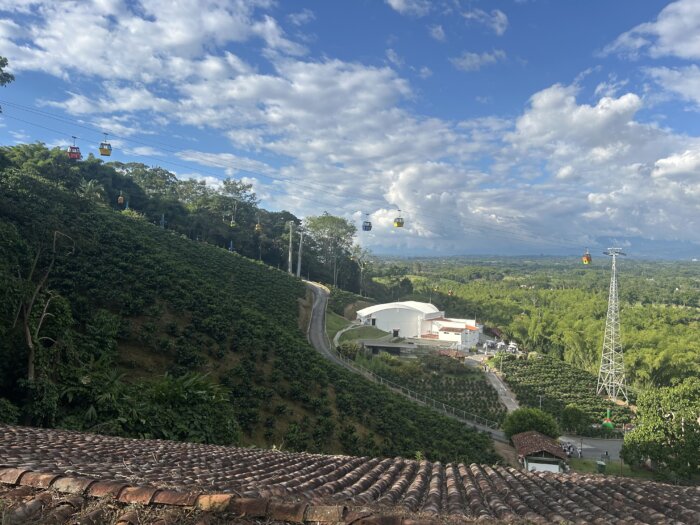
Past the ticket lines, the visitor is greeted by a saccharine panorama. Coffee trees arranged in perfect, measured rows soften the hillsides into the symmetry of a painted canvas; gondolas glide over a skyline of roller coasters and traditional Antioqueño architecture. Visitors navigate winding paths from museums and gift shops to the main square, church, and food courts. A train circles through the coffee farms, bamboo forests, and bubbling streams that give way to waterslides and roller coasters, as the occasional scream breaks through the din of laughter, conversation, and birthday songs. If the Parque del Café does little to emulate the realities of the cafetero lifestyle, it excels at staging the dream of it. [17]
Inaugurated in 1995 by the Federación Nacional de Cafeteros (FNC), the park, in its own words, pays homage to the 540,000 small coffee farming families of Colombia. [18] At first, it was a modest space: a working coffee farm, a regional museum, a few second-hand roller coasters imported from the United States. But the narrative was strong. At a moment when the country was reckoning with armed conflict, narco violence, and the deep class fissures produced by unequal land ownership, the park offered a pacified vision of rural life, celebratory and legible, in which the campesino was a figure of heritage and pride. It sutured local landscapes into global circuits of heritage tourism and gave visitors, and the nation, a version of Colombia to celebrate without the heaviness of history. In its first year, it drew 250,000 visitors. [19]
Three decades later, the park welcomes nearly a million visitors annually, with ever-expanding attractions, new roller coasters and water slides, and more immersive cultural displays. [20] Despite its growth, the park remains suspended in time. With bahareque architecture, manicured landscapes, and coffee plants meticulously pruned to maintain uniformity, visitors encounter a stylized rural idyll that promises to “transport you to a time filled with charm and tradition.” [21]
But this charm and tradition conceal a more complicated history. Coffee’s elevation to national symbol was inseparable from the Antioqueño colonization process in the nineteenth and early twentieth centuries. Official narratives celebrated it as the taming of ‘empty’ lands, erasing the longstanding presence of Indigenous and Afro-descendant communities. [22] Across the Quindío municipalities that now surround the Parque del Café, this meant systematic land conflict, where large concessionaires worked through legal means, complicit authorities, and outright violence to dispossess the poor farmers who had cleared and cultivated the land, reorganizing landholding in ways that privileged wealthy, white, entrepreneurial settlers. [23] As Palacios documents, citing Alejandro López, the colonization process was defined by a struggle between the “axe and legal papers,” epitomizing the class distinctions between coffee-farming families and the industrious large-scale landowners who dispossessed them. [24]
The history of the park’s governing body is equally fraught. The FNC was not, as Palacios documents, an organization that represented the interests of smallholder producers. [25] By the 1930s it had become a closed institution controlled by large producers and exporters, one that maintained small farmers at subsistence level while concentrating coffee income in the hands of intermediaries and commercial elites. [26] The institution that built a monument to the campesino historically subordinated his interests to those of the export bourgeoisie. These processes of accumulation and dispossession were central to the globalization of Colombian coffee and the elevation of Antioqueño culture as a national model of industriousness and morality. [27]
That dispossession would be compounded, decades later, by a different kind of upheaval. On July 18, 1975, Brazil, the world’s leading coffee producer, was struck by a devastating black frost. Ice punctured the very cells of the coffee trees, destroying nearly two-thirds of the country’s harvest overnight. Global prices soared from $0.50 to $3.00 per pound, and Colombia, long second to Brazil, suddenly became the world’s top coffee exporter. [28] This boom, or the Bonanza Cafetera, flooded the Eje Cafetero, or Coffee Axis, with unprecedented wealth.
“There was no culture here back then—nothing at all in the whole region,” explained Iván Restrepo, a lifelong hotelier and expert in tourism in Quindío, the department that would later host the Parque del Café. [29] As a young man during the Bonanza, he recalled how “farmers spent their money on women and booze. And then they bought huge houses, pools, estates.” He gestured animatedly as he shifted gears on the winding road that led towards the Parque del Café, bordered by hillsides teeming with coffee, plantains, and cacao. The paved roads, electricity, schools, and estates we passed are remnants of the Bonanza, which ushered in an infrastructure of modernity.
Yet prosperity was short-lived. Brazil’s coffee crops recovered, new competitors entered the market, and coffee became one of the most volatile commodities of the decade. Smallholders bore the brunt of this instability, which deepened after the 1989 collapse of the International Coffee Agreement and subsequent deregulation. Prices plummeted, production waned, and thousands of cafeteros abandoned the countryside for the cities. Restrepo remembers the aftermath vividly. “There were huge, empty estates, big pools, and no money. You couldn’t make a living just producing coffee anymore.” Out of this collapse, he explains, “that’s where tourism came in.”
The Federación Nacional de Cafeteros could no longer depend on coffee alone. Instead, they shifted towards the production of a potentially more profitable commodity: Colombian identity. The idea was promising. Instead of living at the whim of the dramatic volatility of the coffee market, the FNC turned to heritage as a strategy of differentiation, manufacturing narratives that portrayed the region as both timeless and exceptional, a paradisiacal landscape where the essence of Colombian-ness originated and resided. [30]
This shift coincided with the first wave of efforts to reconfigure Colombian tourism from violence to vibrance. [31] As Buitrago Tejada argues, this national pedagogy relied on stereotyping, recasting Colombians as “no longer savage or dangerous,” but instead “friendly and happy, and the territory […] a paradise.” [32] In the early 1990s, the Eje Cafetero had largely been pacified in the wake of La Violencia and was considered the country’s safe haven, or, in Restrepo’s words, “the Vatican of Colombia.” With the dual efforts of the Colombian government and the FNC, it became a protagonist in the country’s economic and cultural revival.
The branding campaign unfolded in two phases. First, the FNC worked to consolidate pride at both local and national levels by constructing a decisive regional identity. [33] The abandoned estates from the Bonanza Cafetera were reimagined as a constellation of cultural tourist destinations. These sites were reframed from remnants of a temporary windfall to markers of a heritage as old as the nation itself. In this phase, the FNC also crystallized the archetype of the Antioqueño cafetero: a white, Catholic settler devoted to land, family, and capitalism, mythologized as a man who transformed wild, empty lands into coffee and culture. [34] This figure took on flesh in Juan Valdez—mustachioed, donning a traditional wide-brimmed hat and poncho with a donkey at his side—a symbol that became the logo of the FNC, the symbol of the entire coffee-making region, and eventually, of Colombia itself on the global stage. This first phase of territorial rebranding worked to naturalize the imported crop as an essentially Colombian product, inscribing it as a marker of national identity and cultural belonging.
The second phase of the FNC’s project was more intimate. It aimed to educate locals to internalize and perform these values, embracing the identity of Juan Valdez. Its stated goal was to “motivate and inform the inhabitants of the municipalities and rural villages […] so that they become familiar with their heritage, strengthen their sense of belonging to the region, and commit to the development and preservation of their heritage.” [35] Communication strategies urged residents and local authorities to “cultivate a sense of belonging” and to assimilate the values of coffee culture. [36] Citizens were “informed” of an official heritage that represented them, so they might “familiarize themselves with it” and commit to its protection. [37] In practice, culture became a prescription: defined by experts, then transmitted to communities to embody and perform.
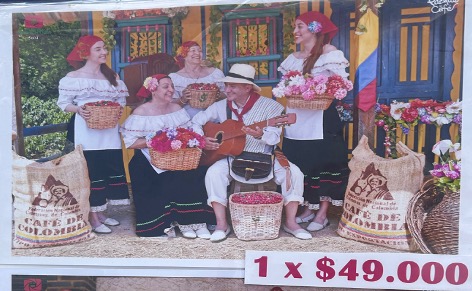
With the Parque del Café, this project of national branding was given spatial form, marrying the logics of Disneyland to the iconography of Colombian cafetero identity. For 49,000 pesos, or about fifteen US dollars, any visitor can become a cafetero for the day, posing in traditional garb in front of a tableau of a campesino home, guitarra in hand, beside enormous sacks of coffee stamped with the FNC logo. [38] For those seeking a deeper immersion, an ecological path departs from the colonial village and roller coasters, crossing a shaded stream before ascending to a covered amphitheater. Inside, children dance in their seats, families wave Colombian flags, and an unseen voice booms: “¿Quiénes están orgullosos de ser Colombianos?” [Who is proud to be Colombian?] The crowd roars, the floor shakes, and the lights dim.
The Show del Café, the park’s most emblematic event, finds the sweet spot between celebration, education, and narrative production. Folkloric dancers in brilliant costumes perform the “story of coffee,” as a theatrical voice narrates from above. Vignettes begin with coffee’s arrival in the Eje Cafetero—“the great land of illusion and peace”—and its cultivation by “good, hardworking people.” [39] Romance blossoms between coffee trees; actors demonstrate traditional dances; the globalization of Colombian coffee is staged as a “cargo carried by the hopes and dreams of Colombian men.” Religious piety, land conquest, economic success, and the beauty of Colombian women intermingle in a performance culminating with the refrain: “Coffee gave rise to our identity.” [40]
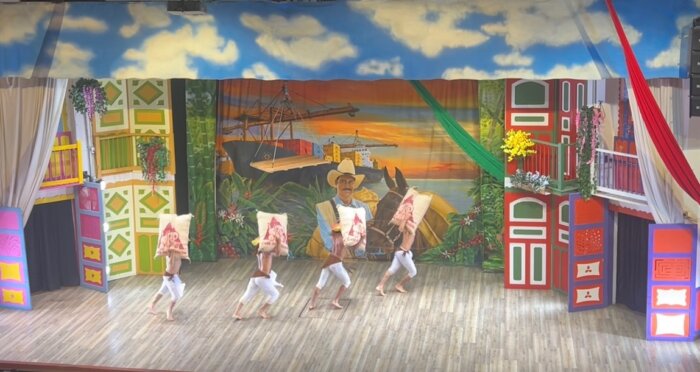
Within the park’s carefully curated vignettes and campesino tableaux, visitors are invited to celebrate an alternative history of Colombia, cultivating nostalgia for a past that never truly existed. By privileging the Juan Valdez myth, the park rewrites Colombian history in a way that justifies Antioqueño colonization. Histories of conquest and appropriation are woven into a consumable national narrative, sidelining complex histories of racialized dispossession and displacement.
The theme park, as a model, provides a perfect vehicle for this simplistic narrative. As Iván Restrepo emphasized, most Quindío tourists just come for a day trip. Instead of being bogged down by the messiness of history, visitors can consume a manicured ideal of Colombian-ness in the time it takes to ride a roller coaster and catch a show. On these day trips, workers and locals are encouraged to play the role of what Brigitte Baptiste, an expert on Colombian tourism, calls “an actor or actress of themselves.” [41] They sustain the theatrics scripted by the FNC, what one Quindío resident called “the land of stereotypes,” encouraging visitors to celebrate an imagined Colombia free from violence, displacement, and inequality. [42] Its symbolic power has been sanctified through logos like Juan Valdez, slogans such as ‘coffee gave rise to our identity,’ and, above all, through spaces like the Parque del Café. [43]
The limits of this imagination are not lost on everyone who passes through it. After one Show del Café, I spoke with Lucía, a woman from the coast of Colombia, about her impressions of the show. “It was a beautiful performance,” she told me. “But it has nothing to do with the Colombia I know.” [44] Despite living in another coffee-growing region, she found the identity on offer entirely foreign. She explained that she felt that she was watching someone else’s national story dressed up as a universal inheritance. The geographic and historical distances between Colombia’s regions are vast enough that the symbols the park presents as national feel, to many Colombians, like regional impositions.
At another Show del Café, I sat next to Mariana, a college student visiting from a neighboring region. After the show, we waited in line for coffee-flavored slushies and discussed the narrative presented in the show. “Whenever I leave the country, everybody I meet has the worst idea of Colombia in mind. It might be a bit stereotypical, but at least it’s nice to have a space where people can see the good part of Colombia.” [45] This sentiment was echoed by locals, tourists, and workers. Even while acknowledging that the narrative was partial, they embraced it as a cathartic rejection of the negative images that feature so prominently in external perceptions. In this sense, the rewriting of the past can itself be celebratory, allowing visitors—if only ephemerally—to embrace a version of the nation smoothed into coherence.
The Parque del Café’s narrative not only rewrites the past but remakes the present. Three decades after its founding, the surrounding landscape is unrecognizable. Mass tourism has driven gentrification, displacing many long-term residents. During one of our conversations, Gabriel told me about the transformations he had witnessed over the past thirty years. For him, the theme park, and the ensuing waves of mass tourism that followed, marked a turn “from culture to commerce.” “There used to be hippies all over, smoking, relaxing, selling their art. Now it’s all tourism,” he told me over tea. “And the benefits almost always go elsewhere, not to the people who live here.” In his view, the park’s attempt to preserve and honor culture instead killed culture as he knew it. [46]
But it was not just the migratory artisan lifestyle that suffered. “After the Bonanza,” Restrepo recalled, “there were 69,000 hectares of coffee-growing land in Quindío. Now there are 19,000.” [47] The number shrinks each year. As one park worker from the neighboring pueblo of Quimbaya put it plainly: “The younger generation has realized that being a bomba (a successful migratory cafetero) just isn’t worth it. You work in rain, sun, through mountains, ten hours a day in the heat. There’s way more money in tourism.” The hardworking Juan Valdez archetype is in decline, even as its performance is at an all-time high.
Coffee production sustains the possibility of heritage tourism, yet as tourism expands, the cafetero lifestyle risks becoming a relic. For Restrepo, this contradiction is alarming: “If things keep going like this, we might lose our UNESCO heritage status.” Since 2011, the region has carried that designation, but its legitimacy depends on the continued existence of authentic production, or, perhaps, the production of authentic existence. [48]
Today, Quindío exists in a tourism bonanza, that, like the bonanza before it, rests on unstable ground. The FNC’s pedagogical efforts to preserve culture through theatrics and to freeze landscapes in time do little to stabilize this paradox. Coffee, once a material livelihood, is becoming a symbolic resource. Yet visitors are not consuming this narrative passively. Lucía, who found the park’s narrative beautiful but unrecognizable; Mariana, who embraced its partiality as catharsis; Gabriel, who mourned what tourism had done to the culture it claimed to honor, challenge the park’s claim to narrative wholeness. If coffee, as the park proclaims, “gave rise to our identity,” then that identity is less a fixed inheritance than a performance in flux—shaped and undone by nostalgia, desire, and the forces of capital in an ever-changing landscape. [49]
3_Fighting Terror in the African Safari: Hacienda Nápoles
Three hundred and fifty kilometers from the Vatican of Colombia sits Puerto Triunfo, a municipality in the department of Antioquia. Until recently, it was a space that never featured on any tourist guide. For decades, Puerto Triunfo was home to Pablo Escobar’s grandest estate, the operational heart of the Medellín Cartel. From this territory, Escobar waged a systematic campaign of terror against the Colombian state. He bombed civilian targets, assassinated presidential candidates, judges, and journalists, establishing a parallel sovereignty so complete that, as Esguerra argues, it posed a fundamental challenge to the state’s monopoly on violence. [50] His estate, Hacienda Nápoles, sprawled across 3,000 hectares of Antioqueño countryside. Escobar boasted a private zoo with African wildlife, an airstrip, a bullring, fiberglass dinosaurs built to replicate Jurassic Park, and a collection of cars and personal effects that announced, in concrete and steel, the absolute impunity of narco power. When authorities killed Escobar in December 1993, the government inherited Hacienda Nápoles, along with the question of what to do with a space so thoroughly defined by opulence and terror.
That question would take more than a decade to answer, and in the interim the land fell into disarray. Hacienda Nápoles sat largely abandoned as Colombia’s conflicts metastasized around it. Guerrilla groups and paramilitaries contested territory, highways became impassable, and large swaths of Antioquia remained effectively ungovernable. In the 2002 presidential election, Álvaro Uribe capitalized on widespread public disillusionment, building his campaign on a radical nationalism and his image as someone “man enough” to declare war on drugs and terror. [51] Once in office, Uribe sought to establish state control through military saturation, citizen informant networks, and the aggressive marketing of a secure Colombia to attract investment and tourism. Uribe worked to guarantee security through what Ojeda describes as a militarized “archipelago of tourist trenches.” [52] Newly secured highways, lined with soldiers, stitched together destinations previously unthinkable to visit. Uribe enlisted everyday Colombians in this project, imploring them to take to the roads as symbolic boots-on-the-ground in his territorial reconquest. As Colombians tentatively embraced these destinations, leisure and celebration doubled as civic participation in the war on terror. A family road trip became a patriotic act. A holiday weekend became a declaration of the state’s victory. Inspired by the successes of the Parque del Café, the “development of cultural theme parks” was elevated to a national research priority. Theme parks became instruments of territorial reincorporation, cultural representation, and state-sponsored joy. [53]
To secure the flows of visitors that symbolized national recovery, Uribe’s administration curtailed civil liberties, saturated contested areas with military personnel, and implemented a system of monetary rewards for soldiers who delivered guerrilla ‘kills.’ These pressures to demonstrate measurable progress in an endless war directly fueled one of the era’s most infamous human rights violations. Between 2002 and 2008, members of the Colombian National Army, often working with paramilitary groups, lured impoverished civilians into rural zones under the pretense of employment. The victims were then executed, dressed in guerrilla uniforms, and presented as combat deaths.
Antioquia, the department where Hacienda Nápoles is located, registered more extrajudicial killings than any other region. The land bears not only the scars of Escobar’s narco empire, but also the imprint of institutional violence enacted in the name of security. Today, the region remains a paramilitary stronghold, where armed groups continue to operate through entrenched networks of state and extrajudicial power. As Esguerra observes, it is precisely the presence of the state—not its absence—that has historically made possible the deadly coalescence of paramilitary networks, local law enforcement, and large landowners. [54] Yet none of this appears in the official rhetoric that justified the region’s transformation. As President Uribe proclaimed in a 2007 address: “Without terrorism we have tourism. Without terrorism we have joy.” [55]
One month after Uribe’s statements, Parques Temáticos Hacienda Nápoles opened its doors. Rising from the red, ragged soil of Escobar’s former estate, the park quickly became a paradigmatic case of Uribista state triumph. Visitors were greeted by a replica of the plane said to have carried Escobar’s first cocaine shipment to the United States. It was displayed like a trophy, a spoil of war mounted for public consumption. It was punctuated by the park’s prominent slogan: ‘Triunfó el Estado’ [The state triumphed]. Beyond the gates, the park offered a zoo including animals from Escobar’s days, a safari, a water park, and other resplendent attractions. As one journalist wrote in La Nación, Nápoles had been “revived from the hell of narcotics to heaven.” [56]
The resulting ‘heaven’ was still willfully tethered to the ‘hell’ from which it came. The museum dedicated to Escobar’s victims, installed in his former home, was filled with graphic images of narco violence. One prominent display paired a photograph of Escobar’s dead body, splayed and bloody, with the words: “The state triumphed! And the country survived!” Across the estate, the remnants of Escobar’s dreamworld persisted in strange afterlives. The massive fiberglass dinosaurs he built for his son were refurbished into the Jurassic Adventure exhibit. His bullring, toys, and collection of cars left scorched and rusted by state bombings in the 1990s were folded into the park’s attractions.
A billboard near the Memorial Museum proclaims that the park “demonstrates the new direction the country has taken to overcome the history of terror.” [57] If, as Esguerra argued, the narco laid bare the fragility of the state’s monopoly on force and destabilized state authority, the theme park on Escobar’s land performs the ideological work of negating this negation. [58] Through an assemblage of graphic images staged for family audiences, violence is transformed into pedagogy, offering a consumable narrative of good triumphing over evil. What the site ultimately celebrates is not the end of violence, but victory over the narco’s challenge to state authority. Hacienda Nápoles is not a rupture with a brutal past, but a palimpsest of violence and memory, where the narco persists within the very grammar of its supposed transcendence.
This official script, however, is neither universally accepted nor uniformly absorbed. For some, the scars of narco violence are too raw to touch. When I told Iván Restrepo about my comparative work with Hacienda Nápoles, he straightened in his seat: “If you want to talk about the narcos, you’ve got the wrong guy.” He was not alone. Many people refuse to ever visit or had gone and were left unsettled. Even among visitors, the park’s callous stitching of violence and celebration drew discomfort. “I don’t believe in ghosts,” one visitor told me. “But this whole place is filled with them. And we are living as if nothing ever happened. It scares me a bit.” [59]
Not all visitors arrived to engage with the park’s script. I asked Angela, a repeat visitor from Bogotá, what she thought of Nápoles’ portrayal of the conflict. “I think when people don’t take it too seriously, it loses its power,” she said with a shrug. [60] For Angela, and many tourists like her, dancing on the grave of Pablo Escobar is sometimes just dancing. Celebration, in this light, can unsettle the heavy-handed scripts of both the state and the narco. As Angela put it, furrowing her brow: “Nobody wants to be reminded of all that. Sometimes you just want to forget.”
On another visit, I met Claudia, who had come to celebrate her daughter’s birthday. We took shelter under one of the massive dinosaurs, part of the homage to Jurassic Park that Escobar once built for his son. “She has no idea where she is.” Claudia pointed at her daughter, splashing innocuously, and laughed. “This place is crazy. But it gives me hope that the people her age don’t have to know what happened here.” [61] In the literal and figurative shadows Escobar left behind, Claudia made a deliberate decision about what to transmit and what histories to let die. As Sturken argues, this kind of forgetting is not the opposite of memory, but its necessary counterpart. [62] Angela’s levity and Claudia’s mercy are not apathy or denial. They represent diverse forms of memory-making enabled by the quotidian acts of celebration that allow people to inhabit a landscape of violence on their own terms.
This desire to forget what is impossible to forget parallels the park’s attempts at de-narcotization. Escobar’s house, which once held the Memorial Museum, was bulldozed. The museum itself has vanished entirely from the park’s website, along with any mention of the man to whom the site owes its name. [63] Gone is the cautious hemming and hawing to produce a tasteful memory of narco violence, making room for a new narrative of not just triumph, but overcoming.
Today, the park is ostensibly not defined by its name, but a new theme: the African safari. Billboards along the road leading up to the park set the stage with close-up images of African children, ‘tribal’ groups in minimal clothing, and thatched huts. Inside, visitors encounter a collage of African iconography. Swahili words lend exotic gloss to waterparks and roller coasters, while statues and displays flatten the continent’s diversity into consumable stereotype. The safari promises an authentic experience of African biodiversity, sutured onto Colombian soil. Escobar’s former bullring now houses the African Museum, where a sign near the entrance proclaims “Todos somos africanos” [We are all African]. Inside, Ramses II, Nelson Mandela, and Charlize Theron appear side by side in a flattened narrative of Africanness.
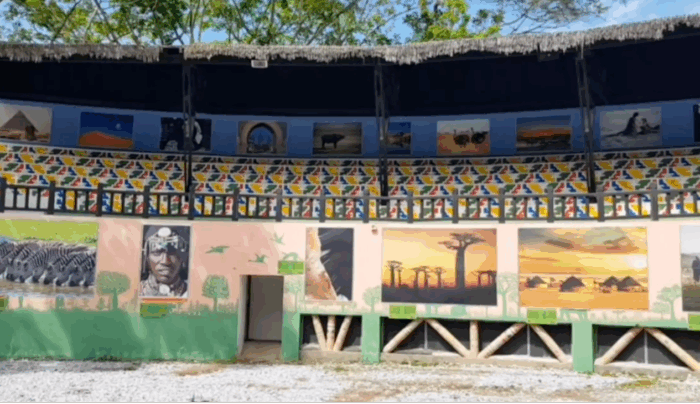
In replacing the narco spectacle with African exoticism, the park attempts to occlude the histories written into the land, from Escobar’s empire to Uribe’s counterinsurgency. Hacienda Nápoles does not merely erase the past; it attempts to fabricate a world in which violence never happened, replacing histories of loss with a choreography of African spectacle. Hacienda Nápoles writes its own moral redemption and an end to history, staging a defeat so complete that the ‘enemy’ does not even warrant recognition.
Still, Escobar’s ghost lingers, which results in a confusing whiplash of narrative. In a single day-trip, you could ride Colombia’s tallest free-fall tower, the Gran Zulú and stroll along Escobar’s airplane landing strip before lunch, then take cover from the scorching sun in the Mechatronic Dinosaur Cave, mourn Escobar’s victims at the Memorial Museum before immersing yourself in the African Museum, and visit the Pablo Escobar gift shop right outside the park’s border before it closes.
Even after years of de-narcotization, the narco imaginary continues to draw people through the gates. As journalist José Báez, a tourist at Hacienda Nápoles, put it, “My generation is the child of Pablo and all the drug traffickers of that era, and no matter how much they try to deny it,” he continued, “there’s always a little narco in the heart of the Colombian.” [64] As another visitor shared, “We all have our good and bad side. But whoever says that they would not feel like the king of the world with as much money as he had is lying.” [65] These admissions are expressions of what Omar Rincón identifies as a genuinely popular narco-aesthetic—a sensibility rooted in the aspirational logic that money and ostentation represent the only available form of social recognition. To criticize or ignore this aesthetic, Rincón insists, “is an act of bourgeois arrogance.” [66] The park’s de-narcotization project repeats this arrogance at an architectural scale, insisting that what many Colombians find legible and aspirational can be buried in Swahili signage and safari aesthetics.
On one particularly hot afternoon at the park, I saw a young couple pose for photos with Escobar’s plane. We struck up a conversation later in the safari, competing with the howls of the monkeys to hear one another. They were traveling through Antioquia by motorcycle to celebrate their engagement. “I’ve lived in Antioquia my whole life and never visited [the park],” Carolina, the fiancée, told me. “My mom always told me not to travel alone… never go to places like this.” She paused, wiping her forehead with a towel. “We knew so many who were killed in the conflict. It leaves you with so much loss, so much fear. But here we are.” She smiled, gesturing to the space around her as if the splendor of the safari negated the land’s violent past.
This multiplicity has material consequences. In a region once defined by cattle farming and then by Escobar’s reign of terror, the narco imaginary is now the primary economic engine. One resident aptly named this transformation ‘narcogentrification.’ “I’ve seen people in Nápoles selling shirts with a picture of Pablo Escobar next to the Virgin Mary,” explained one Puerto Triunfo resident. “But the thing is—people can sell a few shirts to tourists and then have enough money to feed their families. You can’t really blame them.” [67] As Catalina Esguerra argues, “the drug trade cannot be disentangled from Colombia’s self-production of national identity,” nor from its economic life. [68] When President Gustavo Petro proposed handing Hacienda Nápoles over to victims of the armed conflict, massive protests ensued. [69] “Everybody in the municipality eats thanks to the theme park,” declared Dubay Cira Daza, who opposed the proposal. [70] The state triumphed, as the slogan insists. But it is the narco’s afterlife, not the state’s victory, that keeps the gates open and the local economy alive.
Hacienda Nápoles was built to declare Escobar defeated, his challenge to state authority negated, and Colombia reborn. But the narco refuses to stay buried. The park’s successive attempts to contain, sanitize, and ultimately erase Escobar’s legacy, through triumphalist pedagogy, then African exoticism, reveal the structural impossibility of narrative closure over a violence that remains economically indispensable, territorially present, and lodged in the bodies of visitors who arrive carrying their own unfinished histories to the African safari.
Within the park’s bounds, some visitors celebrate state triumph, embracing its narrative of overcoming. Others celebrate Escobar himself, projecting fantasies of opulence, power, and the transgressive thrill of proximity to infamy. Still others are just there for a birthday, an anniversary, or a holiday weekend. As Cabañas observes, Escobar is a “multidimensional ghost” [71] who symbolizes social mobility, or pure evil, or the most unadorned expression of capitalist ambition. It is precisely the messiness of narrative that allows the park to function as a blank slate onto which visitors project their own versions of the story, infuse it with their own embodied memories, or reject it altogether. The park’s clumsy nationalist rhetoric opens threshold spaces for renegotiation: chances to project aspirations, rehearse nostalgia, or reckon, however fleetingly, with a past that refuses to stay buried.
4_Violence, Forgetting, and an Unfinished Nation
Hacienda Nápoles and Parque del Café are neither innocent arenas of celebration nor simple vehicles of state propaganda. They are infrastructures of desire, where the fantasy of a coherent Colombia is produced and undone in the same breath. Their power lies not in the truth of what they narrate, but in the affect they generate. It is in the catharsis, the renewal, the fleeting but genuine sense of belonging made possible, paradoxically, by the very histories these parks work so hard to obscure.
Parque del Café freezes time, embalming a past that never quite existed and insisting on its permanence. Hacienda Nápoles tries to accelerate time, declaring that the past is over, transcended, and defeated. In both, celebration becomes the vehicle for nostalgic consolidation and triumphalist overcoming. But in Colombia, history refuses to stay buried. The narco, the guerrillero, and the displaced campesino are not characters of a distant past, but very real figures that animate the present. As the available hectares of coffee land in Quindío decline, the paramilitary strongholds persist around Puerto Triunfo, and community livelihoods become ever more entangled with the parks that rewrote their histories, neither park can contain what it set out to resolve.
These parks represent opposite poles of Colombian memory-making. But they were both born of crisis and built for the impossible task of performing resolution. In the impossibility of that resolution, the theme park becomes a threshold space where identity is negotiated and narratives contested. Through the poetic minutiae of a day at the park—sunburnt noses, ice-cream-stained T-shirts, cumpleañera tiaras, Escobar merchandise, and haphazardly folded Colombian flags—my interlocutors embraced the good, mocked the bad, and reappropriated official narratives as occasions for renewal, redemption, and joy.
In the shadow of the roller coasters, visitors, locals, and workers are not unwitting actors in a pre-scripted tableau. In both spaces, they were ready and willing to reckon with their identities and histories. Every birthday celebrated on Escobar’s former estate, every flag waved at the Show del Café—these are evidence of how national identity works as ongoing, contested, embodied negotiation. The tourist, the local, the worker all take pleasure in a knowing immersion in the fantasy, and, in doing so, reshape these spaces and the stories they tell.
Over a cup of herbal tea, I asked Gabriel, the hippie from Quindío, what he thought about Colombian identity. “The [armed] conflict is such an important part. Everyone has a story about it. It still hurts to talk about.” He paused for a moment, letting a heavy silence fall between us. “But it’s really about an openness and a tolerance for others. Because we know every day could be our last. That makes us more understanding, more loving. The people you share a meal with today… you might not see them again.” [72] For so many people, these parks function less as a monument to coffee or the narco than a backdrop for the fragile and celebratory act of being together. In overpriced fast food shared beside lazy rivers, in fleeting encounters with strangers who you may never see again, Colombian identity resists definition or resolution. It is unfinished, unstable, but, most importantly, alive.
_How to Cite

_Endnotes
- [1] Interview with Gabriel, Armenia, Colombia, May 2025.
- [2] Antioqueño refers to the people, culture, and traditions of Antioquia, a department in northwest Colombia whose settlers, known as Antioqueños, migrated into the coffee-growing regions during the 19th and early 20th centuries. For more information, see: Marco Palacios, Coffee in Colombia, 1850–1970: An Economic, Social and Political History (Cambridge: Cambridge University Press, 1980), <https://doi.org/10.1017/CBO9780511572869>.
- [3] David Bushnell, The Making of Modern Colombia: A Nation in Spite of Itself (Berkeley: University of California Press, 1993), <https://doi.org/10.1525/9780520913905>.
- [4] Marco Palacios, Between Legitimacy and Violence: A History of Colombia, 1875–2002, transl. Richard Stoller (Durham: Duke University Press, 2006), 136.
- [5] Palacios, Between Legitimacy and Violence, 205.
- [6] Daniel Pécaut, Guerra contra la Sociedad (Bogotá: Editorial Planeta Colombia, 2001).
- [7] Centro Nacional de Memoria Histórica, ¡Basta ya! Colombia: memorias de guerra y dignidad (Bogotá: CNMH, 2013), <http://www.centrodememoriahistorica.gov.co/micrositios/informeGeneral/descargas.html>.
- [8] Antonio Ten, “Los nuevos paraísos: historia y evolución de los parques temáticos,” Arbor 629 (1998): 1754, <https://doi.org/10.3989/arbor.1998.i629.1754>.
- [9] Gerhard Hoffstaedter, “Anthropological Study of Theme Parks,” in The International Encyclopedia of Anthropology, ed. Hilary Callan (Hoboken: Wiley-Blackwell, 2018), <https://doi.org/10.1002/9781118924396.wbiea1646>.
- [10] Jean Baudrillard, Simulacra and Simulation (Ann Arbor: University of Michigan Press, 1994), 13.
- [11] Hoffstaedter, “Anthropological Study of Theme Parks”; Ten, “Los nuevos paraísos,” 1754.
- [12] Catalina Esguerra, Branding Colombia: Violent Myths and New Visions in Contemporary Cultural Production, PhD diss., (Ann Arbor: University of Michigan, 2019), <http://deepblue.lib.umich.edu/handle/2027.42/153518>.
- [13] Esguerra, Branding Colombia, 2.
- [14] Andrés Villamizar, “Los parques temáticos atraen a 19 millones de personas al año,” El Colombiano, February 2, 2025, <https://www.elcolombiano.com/negocios/cuantos-parques-de-diversiones-hay-en-colombia-y-cuanta-plata-mueven-MB26503780>; “La revolución de los parques temáticos,” El Tiempo, September 15, 2008, <https://www.eltiempo.com/archivo/documento/MAM-3093030>.
- [15] João Biehl and Peter Locke, “Deleuze and the Anthropology of Becoming,” Current Anthropology 51, no. 3 (2010): 317–351, here: 320.
- [16] See Gilles Deleuze and Félix Guattari, A Thousand Plateaus: Capitalism and Schizophrenia (Minneapolis: University of Minnesota Press, 1987).
- [17] The term cafetero refers not only to coffee growers but to a broader regional identity and set of cultural practices tied to Colombia’s Coffee Axis (Eje Cafetero), celebrated as emblematic of rural authenticity and national heritage. See “Coffee Cultural Landscape of Colombia, World Heritage List,” UNESCO, last modified July 2011, <https://whc.unesco.org/en/list/1121/>.
- [18] Author’s observation of signage and performances, Parque del Café, Quindío, Colombia, June 2025.
- [19] Daniel Muñoz, “Así se creó nuestro Parque del Café: una historia de orgullo colombiano,” Parque del Café (blog), April 16, 2025, <https://parquedelcafe.co/blog/asi-se-creo-nuestro-parque-del-cafe-una-historia-de-orgullo-cultura-y-tradicion-colombiana/>.
- [20] Una Ruta con Sabor a Café,” Colombia Travel (blog), accessed April 7, 2026, <https://colombia.travel/es/blog/el-parque-del-cafe-en-colombia>.
- [21] “Casa Campesina—Atracción—Parque del Café—Sitio Web Oficial,” Parque del Café, accessed September 17, 2025, <https://parquedelcafe.co/atracciones/casa-campesina/>.
- [22] Nancy P. Appelbaum, Muddied Waters: Race, Region, and Local History in Colombia, 1846–1948 (Durham: Duke University Press, 2003), <https://doi.org/10.1215/9780822384335>.
- [23] Diana María Rodríguez Herrera, “Hacer espacios en patrimonialización: Prácticas cotidianas en la formación del ‘paisaje cultural cafetero’ de Colombia—patrimonio mundial,” PhD diss., (Universitat de València, 2017), <https://dialnet.unirioja.es/servlet/tesis?codigo=224444>; Marco Palacios, Coffee in Colombia, 1850–1970: An Economic, Social and Political History (Cambridge: Cambridge University Press, 1980), 195, <https://doi.org/10.1017/CBO9780511572869>.
- [24] Marco Palacios, Coffee in Colombia, 194.
- [25] Marco Palacios, Coffee in Colombia, 194.
- [26] Marco Palacios, Coffee in Colombia, 219.
- [27] Appelbaum, Muddied Waters.
- [28] Interview with Iván Restrepo, Cartago, Colombia, July 2025. See also: David Vidal, “Colombia: Coffee Bonanza Boomerangs,” in The New York Times, October 16, 1977, <https://www.nytimes.com/1977/10/16/archives/colombia-coffee-bonanza-boomerangs.html>.
- [29] Interview with Iván Restrepo, Cartago, Colombia, July 2025.
- [30] Rodríguez Herrera, “Hacer espacios en patrimonialización.”
- [31] Esguerra, Branding Colombia.
- [32] Andrés Mauricio Buitrago Tejada, ‘Un paraíso llamado Colombia…’ Políticas y sistemas de representación de la nación a comienzos del s. XXI, MA thesis (Bogotá: Universidad Nacional de Colombia, 2016), 72, <https://core.ac.uk/reader/427679390>.
- [33] Ministerio de Cultura and Federación Nacional de Cafeteros de Colombia, Paisaje Cultural Cafetero de Colombia: Excepcional fusión entre naturaleza, cultura y trabajo colectivo (Bogotá: Ministerio de Cultura/FNCC, 2012).
- [34] Buitrago Tejada, ‘Un paraíso llamado Colombia…’.
- [35] Ministerio de Cultura, Paisaje Cultural Cafetero de Colombia, 149.
- [36] Ministerio de Cultura, Paisaje Cultural Cafetero de Colombia, 149.
- [37] Ministerio de Cultura, Paisaje Cultural Cafetero de Colombia, 149.
- [38] The Federación Nacional de Cafeteros de Colombia (FNC), founded in 1927, is a powerful quasi-public institution that represents coffee growers, manages the National Coffee Fund, and oversees Colombia’s coffee research and branding. Beyond its economic role, the FNC has been instrumental in crafting national imaginaries around the cafetero as a symbol of authenticity, productivity, and rural virtue. See Marco Palacios, El café en Colombia, 1850-1970: una historia económica, social y política (México, D.F.: El Colegio de México; Bogotá: Planeta, Ediciones Uniandes, 2002), 429–454, for a comprehensive historical account of the emergence of the FNC and its evolving state-like functions.
- [39] Quotations from “Show del Café“ and “El Arte del Café“, Parque del Café, Quindío, Colombia, June 2025.
- [40] Quotations from “Show del Café“ and “El Arte del Café,” Parque del Café, Quindío, Colombia, June 2025.
- [41] Voces y Caminos, “Brigitte Baptiste: Turismo y biodiversidad en vivo,” Spotify, audio, accessed September 17, 2025, <https://open.spotify.com/episode/5UfXU9yVAhBgcSbo5ou9eo>.
- [42] Interview with anonymous Quíndio resident, Montenegro, Colombia, March 2025.
- [43] Direct quote from “El Show del Café” and “El Arte del Café Show,” June 2025, translation by author.
- [44] Interview with Lucía, Montenegro, Colombia, July 2025.
- [45] Interview with Mariana, Montenegro, Colombia, August 2025.
- [46] Interview with Gabriel, Armenia, Colombia, May 2025.
- [47] Interview with Iván Restrepo, Cartago, Colombia, July 2025.
- [48] Rodríguez Herrera, “Hacer espacios en patrimonialización.”
- [49] Quotations from “Show del Café“ and “El Arte del Café,” Parque del Café, Quindío, Colombia, June 2025.
- [50] Esguerra, Branding Colombia.
- [51] Diana Ojeda, “War and Tourism: The Banal Geographies of Security in Colombia’s ‘Retaking,’” Geopolitics 18, no. 4 (2013): 759–78, here: 761.
- [52] Ojeda, “War and Tourism,” 772.
- [53] Ministerio de Comercio, Industria y Turismo and Ministerio de Cultura, Política de turismo cultural: Identidad y desarrollo competitivo del patrimonio (Bogotá: Ministerio de Cultura, 2007).
- [54] Esguerra, Branding Colombia, 97.
- [55] Ojeda, “War and Tourism,” 764.
- [56] Alexander Sánchez, “Hacienda Nápoles: Del terror de Pablo Escobar a las risas de un pueblo,” in La Nación, July 14, 2018, accessed September 17, 2025, <https://www.nacion.com/revista-dominical/hacienda-napoles-del-terror-de-pablo-escobar-a/GI4ODRFMSJBJZDYLXF6VF6VEPU/story/>.
- [57] Quotation from the Memorial Museum, Hacienda Nápoles, Puerto Triunfo, Colombia, September 2025.
- [58] Esguerra, Branding Colombia.
- [59] Interview with anonymous visitor, Puerto Triunfo, Colombia, September 2025.
- [60] Interview with Angela, Puerto Triunfo, Colombia, September 2025.
- [61] Interview with Claudia, Puerto Triunfo, Colombia, June 2025.
- [62] Marita Sturken, Tangled Memories: The Vietnam War, the AIDS Epidemic, and the Politics of Remembering (Berkeley: University of California Press, 1997), 7.
- [63] Parques Temáticos Hacienda Nápoles, “La Verdadera Aventura Salvaje,” Parques Temáticos Hacienda Nápoles, accessed October 6, 2025, <https://haciendanapoles.com/>.
- [64] José Báez, “La Hacienda Nápoles, un vacío de historias,” HIRARA: El lugar de las palabras (blog), March 28, 2011, accessed September 17, 2025, <https://josebaezg.wordpress.com/2011/03/28/la-hacienda-napoles-un-vacio-de-historias/>.
- [65] Interview with anonymous visitor, Puerto Triunfo, Colombia, September 2025.
- [66] Omar Rincón, “Narco.estética y narco.cultura en Narco.lombia,” Nueva Sociedad 222 (2009): 147–163, here: 147, translation by author.
- [67] Interview with anonymous resident, Puerto Triunfo, Colombia, August 2025
- [68] Esguerra, Branding Colombia, 24.
- [69] Daniel Esteban Reyes Espinosa, “Por propuesta de Petro de entregar la Hacienda Nápoles que era de Pablo Escobar a campesinos víctimas del conflicto armado, comunidad de Puerto Triunfo convocó a protestas,” in Infobae, June 4, 2025, accessed September 17, 2025, <https://www.infobae.com/colombia/2025/06/04/comerciantes-y-empresarios-marcharan-en-contra-de-la-propuesta-de-petro-en-entregar-la-hacienda-napoles-a-campesinos-victimas-del-conflicto-armado/>.
- [70] Daniel Esteban Reyes Espinosa, “Por propuesta de Petro.”
- [71] Miguel A. Cabañas, “A Trauma’s History: Pablo Escobar as Ghostly Myth and the Neoliberal Social Contract,” Revista de Estudios Hispánicos 53, no. 1 (2019): 165-185, here: 181.
- [72] Interview with Gabriel, Armenia, Colombia, June 2025.