Celebration


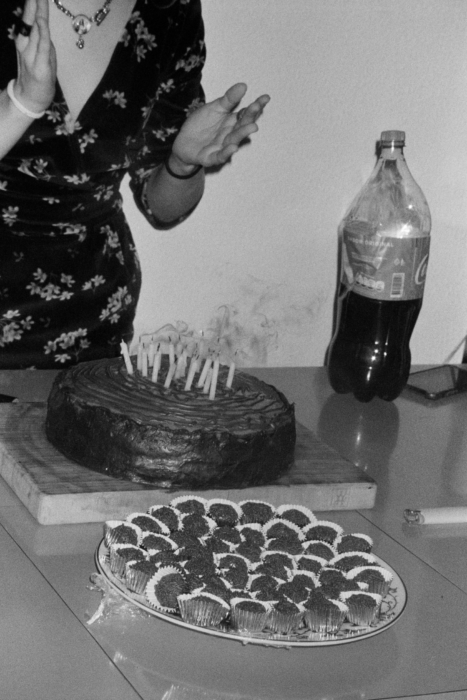
Birthday cakes are often the luminous center of a celebration. This is the case in a photograph by Brazilian artist Helena Ramos, on display at Fundação Serralves from October 21, 2025 to May 3, 2026, in Porto, Portugal. The photograph itself is untitled, but is an integral part of the exhibition A vida das abelhas [The Life of the Bee], comprising sequences of the social life of the artist: from urban nightlife, parties and concerts, to buildings, fashion, and landscape. The artist has named the exhibition after bees—a species of insect that does everything collaboratively—because she refuses to give any one photograph more weight than the others; all of the exhibited pieces share the same dimensions and are arranged in a continuous circular line, making it impossible to determine where the exhibition begins or ends. This way, Ramos is giving credit to her friends, figures and animals appearing in the photos, acknowledging them (and with much affection!) as co-creators. It is a reflection of her collaborative approach to art.
In the seemingly simple image of the birthday cake, the photographer captures a fleeting instant: the fading glow at the end of singing “Happy Birthday.” Surrounded by a bottle of soda, a phone, a lighter, and Brazilian brigadeiros, the scene fixes the precise moment in which the flames of the candles have just been extinguished, yet just before the eating and enjoying the cake and brigadeiros, thus continuing the celebration.
This multilayered quality of brigadeiros opens a lens onto celebrations across scales: from intimate gatherings to national commemorations, and, in the context of this editorial, turning points such as the journal’s porcelain anniversary. This issue marks the 20th publication and 10-year anniversary of On_Culture. This milestone naturally occurred to us as an occasion for celebration and a productive starting point for reflection: why is it such a ubiquitous human impulse to mark anniversaries and thresholds and to declare that the time has come to celebrate? While the occasions and the rituals surrounding them vary—revealing different cosmologies, temporalities, and meaning-making practices—celebrations in their many manifestations may, tentatively, be counted among “human universals.” [1] As such, celebrations, rituals, and festivities have long been a central concern of social theory, recognized as moments in which identity, culture, and power are condensed and made visible. Celebrations organize time and provide shared points of reference; they ensure social cohesion and structure social relations, while equally serving as sites where tensions and fractures within a society are exposed. [2] Reflecting on this issue’s anniversary, we take the milestone as an opportunity to ask how and why we celebrate, what these practices perform and represent, and how are they intertwined with power and political discourse.
This year proved particularly rich for observing tensions and convergences across different festive traditions. The lunar and lunisolar calendars aligned, bringing the Chinese Spring Festival, Mongolian Tsagaan Sar, and Ramadan into near-perfect overlap. This coincidence foregrounds both the differences and the unexpected parallels between celebration practices. On a fundamental level, these celebrations revolve around distinct rituals and distinct lore, while all being similarly tied to changing seasons and the sense of new beginnings. This overlap also reveals how comparable the politics of celebration can be. Under conditions of late capitalism, festive practices increasingly share a globalized consumer character: red envelopes for the Lunar New Year, crescent moons for Eid, and easter eggs appear side by side on the same shelves at the same time. Distinct traditions are packaged in the same materials and transformed into interchangeable seasonal commodities, circulating through the shared global supply chains and generating similar consumer behavior. At the same time, drones and other technologies of warfare are eerily showcased as entertainment—as seen, for example, in this year’s Chinese Spring Festival broadcast. [3] Thus, while the global market makes different celebratory traditions accessible across the world, we witness large-scale violence unfolding elsewhere. The dark side of celebration is never far from the festive and the joyful. This is not to suggest that such a constellation is natural or inevitable, but to observe that the joy of celebration in some places and violence unleashed in others are concurrent—different facets of the same modern condition.
At the same time, celebrations are also tools of resistance that organize collective disobedience. Pride marches, Black Joy, and the National Day of Mourning are practiced as acts of reclaiming humanity and as articulations of concrete political demands. However, in the same stroke, liberatory celebrations get depoliticized, co-opted and appropriated. Taking the Christopher Street Day as it is celebrated in Berlin, for example, it could be argued that it now functions more as a platform for commercial and political advertisement rather than as a clear political voice against heteronormative oppression. [4] As party culture eclipses protest, these celebrations are increasingly absorbed into neoliberal structures.
However, this issue does not seek to evaluate the normative dimensions of celebrations, but rather to explore how the Janus-faced character of celebrations manifests across different contexts and what we can learn from this. The ambivalence of celebrations has, of course, generated many questions that a range of disciplinary approaches have sought to address. Scholars have developed valuable conceptual tools for investigating the role of celebrations in community formation, meaning-making and temporal ordering, drawing attention to such aspects of celebratory practices as rhythm, [5] affect, [6] interpersonal relations, [7] rites of passage, [8] biodiversity and celebration, [9] and the perspective of minoritized communities and Indigenous peoples on established (national) celebration cultures. [10] This issue aims to contribute to this already rich body of research on celebrations, while offering new concerns and settings.
What does it mean to celebrate together—and what unexpected sites might host such togetherness? Frederik Tygstrup’s _Essay offers a reconceptualization of literature as a locus of celebration, shifting attention from individual texts to the broader infrastructure through which literature is produced, circulated, and shared. Gathering writers, readers, editors, critics, libraries, and classrooms into a one analytical frame, Tygstrup argues that this infrastructure instantiates a distinctly celebratory form of being-together. It does so in three ways: by granting literary language the power to describe the world differently and conjure imaginary worlds; by establishing an aesthetic relation between writer and reader in which the latter places her own sensibility in the service of the work; and by opening a space of shared reflection in which readers bring their different capacities and imaginative powers to bear on a common text. Together, these qualities make the life of literature into an exercise in interdependence—a gathering into a public and the creation of a common ground for interaction. In this sense, Tygstrup’s contribution expands the very terrain of what counts as celebration, inviting us to recognize the quiet festivity that structures our encounters with literary culture.
Anthropological perspectives on ritual offer another entry point into the celebratory practices explored in this issue. From the early functionalist theorizations of rites of passage, to more recent explorations of global “frictions,” [11] the negotiations between local traditions and global configurations, anthropologists have examined how the ordinary is transformed into the meaningful through objects and attire, dance and song. Within this issue, Ina Hagen-Jeske examines bridal fashion as a significant cultural phenomenon. She explores how bridal gowns and accessories carry multiple meanings—during acquisition, on the wedding day, and as lasting memory objects. In her _Article, she investigates contemporary ritualized practices and the meanings of wedding attire as expressed both individually and through media representations. Using ethnographic methods, her study focuses on Augsburg, Germany, selected for its transnational bridal fashion district and its history in the textile industry. By combining empirical data with ritual and fashion theory, Hagen-Jeske argues that ritual fashion practices fundamentally differ from everyday fashion, emphasizing the unique symbolic and ceremonial significance of bridal attire.
In keeping with many historical and sociological perspectives, this issue also turns to celebrations, their rituals, and their etiquette as sites where constructed hierarchies are performed and reinforced. [12] Scholars have shown how lavish and tightly regulated court celebrations allowed elites to affirm their class position and legitimize their authority. Panagiotis Doudesis’ _Article draws on two contrasting cases of celebratory dining. One is a nocturnal victory banquet staged by Louis XIV at Versailles in 1674; the other a jubilee feast held at Zwettl Monastery in 1767. Doudesis’ article concerns itself with the role of table ornamentation and its centerpieces in shaping the meaning and experience of elite celebrations. By approaching dining as a representational event, the contribution invites the reader to reconsider how dining participated in the articulation of power in early modern celebratory culture.
On a related note, Darin Stephanov examines how rulers projected their divine and sovereign power outward through public ceremony. In his “Absolutist Celebration in Late Ancien Régimes,” Stephanov approaches public ceremony as an ideological tool through which late eighteenth-century rulers communicated authority and legitimacy. Focusing on the ruler rituals of Empress Catherine II of Russia and King Gustav III of Sweden, the _Article presents celebration as the combination of political power and self-presentation in Enlightenment culture. Through a comparative lens, Stephanov traces how both monarchs invested heavily in ceremonial innovation at a moment when the conceptual foundations of absolutism were growing increasingly fragile.
Moving away from Enlightenment royalty and their exuberance, the issue turns to modern manifestations of what Sydney Coldren calls “celebratory infrastructures” examined through an ethnography of Colombian theme parks. Coldren’s _Article takes the reader into two of Colombia’s most popular theme parks, Hacienda Nápoles and Parque del Café, to uncover their functioning beyond sites of mere leisure; rather, they are complex ecosystems at the intersection of consumerism, national propaganda, and the celebratory act of coming together in a post-conflict society. Bringing together perspectives from interlocutors of different socioeconomic backgrounds, Coldren shows how the unfinished project of Colombian identity formation is negotiated in various ways between the micro-practices of waiting “in the shadow of the roller coasters” and a range of macro-historical processes, such as the commodification of the Antioqueño colonization of Indigenous and Afro-descendant communities. Coldren’s analysis offers an illustration of theme parks as “celebratory infrastructures” that not only reproduce social inequalities but remain porous to constant reconfiguration. Animated by visitors’ desires, griefs, and banal acts of celebration, these spaces emerge as affective terrains where power, emotion, and memory converge in the contingent negotiation of collective life.
Art exhibitions offer yet another form of celebratory space, and Serafina Andrew’s _Perspective demonstrates how celebration can productively resist easy narratives around trauma. Her emotive perspective recounts her experience of the 2024 exhibition When We See Us: A Century of Black Figuration in Painting at Kunstmuseum Basel. Moving through the exhibition space, Andrew reflects on celebration as a potential form of political resistance, in which representation neither glosses over nor essentializes Black experience. Weaving theory with an autobiographical account, the perspective unpacks the affects of carefully curated color codes, spatial layout, and sounds that shape an embodied encounter centering on joy, love, and community, all to celebrate Black art.
This issue also offers a take on the affective dimensions of celebration through the popular music, rhythm, dance and nightlife of reggaetón. In his _Perspective, Miguel Ángel Castro Caballero offers an autoethnographic reflection on reggaetón as a festive and ritual practice within the Latin American migrant community in Germany. Tracing the emergence of the DJ collective La Casa del Perreo and its parties across German cities, the contribution explores how music, dance, and nightlife become spaces of socialization, belonging, and cultural performance far from home. Through personal narrative, cultural analysis, and engagement with debates on festivity, popular culture, and globalization, the _Perspective examines the tensions between community-building, nostalgia, commercialization, and contradiction within contemporary reggaetón culture. Castro Caballero shows how reggaetón parties operates simultaneously as collective refuge, identity negotiation, and a reconfigured ritual landscape shaped by migration and transnational cultural flows.
As a lived and embodied experience, celebration can also be a site of ground-level resistance, where ritual is performed as claim to a territory and negotiation of urban transformations. In her _Article, Adriana Armenta-Ramírez examines religious celebration as a form of socio-territorial resistance in the rapidly urbanizing city of San Andrés Cholula, Mexico. Situating contemporary Catholic festivities within longer histories of conquest, evangelization, and religious syncretism, the contribution shows how processions, pastorelas, and neighborhood-based self-organization extend ritual beyond church spaces into streets, plazas, and everyday urban life. Through qualitative fieldwork and case studies of Christmas Day, Candlemas, and the patron saint celebration of Santiago Xicotenco, the article demonstrates how festive practices sustain Indigenous continuity, collective governance, and public visibility amid gentrification and real estate pressure. The contribution frames celebration not as static heritage, but as a dynamic practice through which communities reaffirm belonging and actively contest territorial displacement.
The tension between celebration, commemoration, and grief comes into particularly sharp relief when national days are examined as ritual formations. Mihai Rusu’s _Essay challenges what he calls the “celebratory paradigm” that dominates scholarly accounts of national days, arguing that these occasions are rarely occasions of unambiguous festivity. Drawing on comparative evidence from Central, Eastern, and Northern Europe—Poland, Hungary, Finland, and the Baltic states—Rusu advances the concept of commemobration to capture the hybrid quality of national day rituals that weave together performances of pride and nationhood with solemn acts of remembrance and grief. The essay devotes particular attention to Poland’s Independence Day on 11 November, where state-centered commemorations increasingly coexist with, and are overshadowed by, nationalist counter-rituals such as the March of Independence—a landscape of rituals simultaneously marked by heroic glorification and a politics of collective victimhood. Situating national days along a continuum from celebration to mourning, Rusu calls for national day studies to move beyond the sociology of celebration and nationalism studies toward a more systematic engagement with memory studies and death studies. His contribution thus reconceptualizes national days as complex, ambivalent events that illuminate the Janus-faced character of celebration explored throughout this issue.
While celebrations reaffirm life and its continuity, this issue also explores another way of celebrating life through the embodied encounter of loss. The _Perspective by Fabrício Belsoff builds on his own re-enactment performance to commemorate one of the landmark works by the Cuban-American artist Ana Mendieta, forty years after her death. Situating aspects of his performance against the backdrop of prior re-enactments of Mendieta’s works within the art world, Belsoff explores re-enactment itself as a potential space of celebration, rather than an act of mourning. He combines intimate reflections of his own performance with a close reading of Mendieta’s artwork to demonstrate how the notion of life becomes central to his embodied tribute. In doing so, Belsoff transforms Mendieta’s legacy into a living presence that continues to animate artistic, political and affective imaginaries across time and disciplines.
Compiling this issue, we examined celebrations in all their ambivalence by looking at them as articulations of power and hierarchies, but also affirmation of life, love, resistance, and belonging. This issue is also a reminder that publishing On_Culture for the last 10 years has always been a collective effort of all the current and previous editors, peer reviewers, proofreaders, and authors. To put some numbers to it: since On_Culture was founded, more than 30 people have dedicated their time, knowledge and passion to the journal as members of the editorial team. Over 300 external scholars have supported the journal by assessing articles and providing valuable feedback. As of now, 239 authors have published 212 contributions in the _Article, _Perspective and _Essay sections. Much like Helena Ramos, who named her exhibition after bees and arranged her photographs in a continuous circle with no clear beginning or end, On_Culture has always resisted the idea that any single contribution carries more weight than another. The journal, too, is a hive: its meaning emerges from the collective labor of many minds, none of whom can fully be separated from the whole. We chose the photograph of the birthday cake—with its just-extinguished candles and its circle of brigadeiros—to capture something of what it feels like to mark this anniversary together. We hope that the publication of issue 20, and the 10th anniversary of On_Culture, is a cause for celebration for everyone who has played a part in making research on the study of culture accessible worldwide. We raise a glass to all of you, and of course to our readers! Cheers!
We hope you enjoy reading about “Celebration”!
Giessen, May 2026
The Editorial Team
Ievgen Bilyk, Riccardo Buonamici, João Henrique da Costa Sol Afonso, Ivana Dinić, Erzhena Dugarova, Zekiye Gürün-Ücem, Katharina Hacker, Isabella Kalte, Jens Kugele, Lucía Mesa Vélez, Kacper Radny, Núbia Sanches Martins, Dorothea Sawon, Luis Guillermo Zazueta Beltran
_How to Cite
The Editorial Team. “Celebration.” On_Culture: The Open Journal for the Study of Culture 20 (2026). <https://doi.org/10.22029/oc.2026.1576>.

_Endnotes
- [1] Donald E. Brown, Human Universals (New York: McGraw-Hill, 1991).
- [2] For classical sociological theorization of ritual, see Émile Durkheim, The Elementary Forms of Religious Life (New York: Free Press, 1995) or, for example, Victor Turner, The Ritual Process: Structure and Anti-Structure (Ithaca, NY: Cornell University Press, 1977).
- [3] Llewellyn Cheung, “Chinese Humanoid Robots Pull off Kung Fu Display at 2026 Spring Festival Gala,” in China South Morning Post, March 30, 2026, <https://www.scmp.com/video/china/3343796/chinese-humanoid-robots-pull-kung-fu-display-2026-spring-festival-gala>.
- [4] See Judith Butler, “I Must Distance Myself from this Complicity with Racism,” in AVIVA-Berlin, July 2010, <https://www.aviva-berlin.de/aviva/content_Interviews.php?id=1427323>.
- [5] Henri Lefebvre, Rhythmanalysis: Space, Time and Everyday Life (London/New York: Continuum, 2004).
- [6] Mihai S. Rusu and Ismo Kantola, “A Time of Meta-celebration: Celebrating the Sociology of Celebration,” Journal of Comparative Research in Anthropology and Sociology 7, no. 1 (2016): 1–22.
- [7] Wendy Leeds-Hurwitz, “Making Marriage Visible: Wedding Anniversaries as the Public Component of Private Relationships,” Text 25, no. 5 (2005): 595–631.
- [8] Orly Redlich, “The Concept of Birthday: A Theoretical, Historical, and Social Overview, in Judaism and Other Cultures,” International Journal of Humanities and Social Sciences 14, no. 9 (2019): 791–801.
- [9] K. V. Krishnamurthy and P. Sahoo, “A Note on the Celebration of World Environment Day,” Journal of the Geological Society of India 100, no. 8 (2024): 1212–13, <https://doi.org/10.17491/jgsi/2024/173970>.
- [10] See Glen S. Coulthard, Red Skin, White Masks: Rejecting the Colonial Politics of Recognition (Minneapolis: University of Minnesota Press, 2014); Audra Simpson, Mohawk Interruptus: Political Life across the Borders of Settler States (Durham: Duke University Press, 2014); Danielle Drozdzewski, “Encountering Memory in the Everyday City,” in Danielle Drozdzewski, Sarah De Nardi, Emma Waterton (eds.), Memory, Place and Identity (London: Routledge, 2016), 19–37.
- [11] Anna Lowenhaupt Tsing, Friction: An Ethnography of Global Connection (Princeton, NJ: Princeton University Press, 2005).
- [12] Norbert Elias, The Civilizing Process: Sociogenetic and Psychogenetic Investigations (Oxford: Blackwell, 2000); Pierre Bourdieu, Distinction: A Social Critique of the Judgement of Taste (Cambridge, MA: Harvard University Press, 1984).